

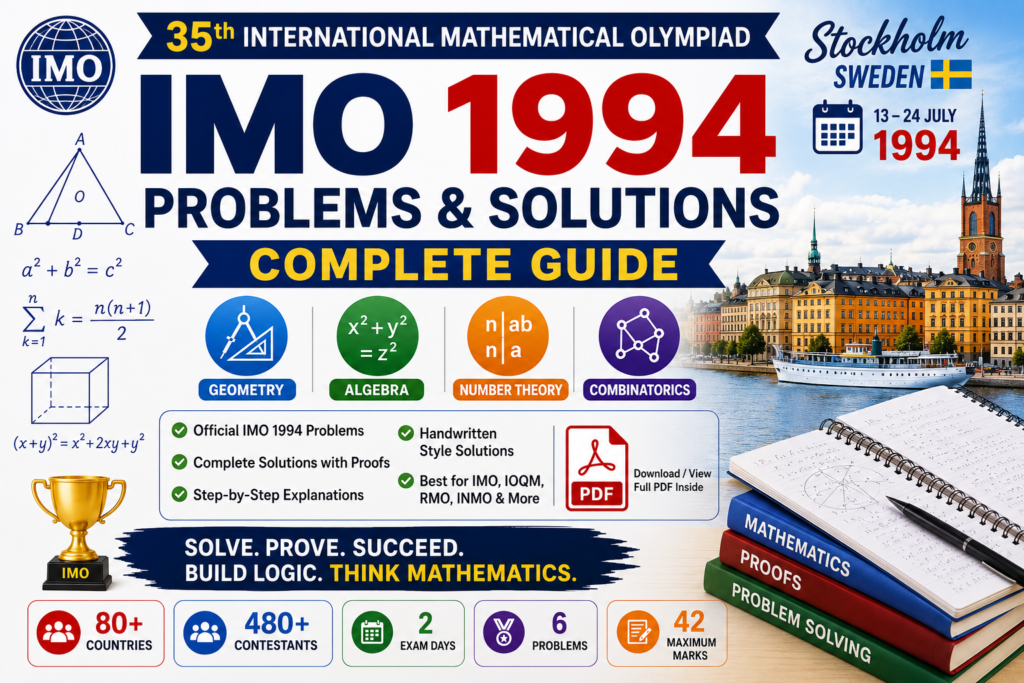
The Complete Guide to the 35th International Mathematical Olympiad (IMO 1994)
The International Mathematical Olympiad (IMO) is the world’s most prestigious mathematics competition for high school students. Every year, the competition brings together the brightest young mathematicians from around the globe to solve six challenging proof-based problems that demand creativity, logical reasoning, and mathematical maturity. Unlike standard school examinations, the IMO is not about memorizing formulas or applying routine methods. Instead, it rewards students who can discover elegant ideas, construct rigorous proofs, and explain their reasoning with clarity.
The 35th International Mathematical Olympiad (IMO 1994) was held in Hong Kong from 8–20 July 1994. The event welcomed 385 contestants representing 69 countries, making it one of the largest international mathematics competitions of its time. Hosted during a period when the IMO was expanding rapidly across the world, the 1994 Olympiad played an important role in bringing together talented students from different cultures who shared a common passion for mathematics. (IMO)
The IMO 1994 problem set is still regarded as one of the classic Olympiad papers. More than thirty years later, mathematics teachers, Olympiad coaches, and national training camps continue to recommend these six problems because they emphasize elegant mathematical thinking instead of complicated calculations. Every problem introduces an important idea that remains useful for modern Olympiad preparation.
One of the reasons why IMO 1994 remains so popular is its excellent balance. The six problems cover all four major branches of Olympiad mathematics—geometry, algebra, number theory, and combinatorics. Each problem develops a different mathematical skill, encouraging students to think creatively, test patterns, and write complete mathematical proofs.
Whether you are preparing for the International Mathematical Olympiad (IMO), IOQM, RMO, INMO, APMO, USAMO, BMO, or another national mathematics competition, studying the IMO 1994 paper will improve your mathematical intuition, proof-writing ability, and confidence when solving unfamiliar problems.
This detailed guide explains the competition, introduces the mathematical ideas behind the paper, and shows why IMO 1994 continues to be one of the finest resources for serious Olympiad preparation.
Overview of IMO 1994
| Detail | Information |
|---|---|
| Olympiad | 35th International Mathematical Olympiad |
| Host City | Hong Kong |
| Host Country | Hong Kong |
| Year | 1994 |
| Competition Dates | 8–20 July 1994 |
| Competition Format | Two Competition Days |
| Total Problems | 6 Proof-Based Problems |
| Time Allowed | 4 Hours 30 Minutes Each Day |
| Maximum Score | 42 Marks |
| Participating Countries | 69 |
| Contestants | 385 |
The competition followed the traditional IMO format that continues to be used today.
Day One
- Problem 1
- Problem 2
- Problem 3
Day Two
- Problem 4
- Problem 5
- Problem 6
Contestants had 4 hours and 30 minutes to solve three problems on each examination day. Every problem carried 7 marks, making the maximum possible score 42 points. (IMO)
Why IMO 1994 Is Still One of the Best Olympiad Papers
Many students preparing for mathematics competitions believe that only recent Olympiad papers are useful.
Experienced Olympiad coaches know that great mathematics never becomes outdated.
A beautiful proof written in 1994 remains just as elegant today.
That is why the IMO 1994 paper is still studied in national Olympiad camps, university mathematics circles, and advanced enrichment programs around the world.
Rather than rewarding memorized techniques, every problem encourages students to search for hidden mathematical structures.
As students work through the six problems, they gradually stop asking,
“Which formula should I use?”
Instead, they begin asking,
“What mathematical idea explains this problem?”
Developing this habit is one of the greatest benefits of Olympiad preparation.
The Four Major Areas of Olympiad Mathematics
Like every International Mathematical Olympiad, the 1994 paper includes problems from the four major branches of Olympiad mathematics.
Together, these subjects develop every essential mathematical skill.
Geometry
Geometry remains one of the most elegant areas of Olympiad mathematics.
The geometry problems in IMO 1994 reward careful observation far more than lengthy calculations.
Students encounter important ideas including:
- Similar triangles
- Circle geometry
- Angle chasing
- Cyclic quadrilaterals
- Collinearity
- Auxiliary constructions
Many experienced contestants spend several minutes studying the diagram before writing the first sentence.
That patience often reveals the hidden observation needed for an elegant proof.
Algebra
Olympiad algebra focuses on insight rather than routine manipulation.
Contestants simplify complicated expressions, recognize symmetry, and discover clever substitutions instead of performing endless calculations.
The algebra problem in IMO 1994 demonstrates that one elegant transformation can replace pages of algebra.
Students preparing for advanced competitions should master:
- Algebraic identities
- Symmetric expressions
- Strategic substitutions
- Functional reasoning
- Inequalities
Number Theory
Number theory remains one of the most fascinating branches of Olympiad mathematics.
Simple questions involving integers frequently produce surprisingly elegant proofs.
The number theory ideas explored in IMO 1994 include:
- Divisibility
- Modular arithmetic
- Prime numbers
- Greatest common divisors
- Integer equations
One valuable habit every Olympiad student should develop is testing several small numerical examples before beginning a formal proof.
Small cases often reveal the hidden mathematical pattern.
Combinatorics
Combinatorics teaches students how to organize mathematical information logically.
Instead of relying on formulas, contestants investigate mathematical structures and explain why certain arrangements must always exist.
Important Olympiad techniques include:
- Counting arguments
- Graph theory
- Recursive reasoning
- Invariants
- Extremal Principle
The combinatorics problems in IMO 1994 reward creativity, organization, and precise logical reasoning.
Difficulty Analysis of IMO 1994
Like every International Mathematical Olympiad, the 1994 paper was carefully designed with gradually increasing difficulty.
| Problem | Subject | Difficulty |
|---|---|---|
| Problem 1 | Geometry | ⭐⭐☆☆☆ |
| Problem 2 | Number Theory | ⭐⭐⭐☆☆ |
| Problem 3 | Algebra | ⭐⭐⭐⭐☆ |
| Problem 4 | Combinatorics | ⭐⭐⭐☆☆ |
| Problem 5 | Geometry | ⭐⭐⭐⭐☆ |
| Problem 6 | Advanced Problem Solving | ⭐⭐⭐⭐⭐ |
The first two problems help contestants build confidence, while the later questions demand deeper mathematical creativity, stronger proof-writing skills, and greater persistence.
This balanced structure is one of the reasons why IMO papers continue to be regarded as some of the best mathematical training resources ever created.
What Makes IMO 1994 Special?
Every International Mathematical Olympiad has its own personality.
Some competitions are remembered because of extremely difficult problems.
Others become famous because of particularly elegant solutions.
IMO 1994 successfully combines both qualities.
The paper encourages experimentation instead of memorization.
Students gradually discover that careful reasoning and creative observation are far more valuable than lengthy calculations.
Several official solutions are remarkably concise, demonstrating that one brilliant mathematical insight can replace pages of computation.
The paper reminds students that mathematics is not about finding answers quickly.
It is about understanding why those answers must always be true.
That deeper understanding is the true goal of Olympiad mathematics.
Skills You Will Develop by Studying IMO 1994
Working carefully through the complete IMO 1994 paper helps students strengthen many valuable mathematical abilities, including:
- Proof-writing
- Logical reasoning
- Creative mathematical thinking
- Pattern recognition
- Mathematical communication
- Strategic problem solving
- Confidence when approaching unfamiliar questions
These skills remain valuable throughout university studies and professional careers in mathematics, engineering, computer science, economics, data science, and scientific research.
Before Reading the Official Solutions
One of the biggest mistakes Olympiad students make is reading the official solution immediately after seeing a difficult problem.
Avoid that temptation.
The struggle itself is where genuine learning happens.
Every unsuccessful attempt teaches something important about the structure of the problem.
Even incorrect ideas help eliminate impossible approaches and move you closer to discovering the elegant solution.
Remember that Olympiad preparation is not about collecting solutions.
It is about developing the habits of mathematical thinking.
More than three decades have passed since the competition, yet the six problems from IMO 1994 remain regular features in national training camps, university mathematics circles, and advanced Olympiad coaching programs. The reason is simple. Every problem teaches a fundamental mathematical idea rather than a temporary trick.
As an Olympiad coach, I often recommend the IMO 1994 paper to students who want to move beyond routine problem solving and begin thinking like mathematicians. The problems encourage careful observation, experimentation, and logical reasoning. Instead of rewarding long calculations, they reward elegant ideas.
One important lesson becomes clear while studying this Olympiad.
The first idea is rarely the best one.
Many contestants begin with an approach that appears promising but eventually leads nowhere. That experience is completely normal. Every unsuccessful attempt teaches something valuable about the mathematical structure of the problem.
Eventually, one simple observation transforms a difficult question into an elegant proof.
That moment of discovery is exactly what Olympiad mathematics is designed to create.
The IMO 1994 paper develops patience, creativity, and mathematical confidence—qualities that remain valuable throughout university mathematics, engineering, computer science, economics, artificial intelligence, and scientific research.
A Coach’s Analysis of Every Problem
Although every IMO problem carries 7 marks, each question measures a different mathematical ability.
Some problems reward observation.
Others require experimentation.
Several demand deep creativity and persistence.
Learning how to approach these questions is much more valuable than memorizing the official solutions.
Problem 1 – Geometry
Subject
Geometry
Difficulty
⭐⭐☆☆☆ (Moderate)
The first problem welcomes contestants with a beautiful geometric configuration.
At first glance, many students immediately begin calculating angles.
Experienced Olympiad contestants usually do something different.
They spend several minutes studying the figure carefully before writing a single line.
That patience often reveals hidden relationships that simplify the entire proof.
Important Mathematical Ideas
- Similar triangles
- Circle geometry
- Angle chasing
- Cyclic quadrilaterals
- Auxiliary constructions
Coaching Advice
Always draw a clean and accurate diagram.
Many successful Olympiad solutions begin with careful observation rather than calculation.
A well-drawn figure often reveals the key idea.
Problem 2 – Number Theory
Subject
Number Theory
Difficulty
⭐⭐⭐☆☆
The second problem explores one of the most beautiful areas of Olympiad mathematics.
Although the statement appears straightforward, direct computation quickly becomes ineffective.
Students must identify an underlying mathematical pattern and explain why it remains true for every possible case.
This is one of the defining characteristics of Olympiad number theory.
Simple questions often produce surprisingly elegant proofs.
Important Concepts
- Divisibility
- Modular arithmetic
- Prime numbers
- Greatest common divisors
- Integer equations
Coaching Advice
Before attempting a formal proof, test several small numerical examples.
Simple experiments frequently reveal the hidden observation needed for the complete solution.
Problem 3 – Algebra
Subject
Algebra
Difficulty
⭐⭐⭐⭐☆
By the third problem, the competition becomes significantly more challenging.
Many contestants initially perform long algebraic manipulations.
Soon those calculations become increasingly complicated.
Experienced students recognize this as an important signal.
When the calculations become longer, a better mathematical idea usually exists.
The official solution demonstrates how symmetry and a clever substitution simplify the entire problem.
One elegant observation replaces pages of unnecessary algebra.
Important Techniques
- Algebraic identities
- Symmetric expressions
- Strategic substitutions
- Functional reasoning
- Simplification
Coaching Advice
Whenever possible, rewrite complicated expressions in a different form.
Changing your perspective is often the key to the solution.
Problem 4 – Combinatorics
Subject
Combinatorics
Difficulty
⭐⭐⭐☆☆
The first problem on the second examination day introduces combinatorial reasoning.
Unlike geometry or algebra, combinatorics rarely offers an obvious starting point.
Students must investigate smaller cases, organize their observations, and gradually build a complete proof.
The strongest solutions rely on logical organization rather than difficult calculations.
Important Mathematical Ideas
- Counting arguments
- Graph theory
- Recursive reasoning
- Invariants
- Extremal Principle
Coaching Advice
If the original problem seems difficult, simplify it first.
Studying smaller examples often reveals the hidden mathematical structure.
Problem 5 – Geometry
Subject
Geometry
Difficulty
⭐⭐⭐⭐☆
Problem 5 is one of the highlights of the IMO 1994 paper.
Instead of depending on one theorem, contestants combine several classical geometric ideas into one elegant proof.
Students quickly realize that writing mathematics clearly is just as important as discovering the correct observation.
A beautiful idea deserves a beautiful explanation.
Important Concepts
- Circle geometry
- Similar triangles
- Collinearity
- Angle relationships
- Geometric transformations
Coaching Advice
Imagine explaining your proof to another Olympiad student.
Each statement should naturally follow from the previous one.
Clear mathematical writing earns valuable marks.
Problem 6 – The Ultimate Challenge
Subject
Advanced Problem Solving
Difficulty
⭐⭐⭐⭐⭐
Like every International Mathematical Olympiad, the final problem represents the highest level of creativity expected during the competition.
Only a small number of contestants solve it completely.
That is intentional.
Problem 6 is designed to distinguish students with exceptional mathematical insight and originality.
Many future IMO gold medalists also spent years learning how to approach problems of this level.
Skills Required
- Creative reasoning
- Pattern recognition
- Structural thinking
- Generalization
- Advanced proof-writing
Coaching Advice
Do not measure your success by whether you solve Problem 6 completely.
Measure your progress by how much your mathematical thinking improves while exploring different approaches.
That improvement will help you in every future Olympiad.
IMO 1994 PDF and Solutions
Five Common Mistakes Olympiad Students Make
After coaching Olympiad students for many years, I have repeatedly observed the same mistakes.
Avoiding these habits can dramatically improve your performance.
1. Reading the Problem Too Quickly
Every word in an Olympiad problem has been chosen carefully.
Missing a single condition can completely change the solution.
Always read the statement several times before beginning.
2. Beginning Calculations Immediately
Many students believe difficult mathematics requires lengthy calculations.
Olympiad mathematics usually rewards elegant observations instead.
Look for patterns before performing computations.
3. Ignoring Small Examples
Simple examples frequently reveal hidden mathematical structures.
Professional mathematicians experiment constantly.
Olympiad students should develop the same habit.
4. Writing Incomplete Proofs
A correct mathematical idea alone is not enough.
Every conclusion must be justified logically.
Complete proofs demonstrate mathematical maturity.
5. Giving Up Too Early
Some Olympiad problems require several unsuccessful attempts.
That experience is completely normal.
Persistence is one of the most valuable qualities a mathematician can develop.
A Four-Week Study Plan Using IMO 1994
Rather than solving the entire paper in one sitting, study it gradually.
This approach develops much deeper mathematical understanding.
Week One
Attempt Problems 1 and 2 under examination conditions.
Review your proofs before reading the official solutions.
Compare every logical step carefully.
Week Two
Focus entirely on Problem 3.
Experiment with several different substitutions before consulting the official proof.
Most learning happens during exploration.
Week Three
Study Problems 4 and 5.
Rewrite the official proofs in your own words.
If you can explain every step without looking at the original solution, you have genuinely understood the mathematics.
Week Four
Spend several days working on Problem 6.
Treat it as a mathematical investigation rather than an examination question.
Discuss ideas with teachers or fellow students whenever possible.
Your objective is to strengthen your mathematical thinking.
Why Olympiad Coaches Still Recommend IMO 1994
More than thirty years after the competition, IMO 1994 continues to be one of the most recommended Olympiad papers.
The reason is simple.
It teaches students how mathematicians actually think.
The paper develops essential habits including:
- Careful observation
- Logical reasoning
- Creative problem solving
- Elegant proof-writing
- Patience when facing unfamiliar challenges
These qualities remain valuable throughout university mathematics, engineering, computer science, economics, artificial intelligence, and scientific research.
Who Should Study IMO 1994?
The IMO 1994 paper is highly recommended for:
- Students preparing for the International Mathematical Olympiad (IMO)
- IOQM, RMO, and INMO aspirants
- APMO participants
- USAMO and BMO competitors
- Mathematics teachers
- Olympiad coaches
- University students interested in proof-based mathematics
Whether your goal is earning an Olympiad medal or becoming a stronger mathematical thinker, IMO 1994 provides outstanding preparation.
The 35th International Mathematical Olympiad (IMO 1994) remains one of the finest competitions in Olympiad history. Hosted in Hong Kong, it introduced students to six beautifully designed problems that continue to inspire mathematical learning around the world.
As you study this classic Olympiad paper, remember that genuine mathematical growth comes from exploration rather than memorization. Every unsuccessful attempt strengthens your intuition, every completed proof improves your reasoning, and every elegant mathematical idea expands your understanding.
If you work through the IMO 1994 problems patiently and thoughtfully, you will gain much more than six official solutions. You will improve your proof-writing skills, strengthen your logical reasoning, and develop the confidence needed for future Olympiad competitions.
Frequently Asked Questions (FAQ)
1. Where was IMO 1994 held?
The 35th International Mathematical Olympiad was held in Hong Kong.
2. How many students participated in IMO 1994?
A total of 385 contestants from 69 countries participated in the competition.
3. Which mathematical subjects appeared in IMO 1994?
The paper covered all four major Olympiad disciplines:
- Geometry
- Algebra
- Number Theory
- Combinatorics
4. Is IMO 1994 suitable for beginners?
Yes. Students beginning Olympiad preparation should first attempt Problems 1 and 2, then gradually progress to the more challenging later problems.
5. What is the best way to study IMO 1994?
Attempt every problem independently before reading the official solution. Afterwards, rewrite the proof in your own words and compare your reasoning with the official approach. This method develops both mathematical understanding and proof-writing skills.
6. Is IMO 1994 still useful for modern Olympiad preparation?
Absolutely. The proof techniques and mathematical ideas presented in IMO 1994 remain highly relevant and continue to appear in national Olympiads, international training camps, and advanced mathematics programs.
7. What is the biggest lesson students can learn from IMO 1994?
The greatest lesson is that Olympiad mathematics rewards creativity, logical reasoning, and elegant proofs—not memorized formulas. Learning to recognize hidden mathematical structures and explain ideas clearly is the foundation of long-term success in mathematics competitions.
Continue Your Olympiad Journey
After completing IMO 1994, continue your preparation with IMO 1995, IMO 1996, IMO 1997, and IMO 1998. Studying complete IMO papers in chronological order helps you recognize recurring mathematical ideas, master proof techniques, and steadily build the mathematical maturity required for success in national and international Olympiad competitions. These classic papers remain some of the best training resources for every aspiring mathematician.