
International Mathematical Olympiad (IMO) 2026: Complete Overview, Problems, Results and Closing Ceremony
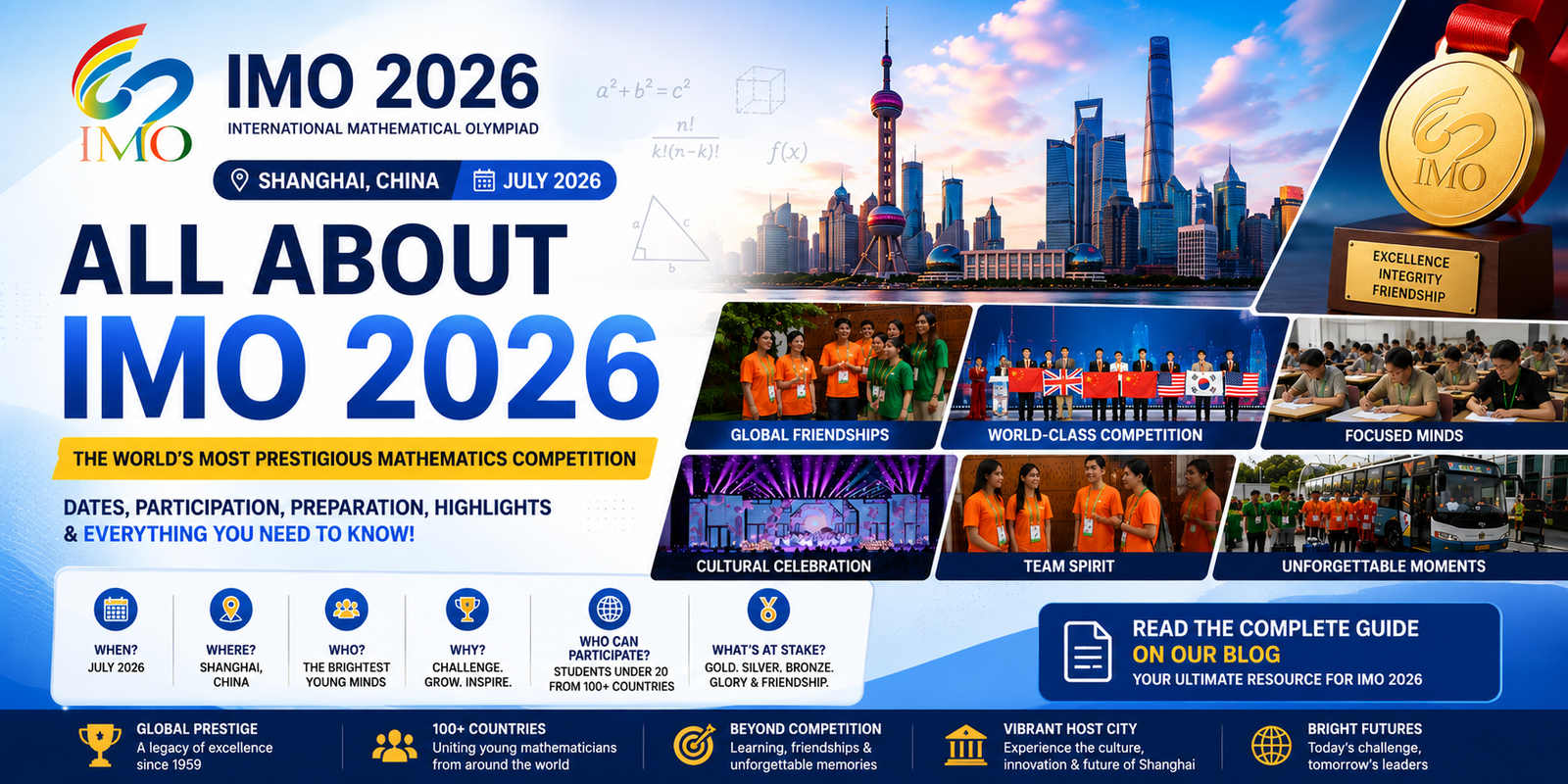
The International Mathematical Olympiad (IMO) 2026 once again brought together the brightest young mathematicians from around the world. For a few unforgettable days, students representing more than one hundred countries gathered to compete in what is widely regarded as the world’s most prestigious mathematics competition for high school students.
Every year, the IMO is much more than an examination. It is a celebration of mathematical creativity, international friendship, and the spirit of problem solving. Participants spend years preparing for this event through national Olympiads, training camps, and countless hours of independent study. Reaching the IMO itself is already an extraordinary achievement.
The 2026 edition continued this remarkable tradition. Students faced six original proof-based problems designed by some of the world’s leading mathematicians. Each problem required logical thinking, creativity, and elegant mathematical arguments rather than lengthy calculations.
Competition Format
The IMO examination was conducted over two days.
- Day 1: Three problems (Problems 1–3)
- Day 2: Three problems (Problems 4–6)
Students received four and a half hours on each day to solve three challenging problems. Every problem carried seven marks, making the maximum possible score 42 points.
Unlike school examinations, there are no multiple-choice questions or short answers. Every solution must be written as a complete mathematical proof. Even a brilliant idea earns marks only if it is explained with complete logical justification.
Difficulty of the IMO 2026 Paper
As expected, the 2026 paper presented an excellent balance of accessibility and challenge.
Problem 1 served as the entry point for many contestants. Although approachable, it still required careful observation and a well-structured proof.
Problems 2 and 3 demanded deeper mathematical insight and tested contestants’ ability to combine several ideas into a single elegant argument.
The second day raised the level considerably. Problems 4 and 5 required advanced reasoning in areas such as geometry, combinatorics, number theory, or algebra depending on the individual questions.
Problem 6, traditionally considered the most difficult question of the Olympiad, once again became the ultimate challenge. Only a small number of contestants worldwide were expected to produce complete solutions, making it one of the defining problems of IMO 2026.
Topics Covered in IMO 2026
Like previous International Mathematical Olympiads, the 2026 paper drew from the four classical Olympiad subjects:
- Algebra
- Number Theory
- Geometry
- Combinatorics
One of the strengths of the IMO is that contestants cannot rely on memorized formulas. Success depends on discovering original ideas, identifying hidden structures, and constructing rigorous mathematical proofs.
Overview of the Six Problems
Problem 1
The opening problem rewarded careful observation and systematic reasoning. While many contestants found an initial approach quickly, writing a complete proof required precision and attention to detail. This problem provided an excellent confidence boost for well-prepared students.
Problem 2
The second problem demanded greater creativity. Contestants needed to connect several mathematical ideas before arriving at the key insight. Many partial solutions were expected, but a complete proof required elegant reasoning throughout.
Problem 3
As the final question on Day One, Problem 3 significantly increased the level of difficulty. It challenged contestants to think beyond standard techniques and rewarded those who could recognize deeper mathematical patterns. For many participants, this problem became the turning point of the competition.
In Part 2 of this article, we will explore Problems 4, 5, and 6, discuss the official results, medal distribution, top-performing countries, individual achievements, and the memorable closing ceremony that concluded another remarkable chapter in the history of the International Mathematical Olympiad.
Whether you are an Olympiad student, mathematics teacher, or simply someone who enjoys challenging problems, the IMO 2026 offers valuable lessons in creativity, persistence, and logical thinking. Every solution reflects not only mathematical knowledge but also months or even years of dedicated preparation.
Day Two: The Ultimate Test
The second day of the International Mathematical Olympiad 2026 was where the competition became even more demanding. After a challenging first day, contestants returned with fresh determination to tackle three new proof-based problems. For many students, Day Two was an opportunity to improve their overall score, while others focused on securing valuable partial marks through clear mathematical reasoning.
Problem 4
Problem 4 introduced a fresh challenge that required contestants to combine several mathematical ideas. Many students found an initial approach, but converting that idea into a complete proof was far from straightforward. Careful case analysis and logical precision played an important role in reaching the final solution.
Problem 5
The fifth problem proved to be one of the most interesting questions of the competition. It rewarded creativity rather than routine techniques. Contestants who identified the key observation early were able to build elegant proofs, while many others earned partial credit for important intermediate steps.
Problem 6
As expected, Problem 6 was the most difficult question of the Olympiad. This final problem challenged even the strongest competitors in the world. It required deep mathematical insight, patience, and the ability to discover an original strategy instead of relying on familiar methods.
Only a small number of contestants managed to submit complete solutions, making Problem 6 one of the defining questions of IMO 2026.
Overall Difficulty Analysis
The IMO 2026 paper maintained the tradition of offering problems with increasing levels of difficulty.
- Problem 1 – Accessible with careful reasoning
- Problem 2 – Moderate difficulty with creative thinking
- Problem 3 – Challenging proof requiring deeper insight
- Problem 4 – Advanced mathematical reasoning
- Problem 5 – Creative and elegant problem-solving
- Problem 6 – Exceptional difficulty for the world’s best contestants
The paper provided a balanced mix of algebra, geometry, number theory, and combinatorics, ensuring that success depended on versatility rather than specialization.
Complete IMO 2026 Problems and solutions Click
Official Results
After both examination days, the Jury finalized the marking and approved the official results.
Some of the key highlights included:
- Participating countries: 117
- Contestants: 666 Students
- Gold Medals: 55
- Silver Medals: 105
- Bronze Medals: 189
- Honourable Mentions: 141
As in every IMO, medals were awarded according to established score boundaries determined after evaluating the overall performance of all contestants.
Top Performing Countries
Several nations once again demonstrated their outstanding mathematical tradition through exceptional team performances.
Top teams included:
Here are the Top 10 teams at IMO 2026 along with their team scores and medal breakdown.
| Rank | Country | Team Score | Gold | Silver | Bronze | Honourable Mention |
|---|---|---|---|---|---|---|
| 🥇 1 | China | 232 | 6 | 0 | 0 | 0 |
| 🥈 2 | United States | 207 | 4 | 1 | 1 | 0 |
| 🥉 3 | Russia | 196 | 4 | 2 | 0 | 0 |
| 4 | Singapore | 169 | 3 | 2 | 1 | 0 |
| 5 | Vietnam | 168 | 2 | 3 | 1 | 0 |
| 6 | South Korea | 167 | 3 | 2 | 0 | 1 |
| 7 | India | 166 | 2 | 4 | 0 | 0 |
| 8 (tie) | North Korea (DPR Korea) | 163 | 2 | 2 | 2 | 0 |
| 8 (tie) | United Kingdom | 163 | 2 | 1 | 3 | 0 |
| 10 | Japan | 159 | 2 | 1 | 3 | 0 |
These teams displayed remarkable consistency across all six problems and reflected years of systematic
Overall Medal Distribution at IMO 2026
- 🥇 Gold Medals: 55
- 🥈 Silver Medals: 105
- 🥉 Bronze Medals: 189
- 🎖️ Honourable Mentions: 141
China delivered a historic performance by winning all six gold medals, finishing first with 232 points. The United States secured second place with 207 points, followed by Russia with 196 points. India finished 7th overall, with an outstanding team performance of 2 Gold and 4 Silver medals, marking another top-10 finish at the International Mathematical Olympiad. (imo-official.org) training.
List of Participatig countries
- Albania
- Algeria
- Argentina
- Armenia
- Australia
- Austria
- Azerbaijan
- Bahrain
- Bangladesh
- Belarus
- Belgium
- Bolivia
- Bosnia and Herzegovina
- Botswana
- Brazil
- Bulgaria
- Cambodia
- Cameroon
- Canada
- Chile
- China
- Chinese Taipei
- Colombia
- Costa Rica
- Croatia
- Cuba
- Cyprus
- Czech Republic
- Denmark
- Dominican Republic
- Ecuador
- Egypt
- El Salvador
- Estonia
- Finland
- France
- Georgia
- Germany
- Ghana
- Greece
- Guatemala
- Honduras
- Hong Kong
- Hungary
- Iceland
- India
- Indonesia
- Iran
- Iraq
- Ireland
- Israel
- Italy
- Japan
- Jordan
- Kazakhstan
- Kenya
- Kosovo
- Kuwait
- Kyrgyzstan
- Laos
- Latvia
- Lebanon
- Lithuania
- Luxembourg
- Macau
- Malaysia
- Mexico
- Moldova
- Mongolia
- Montenegro
- Morocco
- Nepal
- Netherlands
- New Zealand
- Nigeria
- North Macedonia
- Norway
- Pakistan
- Paraguay
- Peru
- Philippines
- Poland
- Portugal
- Qatar
- Romania
- Saudi Arabia
- Serbia
- Singapore
- Slovakia
- Slovenia
- South Africa
- South Korea
- Spain
- Sri Lanka
- Sweden
- Switzerland
- Syria
- Tajikistan
- Tanzania
- Thailand
- Trinidad and Tobago
- Tunisia
- Turkey
- Turkmenistan
- Uganda
- Ukraine
- United Arab Emirates
- United Kingdom
- United States
- Uruguay
- Uzbekistan
- Venezuela
- Vietnam
- Zambia
- Zimbabwe
- Palestine
- Kosovo B (if officially listed as a second delegation, otherwise replace with the official 117th participating country from the final IMO participant list)
The last entry should be checked against the official IMO 2026 participant list before publishing. The IMO occasionally has late withdrawals or changes in delegation status, so the official website is the authoritative source.
Outstanding Individual Performances
One of the most inspiring aspects of every IMO is the achievement of students who earn perfect or near-perfect scores.
Several contestants impressed the international jury with beautifully written proofs, elegant mathematical arguments, and exceptional creativity. Their performances will undoubtedly inspire future generations of Olympiad students around the world.
The Closing Ceremony
The Closing Ceremony marked the emotional conclusion of the International Mathematical Olympiad 2026.
Students, team leaders, coordinators, volunteers, and organizers gathered together to celebrate the achievements of every participant. Medal winners proudly received their awards while the audience applauded the months and years of dedication that brought these young mathematicians to the world’s biggest mathematical stage.
Beyond the medals, the ceremony celebrated international friendship. Students who had met as competitors left as friends, sharing experiences, cultures, and a common passion for mathematics.
One of the most memorable moments came when the IMO flag was officially passed to the host country of the next International Mathematical Olympiad, symbolizing the continuation of a tradition that has inspired young mathematicians for more than six decades.
Why IMO Matters
The International Mathematical Olympiad is about much more than solving difficult problems.
It teaches students to think independently, communicate ideas clearly, and develop persistence when faced with challenging questions. Many former IMO contestants have gone on to become leading researchers, professors, entrepreneurs, software engineers, and innovators.
The competition also strengthens international cooperation by bringing together talented students from every corner of the world.
The International Mathematical Olympiad 2026 once again showcased the incredible talent, creativity, and determination of young mathematicians worldwide. Every contestant who qualified for the Olympiad deserves recognition for reaching one of the highest levels of mathematical competition.
Whether you solved one problem or all six, the journey of preparing for the IMO develops skills that extend far beyond mathematics. Logical thinking, perseverance, and curiosity remain lifelong assets.
As the mathematical community now looks ahead to the next Olympiad, the problems and solutions from IMO 2026 will continue to be studied by students, teachers, and Olympiad enthusiasts for many years.
If you would like to explore the official IMO 2026 problems, complete proof-based solutions, score analysis, and preparation resources, continue browsing our website. We regularly publish Olympiad articles, previous-year papers, detailed solutions, and study guides to help students prepare for future competitions.
Thank you for reading, and we hope this complete guide helps you better understand one of the world’s greatest mathematical competitions.