
IMO 2027: International Mathematical Olympiad – Dates, Host Country, Eligibility, Selection Process & Preparation
The International Mathematical Olympiad (IMO) is one of the world’s most prestigious mathematics competitions for school students. Every year, talented young mathematicians from countries around the world come together to solve challenging problems in algebra, geometry, number theory and combinatorics.
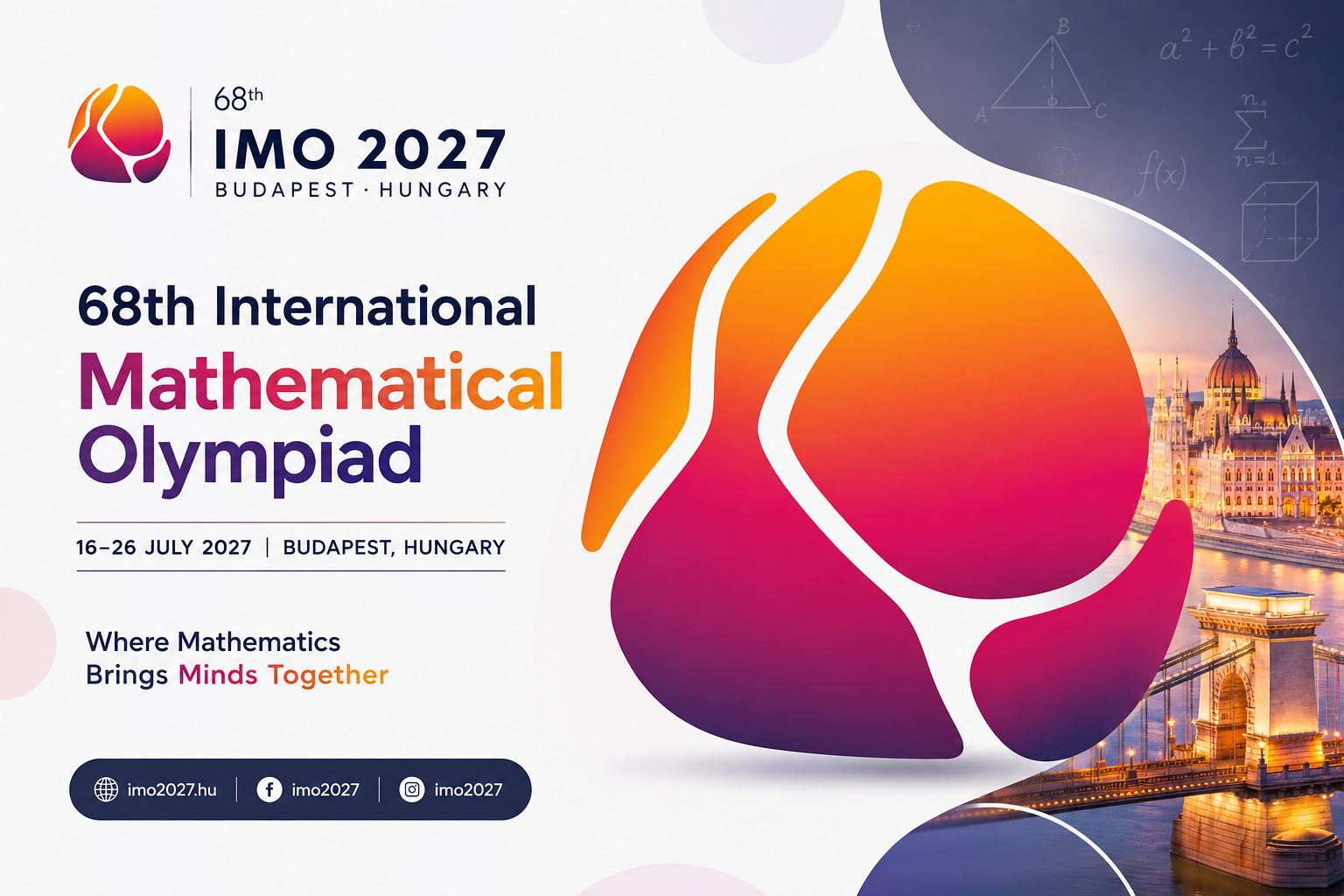
The 68th International Mathematical Olympiad (IMO 2027) will be held in Budapest, Hungary, from July 16 to July 26, 2027. Budapest will welcome students, team leaders, deputy leaders and mathematicians from participating countries for one of the most important events in the international mathematical calendar. (IMO Official)
For students in India, the journey toward IMO 2027 begins much earlier through the national Olympiad selection programme conducted by the Homi Bhabha Centre for Science Education (HBCSE) on behalf of the National Board for Higher Mathematics (NBHM).
This complete guide explains everything students, parents and teachers need to know about IMO 2027, including dates, eligibility, examination format, syllabus, preparation strategy and India’s selection process.
1. What is IMO 2027?
The International Mathematical Olympiad (IMO) is an annual international mathematics competition for school students. It brings together some of the strongest young problem-solvers from participating countries.
IMO is not a conventional school examination. Instead of simply testing formulas and routine calculations, IMO problems require students to use:
- Logical reasoning
- Creative thinking
- Mathematical intuition
- Proof-writing
- Problem-solving techniques
- Deep understanding of mathematical concepts
The IMO has been held since 1959 and has become one of the best-known international academic competitions for school students.
IMO 2027 will be the 68th International Mathematical Olympiad. The official IMO website lists Budapest, Hungary as the host city, with the event scheduled for July 16–26, 2027. (IMO Official)
2. IMO 2027 Dates and Host City
The official schedule currently available for IMO 2027 is:
| Event | Details |
|---|---|
| Olympiad | 68th International Mathematical Olympiad |
| Year | 2027 |
| Host Country | Hungary |
| Host City | Budapest |
| Official Event Dates | July 16–26, 2027 |
The official IMO website confirms that the 68th IMO will take place in Budapest, Hungary, from July 16 to July 26, 2027. (IMO Official)
The official IMO 2027 website provides additional information for participants. Its FAQ currently states that participants are expected to arrive on July 19 and depart on July 26, with the week including ceremonies, activities and the two competition days. (IMO2027)
Because detailed operational schedules can change, students should check the official IMO 2027 website for the latest announcements.
The Concept Behind the IMO 2027 Logo

The IMO 2027 logo was designed to reflect both the host country, Hungary, and the mathematical spirit of the event. For this reason, the designers chose the Gömböc, a fascinating geometric shape developed by Hungarian researchers Gábor Domokos and Péter Várkonyi.
The logo presents the Gömböc in a simple and modern form. Its distinctive shape is also used as the inspiration for other elements of the IMO 2027 visual identity, creating a consistent look throughout the event.
The bright and playful colours are designed to appeal to the secondary-school students participating in the Olympiad. At the same time, the Gömböc represents three important ideas associated with IMO 2027: Hungary, mathematics, and its unique equilibrium property.
Primary Logo
The primary logo is the main official visual identity of IMO 2027. It features the complete event name:
“68th International Mathematical Olympiad – Budapest 2027”
The primary logo is intended to be used only in its horizontal format and original full-colour version. A Hungarian-language version is also available, following the same typography and overall design.
Secondary Logo
The secondary logo is designed for situations where the event identity needs to appear repeatedly or on a larger scale. Instead of the full event name, it uses the shorter title:
“IMO 2027”
The secondary logo can be used in both full-colour and monochrome versions, making it suitable for a wider range of applications.
3. Who Can Participate in IMO 2027?
Students cannot normally register directly for the International Mathematical Olympiad.
Each participating country has its own national selection system through which students are chosen to represent that country.
The general IMO regulations place age and school-enrolment requirements on contestants. In particular, contestants must generally be under 20 years of age at the time specified by the IMO regulations and must meet the applicable secondary-education requirements. Exact eligibility should always be checked against the regulations and the student’s national selection programme.
For Indian students, eligibility is determined through India’s official Mathematical Olympiad programme.
Therefore, if you are an Indian student hoping to participate in IMO 2027, the important question is not simply:
“Can I directly apply for IMO?”
Instead, you need to qualify through India’s national selection pathway.
4. IMO 2027 Selection Process
The International Mathematical Olympiad does not have one worldwide entrance examination.
Each country selects its own team.
For India, the Mathematical Olympiad programme is organized by HBCSE on behalf of NBHM. The programme is designed to identify and train talented pre-university mathematics students. (HBCSE Olympiads)
The Indian pathway can be summarized as:
IOQM → RMO → INMO → IMOTC → IMO
Stage 1: IOQM
The first stage is the Indian Olympiad Qualifier in Mathematics (IOQM).
According to HBCSE, the IOQM is a three-hour examination consisting of 30 questions, with answers recorded on an OMR sheet. (HBCSE Olympiads)
Stage 2: RMO
Students who qualify through the required criteria proceed to the Regional Mathematical Olympiad (RMO).
For the 2026–27 cycle, HBCSE currently lists:
RMO 2026: November 15, 2026
Time: 1:00 PM–4:00 PM
Duration: 3 hours
Questions: 6 proof-based problems (HBCSE Olympiads)
Stage 3: INMO
The next stage is the Indian National Mathematical Olympiad (INMO).
For the 2026–27 cycle, HBCSE currently lists:
INMO 2026: January 17, 2027
Time: 12:00 PM–4:30 PM
Duration: 4.5 hours
Questions: 6 proof-based problems (HBCSE Olympiads)
Stage 4: International Mathematical Olympiad Training Camp
The best-performing students from the national selection process are invited to the International Mathematical Olympiad Training Camp (IMOTC).
HBCSE states that approximately 65 students are invited to the training camp, where students receive advanced training and take selection tests. (HBCSE Olympiads)
Stage 5: Indian IMO Team
At the end of the training and selection process, six students are selected to represent India at the IMO. (HBCSE Olympiads)
The selected students then undergo additional preparation before travelling to the International Mathematical Olympiad.
5. IMO 2027 Exam Format
The IMO is a proof-based mathematics competition, not a multiple-choice examination.
The competition consists of two examination days.
Students normally solve three problems on each day, with each examination session lasting approximately 4.5 hours.
Therefore, contestants face:
- 2 examination days
- 3 problems per day
- 6 problems in total
- Approximately 4.5 hours per examination day
The problems are designed to test mathematical reasoning rather than memorization.
A successful solution needs to present a convincing mathematical argument. Simply writing an answer is not enough.
The main skills tested include:
- Constructing mathematical proofs
- Finding hidden patterns
- Developing useful lemmas
- Choosing an appropriate strategy
- Writing logical arguments clearly
- Combining different mathematical ideas
6. IMO Syllabus and Important Topics
There is no simple school-style chapter list that completely defines the IMO syllabus.
However, the major areas traditionally associated with mathematical Olympiad problems are:
1. Algebra
Important areas include:
- Inequalities
- Polynomials
- Functional equations
- Sequences
- Progressions
- Equations
- Binomial coefficients
- Algebraic identities
2. Geometry
Students should develop strong knowledge of:
- Triangles
- Circles
- Quadrilaterals
- Similarity
- Congruence
- Ceva’s theorem
- Menelaus’ theorem
- Concurrency
- Collinearity
- Coordinate geometry
- Trigonometric methods
- Euclidean constructions
3. Number Theory
Important topics include:
- Divisibility
- Prime numbers
- Greatest common divisor
- Euclidean algorithm
- Modular arithmetic
- Congruences
- Diophantine equations
- Chinese Remainder Theorem
- Fermat’s Little Theorem
- Euler’s theorem and phi function
- Pythagorean triples
4. Combinatorics
Important concepts include:
- Counting
- Pigeonhole Principle
- Recursion
- Graph theory
- Invariants
- Extremal arguments
- Combinatorial constructions
HBCSE specifically identifies algebra, combinatorics, geometry and number theory as the major areas from which Mathematical Olympiad problems are posed. It also notes that the difficulty increases from RMO to INMO to IMO. (HBCSE Olympiads)
Importantly, HBCSE also warns that the listed topics do not constitute an exhaustive list and that Olympiad problems may involve ideas beyond the explicitly listed topics. (HBCSE Olympiads)
7. How to Prepare for IMO 2027
Preparing for IMO is different from preparing for a normal school examination.
The goal should not be to memorize hundreds of formulas. Instead, students should gradually develop their ability to solve unfamiliar problems.
Step 1: Build Strong Fundamentals
Start with the fundamentals of:
- Algebra
- Geometry
- Number theory
- Combinatorics
Make sure you understand the underlying ideas rather than simply memorizing formulas.
Step 2: Learn Mathematical Proofs
Proof-writing is one of the most important skills for advanced Olympiad mathematics.
Learn how to use:
- Direct proof
- Proof by contradiction
- Mathematical induction
- Contrapositive arguments
- Case analysis
- Invariants
- Extremal arguments
Step 3: Solve Problems Regularly
Instead of solving a very large number of easy problems, spend meaningful time on challenging problems.
For example, you might divide your practice into:
Monday: Number Theory
Tuesday: Geometry
Wednesday: Algebra
Thursday: Combinatorics
Friday: Mixed Olympiad Problems
Weekend: Full-length practice and review
Step 4: Do Not Look at Solutions Too Quickly
When you encounter a difficult problem, give yourself enough time to explore it.
Try:
- Understanding the problem
- Testing small cases
- Drawing diagrams
- Looking for patterns
- Forming a conjecture
- Searching for a proof
Only after serious attempts should you study a solution.
Step 5: Maintain a Problem-Solving Notebook
Keep a notebook containing:
- Problems you could not solve
- Important ideas
- Useful lemmas
- Mistakes
- New techniques
- Elegant solutions
Reviewing this notebook regularly can be more valuable than repeatedly solving problems you already know.
8. Important Previous IMO Papers
Previous IMO papers are among the best resources for understanding the level and style of the competition.
Students preparing for IMO 2027 should work through previous papers from different years rather than concentrating on only one or two recent contests.
Useful practice can include:
- IMO 2026
- IMO 2025
- IMO 2024
- IMO 2023
- IMO 2022
- IMO 2021
- IMO 2020
- Older IMO problems from previous decades
The official IMO website provides previous IMO problems and competition information. HBCSE also provides previous Mathematical Olympiad papers and solutions for students preparing in India. (HBCSE Olympiads)
9. India’s Pathway to IMO 2027
For Indian students, preparation for IMO 2027 is already connected with the 2026–27 Mathematical Olympiad cycle.
The currently published HBCSE schedule gives the following important dates:
| Stage | Examination | Date |
|---|---|---|
| Stage 1 | IOQM 2026 | Check official IOQM schedule |
| Stage 2 | RMO 2026 | November 15, 2026 |
| Stage 3 | INMO 2026 | January 17, 2027 |
| Stage 4 | IMOTC | After INMO selection |
| Stage 5 | IMO 2027 | July 16–26, 2027 |
HBCSE currently confirms the RMO and INMO dates above for the 2026–27 cycle. (HBCSE Olympiads)
The complete pathway is:
IOQM → RMO → INMO → IMOTC → Selection of 6 students → IMO 2027
HBCSE explains that the top students from INMO proceed to the International Mathematical Olympiad Training Camp, where selection tests are conducted, and six students are ultimately selected for the Indian IMO team. (HBCSE Olympiads)
Students should always check the latest HBCSE and IOQM announcements because eligibility requirements, dates and selection criteria can be updated.
HBCSE Mathematical Olympiad 2026–27
10. Important Dates and Official Resources
The most important confirmed international date at present is:
IMO 2027
Host: Budapest, Hungary
Dates: July 16–26, 2027
Edition: 68th International Mathematical Olympiad (IMO Official)
Indian Selection
RMO 2026: November 15, 2026
INMO 2026: January 17, 2027 (HBCSE Olympiads)
Official Websites
Students should rely primarily on official sources for announcements:
International Mathematical Olympiad – Official Website
11. FAQs About IMO 2027
When is IMO 2027?
The 68th International Mathematical Olympiad will take place from July 16 to July 26, 2027. (IMO Official)
Where will IMO 2027 be held?
IMO 2027 will be held in Budapest, Hungary. (IMO Official)
Is IMO 2027 being held in Dubai?
No. The official IMO website confirms that Budapest, Hungary is the host city for IMO 2027. (IMO Official)
Can students register directly for IMO 2027?
Generally, no. Students are selected through their country’s national Olympiad programme.
For India, students must follow the Indian Mathematical Olympiad selection pathway.
How many students represent India at IMO?
India sends a team of six students to the IMO. HBCSE confirms that six students are selected through the training-camp selection process. (HBCSE Olympiads)
What subjects are important for IMO?
The four major areas are:
- Algebra
- Geometry
- Number Theory
- Combinatorics
Is IMO based on school mathematics?
IMO uses mathematical concepts accessible to school students, but the problems are substantially more challenging than routine school exercises. They emphasize creativity, reasoning and proof.
How many problems are there in the IMO?
There are six problems, normally divided into two competition days with three problems on each day.
How should I start preparing for IMO 2027?
Begin with fundamentals in algebra, geometry, number theory and combinatorics. Then gradually move toward proof-based Olympiad problems and previous IMO papers.
12. Conclusion
IMO 2027 is an exciting opportunity for young mathematicians who enjoy challenging problems and creative mathematical thinking.
The 68th International Mathematical Olympiad will be held in Budapest, Hungary, from July 16 to July 26, 2027. (IMO Official)
For Indian students, the road to Budapest begins much earlier. The national pathway moves through IOQM, RMO, INMO and the International Mathematical Olympiad Training Camp, followed by the selection of six students for India’s IMO team. (HBCSE Olympiads)
The most important thing to remember is that IMO preparation is a long-term process. Strong fundamentals, regular problem solving, proof-writing practice and careful study of previous Olympiad problems can gradually develop the skills required for international-level mathematics.
If your goal is IMO 2027, start early, practise consistently and focus on understanding why a solution works—not just on finding the final answer.
Keep solving. Keep learning. Keep thinking.
Good luck to every future IMO 2027 participant!