
Have you ever seen a Mathematical Olympiad problem and thought, “I know all these concepts, so why can’t I solve this?”
This happens to many students.
A student may be very good at school mathematics, get excellent marks in exams, and solve textbook exercises quickly. But when they try an International Mathematical Olympiad (IMO) problem, suddenly the question feels completely different.
The reason is simple.
School mathematics and Olympiad mathematics use many of the same basic ideas, but they ask you to use those ideas in very different ways.
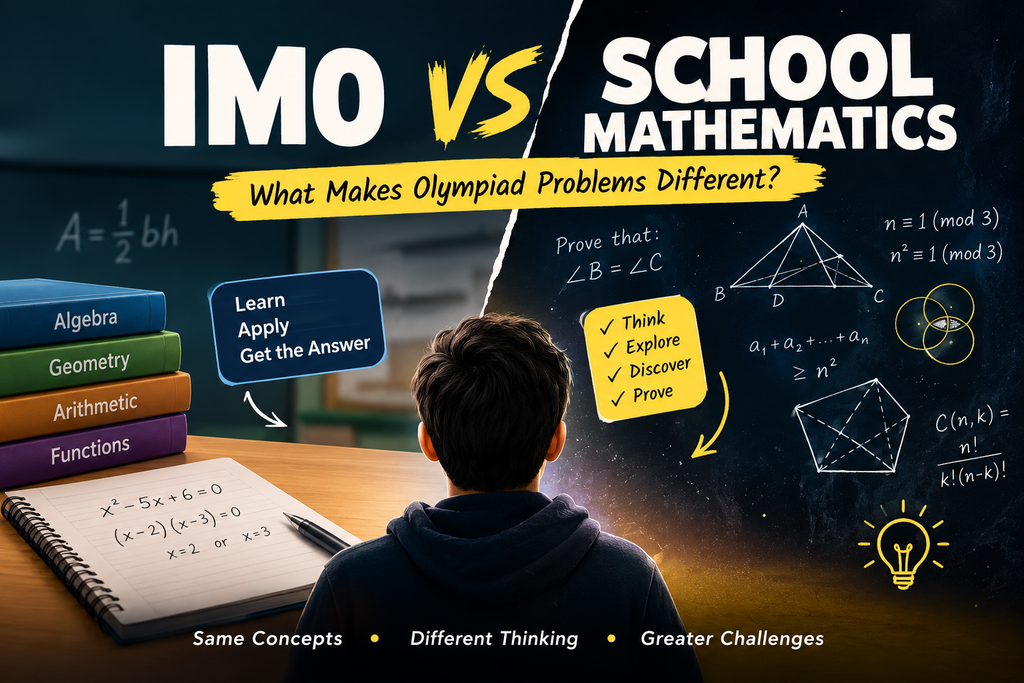
In school, you are often taught a method and then asked to apply it.
In Olympiad mathematics, you are often given a problem where the method is hidden. You have to discover it yourself.
That is what makes Mathematical Olympiad problems so interesting.
What is the International Mathematical Olympiad?
The International Mathematical Olympiad, commonly called the IMO, is an international mathematics competition for school students.
The problems are based on pre-university mathematics, with major areas including algebra, geometry, number theory and combinatorics.
But IMO mathematics is not simply about knowing more formulas than your classmates.
A large part of the challenge comes from solving problems that you have not seen before and giving a clear mathematical proof of your answer.
This is why a student who is excellent at routine calculations may still need a different kind of preparation for the IMO.
School Mathematics: Learn a Method and Apply It
Let’s take a simple example.
Suppose you are asked to solve:
You may immediately factorize it:
Therefore,
This is a perfectly good mathematical question.
You have learned how to factor a quadratic equation, recognized the type of problem, and applied the method.
A lot of school mathematics works this way.
You learn:
- a formula,
- a theorem,
- a procedure,
- a definition,
and then practice using it in different questions.
This builds an essential mathematical foundation.
But Olympiad problems often take the next step.
Olympiad Mathematics: Where Is the Idea?
Imagine you are given a problem involving positive integers and divisibility.
The problem doesn’t tell you:
“Use modular arithmetic.”
It doesn’t tell you:
“Factor this expression.”
It doesn’t even tell you what the important observation is.
You have to figure that out.
You might try small values.
You might look for a pattern.
You might factor something.
You might consider the expression modulo a suitable integer.
You might discover that one particular case is impossible.
Or you might suddenly notice a completely different idea.
That process of searching is a huge part of Olympiad mathematics.
The question is no longer simply:
“Which formula should I use?”
It becomes:
“What is really happening here?”
Knowing a Theorem Is Only the Beginning
Suppose you know Ceva’s theorem.
You remember that for three cevians in a triangle,
is related to their concurrency.
Great.
But an Olympiad problem usually won’t come with a big sign saying:
USE CEVA’S THEOREM HERE.
You have to recognize that the geometry of the problem has created exactly the kind of ratios where Ceva may be useful.
This is a very important difference.
Learning a theorem is knowledge.
Recognizing when to use the theorem is problem-solving skill.
And that skill develops through practice.
The Same Mathematics Can Feel Completely Different
Consider geometry.
At school, you might be asked to find the area of a triangle when the base and height are given.
You know:
Put in the values and you’re done.
An Olympiad geometry problem might instead give you a triangle containing several points, lines and circles.
You may know all the relevant school geometry.
You may know:
- similar triangles,
- angle properties,
- cyclic quadrilaterals,
- Pythagoras,
- angle bisectors,
and still have no idea where to begin.
Why?
Because the difficulty isn’t necessarily the mathematics itself.
The difficulty is finding the connection between the pieces of mathematics you already know.
That is one of the most important things students discover when they begin Olympiad preparation.
In Olympiad Mathematics, the Answer Is Not Enough
There is another major difference: proof.
Suppose you somehow know that the answer to a problem is .
In a routine calculation, that may be the main thing the question is asking for.
In an Olympiad problem, you have to explain why must be the answer.
Every important step needs a logical reason.
This is why Olympiad students spend so much time learning how to write proofs.
A good solution doesn’t just say:
“Obviously…”
or
“It is clear that…”
It explains the mathematics.
You want another person to be able to read your solution and understand exactly why your conclusion follows.
That habit of rigorous thinking is one of the most valuable things Mathematical Olympiad training can develop.
Olympiad Problems Often Combine Several Ideas
Another reason IMO problems can feel difficult is that one problem may require several different ideas.
For example, a number theory problem might involve:
divisibility + prime numbers + modular arithmetic
A geometry problem might involve:
similar triangles + cyclic quadrilaterals + angle chasing
An algebra problem might involve:
Vieta’s formulas + inequalities + substitution
A combinatorics problem might involve:
pigeonhole principle + parity + an invariant
None of these individual topics may be extremely advanced.
The challenge is seeing how they fit together.
That’s why simply reading a list of Olympiad formulas is not enough.
You have to solve problems.
There Isn’t Always One “Correct Method”
One of the nicest things about Olympiad mathematics is that there can sometimes be several ways to solve the same problem.
One student may find a synthetic geometry solution.
Another may use coordinates.
Someone else may discover a clever transformation.
All of them can lead to a correct proof.
This is very different from following a fixed algorithm.
Instead of asking students to reproduce one particular method, Olympiad problems encourage them to explore.
You may try something that doesn’t work.
That’s normal.
You may spend twenty minutes drawing diagrams and getting nowhere.
That’s normal too.
Sometimes the failed attempts are what eventually lead you to the right idea.
This Is Where Mathematical Creativity Comes In
Olympiad preparation is not just about becoming faster at calculations.
It is about becoming better at thinking.
When you see a difficult problem, you gradually learn to ask:
- Can I try a smaller case?
- Is there a pattern?
- Is there some symmetry?
- Can I work backwards?
- Can I prove the opposite statement?
- Is something staying unchanged?
- What happens in the largest or smallest case?
- Can I draw the situation differently?
- Is there a theorem hiding here?
- Can I break the problem into smaller parts?
These questions become part of your mathematical thinking.
And that is something that develops slowly through experience.
So, Is School Mathematics Important for the IMO?
Absolutely.
Olympiad mathematics does not replace school mathematics.
It builds on it.
A student who wants to study Olympiad mathematics needs a strong foundation in areas such as algebra, geometry, arithmetic, equations, functions and basic counting.
The difference comes when you start taking those ideas beyond routine exercises.
You don’t stop learning formulas.
You start asking why the formulas work, where they can be used, and how they can be combined with other ideas.
A useful way to think about it is:
School mathematics gives you the tools.
Olympiad mathematics teaches you how to think with those tools.
A Simple Example
Consider:
You could add all the numbers one after another.
But there is a much nicer observation.
Pair the first and last numbers:
Then:
and:
Every pair gives .
There are 50 pairs, so:
The interesting part isn’t really the multiplication.
It is the observation that the numbers can be reorganized into useful pairs.
This is the kind of thinking that becomes increasingly important in Olympiad mathematics.
What Should an Olympiad Student Learn?
A student preparing seriously for Mathematical Olympiads should gradually build several different skills.
Learn the Mathematics
Understand the important concepts, formulas and theorems.
Learn the Proofs
Don’t just memorize a theorem. Understand why it is true.
Solve Unfamiliar Problems
This is where problem-solving ability develops.
Learn Techniques
For example:
- contradiction,
- induction,
- pigeonhole principle,
- invariants,
- extremal principle,
- modular arithmetic,
- construction,
- inequalities,
- transformations.
Learn to Write
A brilliant idea is not enough if you cannot communicate the proof clearly.
Be Patient
Some Olympiad problems take a long time.
Getting stuck is part of the process.
IMO vs School Mathematics
Here is the difference in a simple form:
| School Mathematics | Olympiad Mathematics |
|---|---|
| Learn a method | Discover a method |
| Apply known formulas | Decide which tools may help |
| Familiar question types | Unfamiliar problems |
| Calculation is often central | Reasoning is central |
| Usually a direct route | May require exploration |
| Practice similar examples | Practice varied problems |
| Answer is important | Proof and reasoning are essential |
| Follow a procedure | Develop a strategy |
| Focus on curriculum | Focus on mathematical thinking |
Neither approach is “wrong.”
They serve different purposes.
School mathematics gives students the foundation they need.
Olympiad mathematics takes that foundation and challenges students to use it creatively.
The Biggest Change Is in the Way You Think
Perhaps the easiest way to remember the difference is this:
School Mathematics
“Which formula should I use?”
Olympiad Mathematics
“What idea could make this problem work?”
And eventually, you start asking an even better question:
“Why does this idea work?”
That is when mathematics becomes much more than calculation.
It becomes problem solving.
At Last
If you are starting Mathematical Olympiad preparation, don’t worry if the first few problems feel impossible.
That is normal.
You are learning a different style of mathematics.
Start with the fundamentals. Learn important theorems and techniques. Solve problems regularly. Try to find your own solution before reading the official one. And most importantly, learn to write down why your solution works.
Over time, you will begin to recognize patterns that were invisible to you before.
A geometry diagram will start suggesting a theorem.
A number theory expression will start suggesting a congruence.
A combinatorics problem will start suggesting an invariant.
An inequality will start suggesting a substitution.
That change in the way you see a problem is one of the most rewarding parts of Olympiad mathematics.
Learn the tools. Understand the ideas. Prove the results. Solve the problems.
Learn • Prove • Solve.
Frequently Asked Questions
Is IMO mathematics the same as school mathematics?
No. There is significant overlap in the underlying mathematics, but IMO problems generally require more creative problem solving, deeper reasoning and rigorous proof.
Is the IMO only for students who are good at mathematics?
Students with a strong interest in mathematics can develop Olympiad skills through systematic practice. Being good at routine school exercises is helpful, but Olympiad problem solving requires additional training.
Do I need to memorize many formulas for Mathematical Olympiad?
You should know important formulas and theorems, but memorization alone will not prepare you for Olympiad problems. Understanding and applying mathematical ideas is much more important.
What are the main areas of IMO mathematics?
The major areas are algebra, geometry, number theory and combinatorics.
Why are IMO problems so difficult?
Often, the individual mathematics is not the main difficulty. The challenge is discovering the right idea, connecting different concepts and constructing a complete proof.
How should I start preparing for Mathematical Olympiad?
Build a strong mathematical foundation first. Then study Olympiad theorems and techniques and gradually work through increasingly challenging problems. Spend time thinking about a problem before looking at its solution.