
European Girls’ Mathematical Olympiad (EGMO):Complete Guide & Selection Process
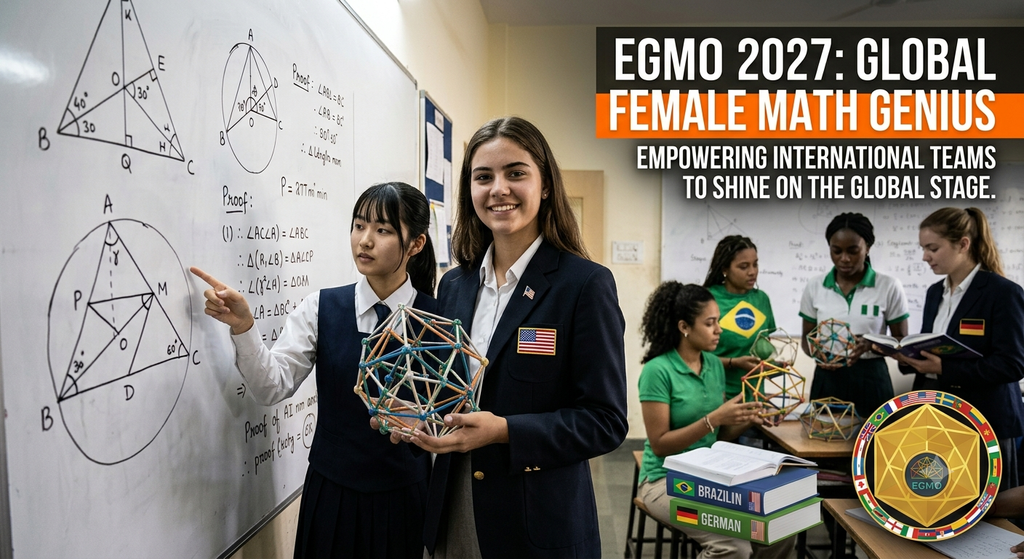
The European Girls’ Mathematical Olympiad (EGMO) is a world-renowned international mathematics competition for female high school students. Modeled after the prestigious International Mathematical Olympiad (IMO), the EGMO was established in 2012 to empower young women, bridge the gender gap in STEM fields, and foster global collaboration among future scientific leaders.
What started as an initiative among European nations has expanded into a global phenomenon, drawing participating teams from over 50 countries across Europe, Asia, the Americas, Africa, and Oceania.
At a Glance: Key Competition Details
| Feature | Specifications |
| Official Name | European Girls’ Mathematical Olympiad (EGMO) |
| First Edition | 2012 (Cambridge, United Kingdom) |
| Target Audience | Female high school / pre-university students |
| Team Size | 4 Female Contestants + 1 Team Leader + 1 Deputy Leader |
| Format | 2 Consecutive Examination Days (4.5 hours per paper) |
| Total Questions | 6 Descriptive Proof-Based Problems (3 per day) |
| Scoring | 0 to 7 points per problem (Maximum Score: 42 points) |
Exam Format and Syllabus Breakdown
The EGMO features advanced, proof-oriented problems that demand deep logical reasoning, creative mathematical insights, and rigorous argumentation.
Competition Format
- Duration: Two examination papers administered on consecutive days. Students are given 4.5 hours per day to solve 3 problems.
- Problem Style: Fully descriptive proof problems. Answers require complete mathematical demonstrations rather than numerical answers.
Core Syllabus Topics
- Algebra: Functional equations, inequalities, polynomials, algebraic structures, and sequences.
- Geometry: Synthetic Euclidean geometry, cyclic quadrilaterals, triangle centers, transformations, and projective properties.
- Number Theory: Modular arithmetic, Diophantine equations, divisibility properties, and prime numbers.
- Combinatorics & Graph Theory: Invariants, colorings, extremal combinatorics, pigeonhole principle, and graph properties.
- Trigonometry & Elementary Probability
Note on Exclusions: Standard university-level calculus, real analysis, and statistical methods are strictly excluded from the EGMO syllabus.
The “Black Box” Concept in Olympiad Mathematics
In advanced mathematical competitions like the EGMO, the term “Black Box” refers to two distinct concepts that every contestant should understand:
1. “Black Box” Functions & Processes (In Problem-Solving)
In Combinatorics and Algebra problems, a “black box” is a conceptual system where an input goes in, an underlying transformation occurs, and an output is produced.
- Students are often tasked with determining the internal rules of the box based solely on observed inputs and outputs.
- It tests functional reasoning, state transitions, and algorithmic thinking without relying on standard algebraic formulas.
2. “Black Box” Proof Fallacy (In Scoring & Evaluation)
In descriptive olympiad exams, using a “black box” approach—stating a complex, high-level university theorem or result without proof or proper context—is heavily discouraged.
- Contestants are required to reveal all steps of their mathematical reasoning.
- Submitting a solution where key steps are hidden within an unjustified claim will result in loss of points, as graders cannot evaluate the student’s problem-solving validity.
Global Eligibility Requirements
To represent a country on the international EGMO stage, candidates must meet universal criteria established by the EGMO Advisory Board:
- Gender: Exclusively open to female contestants.
- Educational Status: Candidates must be enrolled in full-time primary or secondary education (or home-schooled working toward high school credentials) on or after December 1st of the year preceding the competition.
- Tertiary Enrollment: Contestants must not have matriculated at or enrolled in a degree-granting tertiary institution prior to the exam.
- Selection: Individual registration is not allowed. Contestants must be selected through their country’s official National Mathematical Olympiad program.
How to Register for EGMO 2027: Step-by-Step Process
Students cannot apply or register directly on the official EGMO portal. Participation is by official invitation extended to national mathematical organizations.
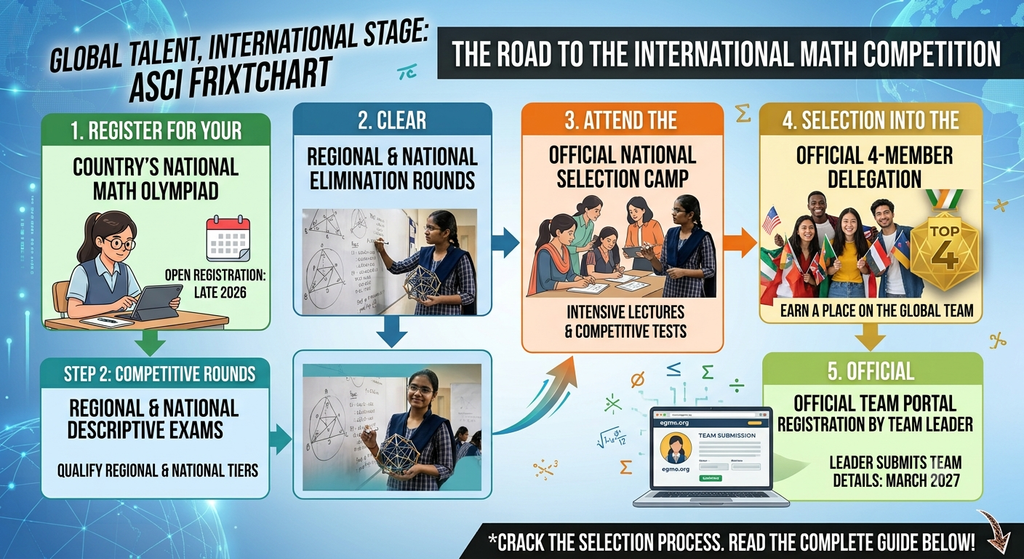
Registration Stages for EGMO 2027
- Step 1 — National Stage Entry (Late 2026): Aspirants must register for their country’s preliminary qualifier (e.g., IOQM in India, AMC/AIME in the USA, UKMT in the UK).
- Step 2 — Advanced National Rounds (Early 2027): High scorers qualify for descriptive national olympiads (e.g., INMO, USAMO, BMO2).
- Step 3 — National Selection & Training Camp (Early 2027): Top female performers are invited to national training camps organized by accredited math bodies (such as HBCSE, MAA, or UKMT).
- Step 4 — Final Delegation Selection: The top 4 female students from the camp are selected to represent the country.
- Step 5 — Official Institutional Registration (March 2027): The designated Team Leader registers the selected 4-member student team and leadership details on the official EGMO portal (
www.egmo.org) prior to the event deadline.
Global Awards and Scoring System
Contestants earn individual medals based on their cumulative scores out of 42 points. The medal distribution follows strict international ratios relative to student performance:
| Award | Target Distribution | Description |
| Gold Medal | ~ Top 1/12th of participants | High-level performance (typically scores e 30-33$) |
| Silver Medal | ~ Next 2/12ths of participants | Upper-tier performance (typically scores 20-22$) |
| Bronze Medal | ~ Next 3/12ths of participants | Solid performance (typically scores 12-14$) |
| Honourable Mention | Non-medalist achieving 7/7 | Awarded for a perfect score on at least one problem |
Official EGMO Schedule (2024 – 2027)
The competition rotates host cities globally every spring to foster international exchange and highlight world-class host institutions:
| Edition | Year | Host City & Country | Event Dates |
| 13th EGMO | 2024 | Tskaltubo, Georgia | April 11 – April 17, 2024 |
| 14th EGMO | 2025 | Pristina, Kosovo | April 11 – April 17, 2025 |
| 15th EGMO | 2026 | Bordeaux, France | April 9 – April 15, 2026 |
| 16th EGMO | 2027 | Šibenik, Croatia | April 11 – April 17, 2027 |
Why EGMO Matters
Beyond earning medals, competing in the EGMO serves as a major milestone for young women pursuing higher mathematics, research, computer science, and quantitative analysis. Past participants frequently secure admissions to leading global universities and gain access to an international network of female mathematicians.