
Indian National Mathematical Olympiad (INMO): The Complete Guide for Students, Parents, and Teachers
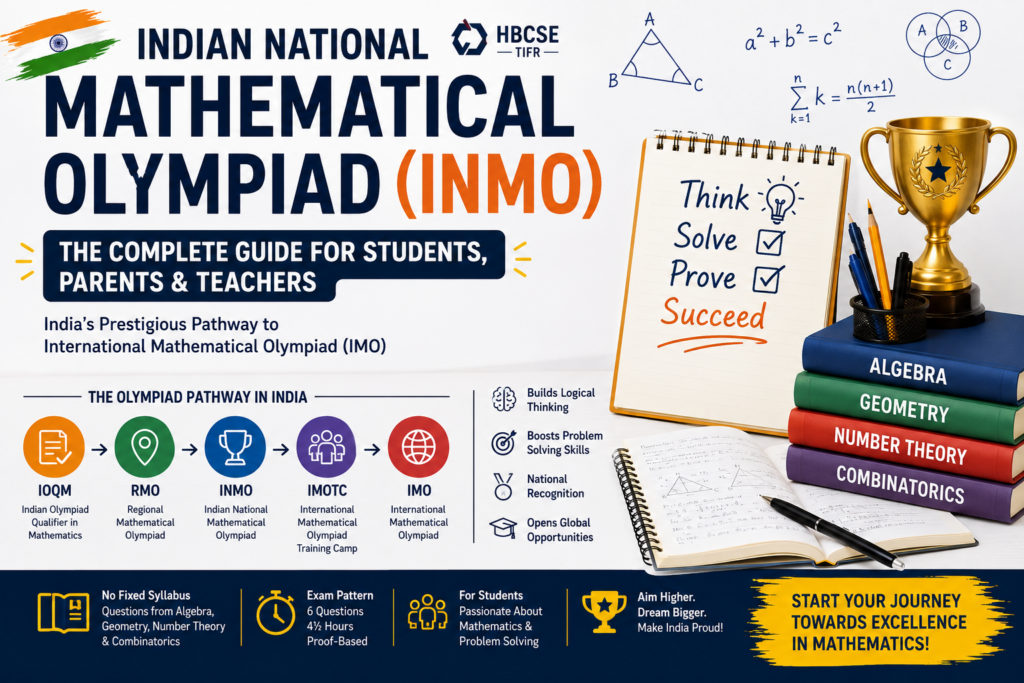
Mathematics is much more than formulas and calculations. At its highest level, it is about discovering patterns, solving challenging problems, and proving why a statement is true. For students in India who enjoy this kind of mathematical thinking, the Indian National Mathematical Olympiad (INMO) is one of the most prestigious competitions they can aspire to.
Every year, thousands of talented students begin their Olympiad journey through the Indian Olympiad Qualifier in Mathematics (IOQM). Only the best performers move through successive stages, and a select group finally earns the opportunity to compete in the INMO. Performing well in the INMO can lead to the International Mathematical Olympiad Training Camp (IMOTC) and, ultimately, a place on the Indian team for the International Mathematical Olympiad (IMO). The Mathematical Olympiad Programme in India is conducted by the Homi Bhabha Centre for Science Education (HBCSE), TIFR, on behalf of the National Board for Higher Mathematics (NBHM).
Unlike school examinations, the INMO is not about memorizing formulas or applying standard methods. Every problem demands creativity, logical reasoning, and the ability to write complete mathematical proofs. This is why the INMO is respected not only in India but also by universities and mathematicians around the world.
What is the Indian National Mathematical Olympiad (INMO)?
The Indian National Mathematical Olympiad (INMO) is the third stage of India’s Mathematical Olympiad Programme. It is a national-level proof-based examination designed to identify students with exceptional mathematical ability. Students who qualify for the INMO compete against some of the brightest young mathematicians in the country.
The primary purpose of the examination is to identify students who can be trained further for international competitions. The top performers in the INMO are invited to the International Mathematical Olympiad Training Camp (IMOTC), where intensive training and selection tests are conducted before choosing India’s six-member team for the International Mathematical Olympiad.
Reaching the INMO is considered one of the highest achievements for school students interested in competitive mathematics.
A Brief History of the INMO
India has been actively participating in the International Mathematical Olympiad since 1989. To identify and train talented students, the National Board for Higher Mathematics established a structured Mathematical Olympiad Programme under the guidance of HBCSE, TIFR.
Over the years, the programme has produced many internationally recognized mathematicians, researchers, and educators. Indian students have consistently improved their performance at the IMO, earning numerous gold, silver, and bronze medals while establishing India as one of the world’s strongest emerging mathematical nations.
Today, the INMO represents one of the most respected academic competitions for school students in India.
The Complete Selection Process
One of the most common misconceptions is that students can register directly for the INMO. In reality, qualification takes place through several carefully designed stages.
The journey begins with the Indian Olympiad Qualifier in Mathematics (IOQM). Students who perform well in the IOQM qualify for the Regional Mathematical Olympiad (RMO). Outstanding performers in the RMO are then invited to the Indian National Mathematical Olympiad (INMO).
Students who excel in the INMO are invited to the International Mathematical Olympiad Training Camp (IMOTC), where they receive advanced training from experienced mathematicians. After several rigorous selection tests, six students are chosen to represent India at the International Mathematical Olympiad (IMO).
The complete pathway can be summarized as:
IOQM → RMO → INMO → IMOTC → IMO
Each stage becomes progressively more challenging, and only the strongest students move forward.
Who Can Appear for the INMO?
Students cannot apply directly for the INMO. They must first qualify through the earlier stages of the Mathematical Olympiad Programme.
Eligibility requirements are announced each year by HBCSE and generally depend on factors such as age, school enrollment, nationality, and performance in the qualifying examinations. Since the official criteria may change from year to year, students should always check the latest notification before applying for the IOQM.
INMO Exam Pattern
The INMO is very different from most competitive examinations in India.
The examination is conducted on a single day and lasts 4½ hours. Students are required to solve six proof-based problems. Every question demands complete mathematical justification rather than simply writing the final answer. Calculators and electronic devices are not permitted during the examination, and students are expected to present clear, logical proofs. Geometry constructions are done using only permitted instruments such as a ruler and compass.
Unlike objective examinations, there are no multiple-choice questions. The quality of mathematical reasoning is often more important than the final answer itself, and partial credit may be awarded for correct ideas supported by sound arguments.
INMO Syllabus
One unique feature of the INMO is that there is no officially prescribed chapter-wise syllabus. Instead, questions are drawn from four broad areas of Olympiad mathematics.
Algebra
Students should develop a strong understanding of inequalities, polynomials, functional equations, sequences, recursions, symmetric expressions, identities, and algebraic transformations. Most problems require creative thinking rather than lengthy computations.
Geometry
Geometry remains one of the most important parts of the Olympiad syllabus. Students should be familiar with Euclidean geometry, cyclic quadrilaterals, similar triangles, Ceva’s Theorem, Menelaus’ Theorem, power of a point, homothety, inversion, and advanced synthetic geometry.
Number Theory
Typical topics include divisibility, prime numbers, modular arithmetic, Diophantine equations, Euler’s Totient Function, congruences, greatest common divisors, quadratic residues, and mathematical induction.
Combinatorics
Combinatorics problems often involve counting techniques, graph theory, invariants, extremal principles, coloring arguments, recursion, the pigeonhole principle, and constructive reasoning.
Unlike school mathematics, Olympiad questions frequently combine ideas from several topics into a single problem.
Why is the INMO So Difficult?
Many students who score exceptionally well in school examinations are surprised by the difficulty of the INMO. The challenge lies not in complicated calculations but in discovering original ideas and expressing them through rigorous proofs.
An INMO problem may appear simple at first, yet solving it often requires deep insight, patience, and creativity. It is common for contestants to spend an hour or more on a single problem before making meaningful progress.
Success in the INMO depends on developing mathematical maturity over several years rather than memorizing formulas or practicing routine exercises. Students who enjoy exploring ideas, experimenting with different approaches, and learning from difficult problems often perform best in Olympiad mathematics.
How to Prepare for the INMO
Preparing for the Indian National Mathematical Olympiad is very different from preparing for school examinations or entrance tests. Olympiad mathematics is not about remembering formulas or solving routine exercises. Instead, it focuses on developing creativity, logical reasoning, and the ability to write complete mathematical proofs.
The first step is to build a strong foundation in the four major Olympiad subjects: algebra, geometry, number theory, and combinatorics. Before attempting difficult Olympiad problems, students should become comfortable with fundamental concepts and standard theorems. A solid understanding of these topics makes advanced problem-solving much easier.
Regular practice is the key to success. Rather than solving dozens of easy questions, it is better to spend time on one or two challenging problems each day. Even if a solution is not found immediately, the process of exploring different ideas helps develop mathematical intuition.
Writing proofs is equally important. After solving a problem, students should rewrite the solution neatly, explaining every logical step. Good mathematical communication often earns valuable partial credit in proof-based examinations like the INMO.
A One-Year Preparation Plan
Students planning to qualify for the INMO should follow a structured study schedule instead of studying randomly.
During the first three months, focus on strengthening concepts in algebra, geometry, number theory, and combinatorics. Solve previous IOQM questions and easier Olympiad problems to build confidence.
The next three months should be devoted to Regional Mathematical Olympiad (RMO) papers, older INMO problems, and national Olympiad questions from other countries. These problems introduce students to the style and creativity expected in proof-based competitions.
In the following three months, solve previous INMO papers under timed conditions. Attempt every problem independently before reading the official solution. Compare your proof with the official one and identify better methods or missing arguments.
The final three months should be spent simulating actual examinations. Solve complete six-question papers within four and a half hours and practice writing clear, well-organized proofs. This develops both mathematical stamina and effective time management.
Best Books for INMO Preparation
Choosing the right books can significantly improve Olympiad preparation. The following resources are widely recommended by teachers and former Olympiad participants.
Challenge and Thrill of Pre-College Mathematics by V. Krishnamurthy, C. R. Pranesachar, K. N. Ranganathan, and B. J. Venkatachala is one of the best introductory books for Indian Olympiad students.
Problem-Solving Strategies by Arthur Engel introduces numerous techniques used in mathematical Olympiads and contains hundreds of challenging problems with detailed solutions.
The Art and Craft of Problem Solving by Paul Zeitz is an excellent resource for developing creative problem-solving skills.
104 Number Theory Problems by Titu Andreescu helps students strengthen one of the most important Olympiad topics.
Geometry Revisited by Coxeter and Greitzer remains a classic reference for Euclidean geometry.
Students should also solve as many previous IOQM, RMO, INMO, and International Mathematical Olympiad (IMO) papers as possible. There is no better preparation than working through original competition problems.
How to Register for the INMO
Students should note that there is no direct registration for the Indian National Mathematical Olympiad.
The first step is to register for the Indian Olympiad Qualifier in Mathematics (IOQM) through the official registration process announced each year. Students who qualify in the IOQM become eligible for the Regional Mathematical Olympiad (RMO), and successful candidates from the RMO are invited to the INMO.
The complete qualification pathway is:
IOQM → RMO → INMO → IMOTC → IMO
Registration dates, eligibility criteria, examination centres, and official notifications are published every year on the HBCSE Mathematical Olympiad website. Students should always refer to the latest official announcement before registering because schedules and eligibility requirements may change. (olympiads.hbcse.tifr.res.in)
Common Mistakes Students Make
Many talented students fail to qualify simply because they prepare in the wrong way.
One common mistake is relying entirely on school textbooks. Although school mathematics builds a useful foundation, Olympiad questions require much deeper reasoning and creativity.
Another mistake is reading solutions too quickly. Students learn far more by struggling with a difficult problem for an hour than by immediately reading the official solution.
Many students also avoid geometry because they find it difficult. However, geometry is an important part of almost every major Olympiad, and ignoring it can significantly reduce overall performance.
Finally, students often neglect proof writing. Even when the correct idea is found, poor presentation or incomplete justification can lead to the loss of valuable marks.
Benefits of Qualifying for the INMO
Qualifying for the Indian National Mathematical Olympiad is an outstanding academic achievement.
Successful students receive national recognition and may be invited to the International Mathematical Olympiad Training Camp (IMOTC), where they receive advanced instruction from experienced mathematicians and former Olympiad medalists.
The skills developed during Olympiad preparation extend far beyond competitions. Students become better at logical reasoning, analytical thinking, problem solving, and mathematical communication. These abilities are highly valuable in engineering, computer science, artificial intelligence, economics, data science, physics, and many other disciplines.
Many former Olympiad participants have gone on to study at prestigious institutions such as the Indian Statistical Institute (ISI), Chennai Mathematical Institute (CMI), the Indian Institutes of Technology (IITs), IISc Bangalore, MIT, Harvard, Princeton, Stanford, and the University of Cambridge.
INMO vs IMO
The INMO is India’s national proof-based mathematics Olympiad, while the International Mathematical Olympiad (IMO) is the world’s most prestigious mathematics competition for high school students.
Students do not qualify directly for the IMO. They must first perform well in the IOQM, qualify for the RMO and INMO, attend the International Mathematical Olympiad Training Camp (IMOTC), and then earn a place on India’s six-member IMO team through a series of selection tests.
Although both competitions emphasize proof writing and creative thinking, IMO problems are generally even more challenging and require greater originality and mathematical maturity.
Frequently Asked Questions
Can students register directly for the INMO?
No. Students must first qualify through the IOQM and the RMO.
How many questions are asked in the INMO?
The examination usually consists of six proof-based problems to be solved in four and a half hours.
Is there an official syllabus?
No. The examination covers classical Olympiad mathematics, including algebra, geometry, number theory, and combinatorics.
Are calculators allowed?
No. Calculators and electronic devices are not permitted during the examination.
How many students qualify for the IMOTC?
Each year, only a limited number of the highest-performing INMO students are invited to the International Mathematical Olympiad Training Camp, where the Indian IMO team is selected.
The Indian National Mathematical Olympiad is much more than a competitive examination. It is a journey that encourages curiosity, persistence, and creative mathematical thinking. Students who prepare seriously for the INMO develop problem-solving skills that remain valuable throughout their academic and professional careers.
Whether your goal is to represent India at the International Mathematical Olympiad or simply become a stronger mathematical thinker, the key is consistent practice, patience, and a willingness to learn from every challenging problem. Every Olympiad medalist once started with a single question, and every solved problem brings you one step closer to achieving your mathematical goals.