

British Mathematical Olympiad (BMO): The Complete Guide for Students, Parents, and Teachers
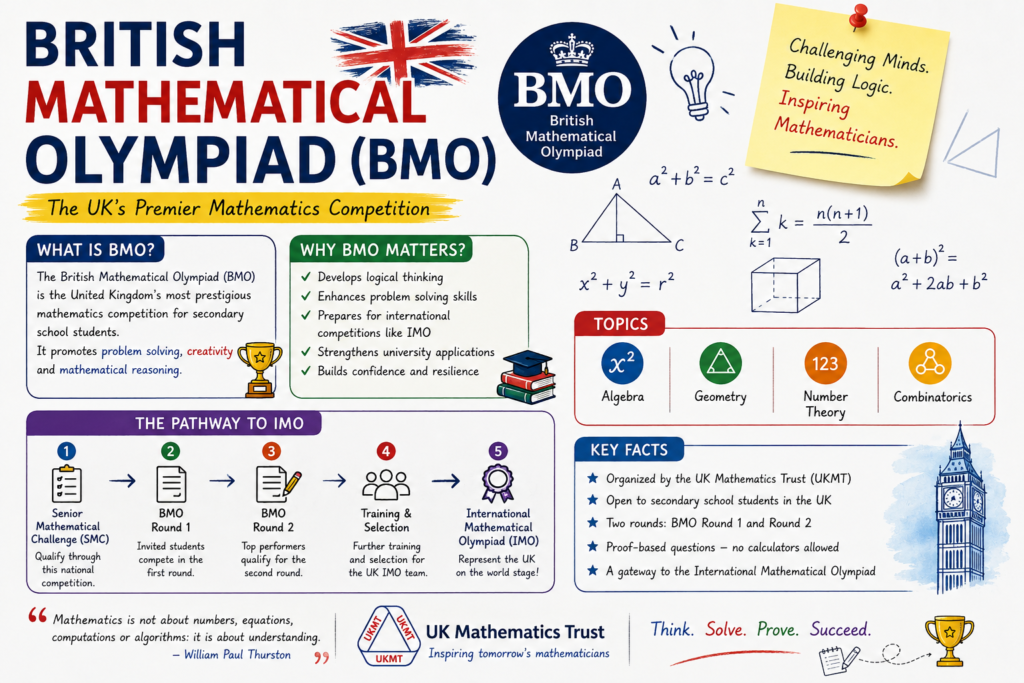
For students who enjoy solving challenging mathematical problems, the British Mathematical Olympiad (BMO) is one of the most respected competitions in the world. Organized in the United Kingdom, the BMO is much more than a school mathematics contest—it is the country’s highest-level mathematical Olympiad for secondary school students and an important step toward representing the UK at the International Mathematical Olympiad (IMO).
Unlike classroom examinations, the BMO is designed to test creativity rather than memorization. Contestants are expected to solve unfamiliar problems, discover original ideas, and write complete mathematical proofs. Every problem encourages students to think deeply and approach mathematics from different perspectives.
For decades, the British Mathematical Olympiad has helped identify some of the United Kingdom’s most talented young mathematicians. Many former participants have gone on to study at leading universities such as the University of Cambridge, the University of Oxford, Imperial College London, and other world-renowned institutions. Some have become university professors, researchers, software engineers, and scientists who continue to contribute to mathematics and technology.
Whether you are a student hoping to qualify, a parent looking for guidance, or a teacher preparing future Olympians, this guide explains everything you need to know about the British Mathematical Olympiad.
What is the British Mathematical Olympiad?
The British Mathematical Olympiad (BMO) is the United Kingdom’s premier proof-based mathematics competition for secondary school students. It is organized by the UK Mathematics Trust (UKMT) with support from leading universities and experienced mathematicians.
The competition aims to identify students with exceptional mathematical ability and provide a pathway to higher-level Olympiad training. Outstanding performers may be invited to national training camps and eventually compete for a place on the United Kingdom’s team for the International Mathematical Olympiad.
Unlike multiple-choice competitions, the BMO requires students to explain their reasoning carefully. Every solution must include a logical proof, making the competition an excellent introduction to advanced mathematical thinking.
A Brief History
The British Mathematical Olympiad has been an important part of mathematics education in the United Kingdom for many years.
It was established to encourage talented students to explore mathematics beyond the school curriculum and to prepare them for international competitions. Over time, the Olympiad has earned a reputation for producing elegant, challenging problems that require creativity and clear reasoning.
The competition has also played a major role in selecting students for the United Kingdom’s IMO team. Many former BMO participants have represented the UK internationally and later built successful careers in mathematics, engineering, computer science, finance, and scientific research.
Today, thousands of students begin their Olympiad journey through UKMT competitions, with the BMO serving as the highest national proof-based contest.
Who Organizes the BMO?
The British Mathematical Olympiad is organized by the UK Mathematics Trust (UKMT).
The UKMT is a charitable organization dedicated to promoting the enjoyment of mathematics among young people. Every year, it organizes a wide range of mathematics competitions for students of different age groups, from primary school through secondary education.
The UKMT works closely with universities, teachers, and former Olympiad participants to develop high-quality mathematical problems and provide enrichment opportunities for talented students.
Because of its long history and commitment to mathematical education, the UKMT is widely respected throughout the international Olympiad community.
Why is the British Mathematical Olympiad Important?
The British Mathematical Olympiad is considered one of the strongest national Olympiads in Europe.
The competition encourages students to think independently rather than follow memorized procedures. Many problems have multiple approaches, rewarding creativity and elegant reasoning instead of lengthy calculations.
Performing well in the BMO demonstrates exceptional mathematical ability and can strengthen university applications, particularly for students interested in mathematics, engineering, physics, computer science, or related fields.
The BMO also provides valuable experience for students preparing for international competitions, especially the International Mathematical Olympiad.
Who Can Participate?
The British Mathematical Olympiad is intended for secondary school students studying in the United Kingdom and certain eligible British schools overseas.
Students normally qualify for the BMO through the UKMT Senior Mathematical Challenge (SMC).
The highest-scoring students in the Senior Mathematical Challenge receive invitations to participate in the British Mathematical Olympiad.
Exact eligibility rules and qualification thresholds may vary slightly from year to year, so students should always check the latest information published by the UK Mathematics Trust.
How Do Students Qualify?
The qualification pathway for the British Mathematical Olympiad is straightforward but highly competitive.
Most students begin by taking the Senior Mathematical Challenge (SMC).
Students who achieve outstanding scores receive invitations to British Mathematical Olympiad Round 1 (BMO1).
The highest performers in BMO1 qualify for British Mathematical Olympiad Round 2 (BMO2).
After additional training and selection activities, a small group of students is chosen to represent the United Kingdom at the International Mathematical Olympiad (IMO).
The pathway can be summarized as follows:
Senior Mathematical Challenge → BMO Round 1 → BMO Round 2 → National Training → IMO Team Selection
Each stage becomes significantly more challenging, requiring stronger proof-writing skills and deeper mathematical understanding.
Registration Process
Students do not usually register directly for the British Mathematical Olympiad.
Registration begins through schools participating in the UK Mathematics Trust competitions. Schools register students for the Senior Mathematical Challenge, and qualifying students are then invited to participate in the later Olympiad rounds.
Students who are educated outside traditional schools should consult the UK Mathematics Trust for information about participation through approved centres or alternative arrangements.
Registration dates are announced annually, and schools are encouraged to complete entries before the official deadlines.
Exam Format
The British Mathematical Olympiad is very different from standard school mathematics examinations.
Questions require complete written proofs rather than multiple-choice answers.
BMO Round 1
The first round usually contains several proof-based questions covering different areas of Olympiad mathematics. Students are expected to explain their reasoning clearly and present complete mathematical arguments.
BMO Round 2
The second round is considerably more difficult and is intended for the strongest students in the country. Problems require originality, advanced techniques, and elegant proofs similar in style to International Mathematical Olympiad questions.
Marks are awarded for mathematical reasoning, logical presentation, and correctness. Partial credit is often given for important ideas even if the complete solution is not reached.
BMO Syllabus
The British Mathematical Olympiad does not follow a fixed textbook syllabus.
Instead, questions are drawn from the four classical areas of Olympiad mathematics.
Algebra
Students should be comfortable with inequalities, sequences, functional equations, algebraic identities, recurrence relations, and polynomial problems.
Geometry
Topics include Euclidean geometry, circles, cyclic quadrilaterals, similar triangles, angle chasing, homothety, inversion, Ceva’s Theorem, Menelaus’ Theorem, and geometric transformations.
Number Theory
Important topics include divisibility, modular arithmetic, prime numbers, Diophantine equations, greatest common divisors, Euler’s Theorem, congruences, and mathematical induction.
Combinatorics
Students should understand counting techniques, graph theory, invariants, extremal principles, recursion, constructive proofs, and the pigeonhole principle.
Many BMO problems combine ideas from multiple topics, making creativity more important than memorizing formulas.
How Difficult is the British Mathematical Olympiad?
The British Mathematical Olympiad is widely regarded as one of the most challenging school mathematics competitions in the United Kingdom.
Even students who achieve excellent grades in school mathematics often find the Olympiad difficult because the problems require original thinking rather than routine methods.
Contestants frequently spend a long time exploring different ideas before discovering the key observation needed to complete a proof. Success depends on patience, creativity, and the ability to communicate mathematical reasoning clearly.
Preparing for the BMO is therefore not just about learning more mathematics—it is about learning how mathematicians think.
British Mathematical Olympiad (BMO): The Complete Guide for Students, Parents, and Teachers
How to Prepare for the British Mathematical Olympiad
Preparing for the British Mathematical Olympiad requires a different mindset from preparing for school examinations. The competition is designed to reward logical thinking, creativity, and clear mathematical reasoning rather than speed or memorization.
The first step is to develop a solid understanding of the four main Olympiad subjects: algebra, geometry, number theory, and combinatorics. Students should focus on understanding concepts deeply instead of memorizing formulas. Most BMO problems require combining ideas from different areas of mathematics, so building a broad foundation is essential.
Regular problem-solving is the most important part of preparation. Solving one difficult problem every day is usually more beneficial than completing many routine exercises. Students should spend time exploring different approaches before looking at official solutions. Even unsuccessful attempts help develop mathematical intuition and improve problem-solving skills.
Writing complete proofs is equally important. Every solution should explain each step logically and clearly. Good presentation often makes the difference between partial marks and full marks in proof-based competitions.
Studying previous British Mathematical Olympiad papers is another excellent way to prepare. By analyzing official solutions, students learn elegant techniques and understand how experienced mathematicians communicate their ideas.
A One-Year Preparation Plan
Students who aim to qualify for the British Mathematical Olympiad should prepare consistently throughout the year.
During the first three months, strengthen your knowledge of algebra, geometry, number theory, and combinatorics. Focus on learning standard Olympiad techniques and solving introductory proof-based problems.
In the next three months, begin working through previous Senior Mathematical Challenge papers and easier BMO Round 1 problems. This stage helps students become familiar with the style of British Olympiad questions.
During the following three months, solve previous BMO Round 1 and Round 2 papers under timed conditions. Compare your solutions with official marking schemes and improve your proof-writing skills.
The final three months should be devoted to mock examinations. Attempt complete papers within the official time limit and carefully review every solution afterward. This develops mathematical confidence, improves time management, and prepares students for the actual competition.
Best Books for BMO Preparation
A carefully chosen collection of books can greatly improve Olympiad preparation.
One of the most highly recommended resources is Problem-Solving Strategies by Arthur Engel, which introduces a wide range of Olympiad techniques through carefully explained examples.
The Art and Craft of Problem Solving by Paul Zeitz helps students develop creative mathematical thinking and is considered essential reading for advanced Olympiad preparation.
The IMO Compendium contains hundreds of International Mathematical Olympiad problems with detailed solutions and provides excellent practice for students preparing for higher-level competitions.
For geometry, Geometry Revisited by Coxeter and Greitzer remains one of the finest classical references.
Students interested in number theory should study 104 Number Theory Problems by Titu Andreescu.
In addition to books, solving previous BMO, IMO, USAMO, INMO, and APMO papers is one of the most effective ways to improve problem-solving ability.
From the BMO to the International Mathematical Olympiad
The British Mathematical Olympiad is one of the main pathways through which students qualify for the United Kingdom’s International Mathematical Olympiad team.
Students who perform exceptionally well in BMO Round 1 are invited to compete in BMO Round 2. The strongest contestants may then participate in advanced training camps and selection activities organized by the UK Mathematics Trust.
During these training programs, students solve challenging problems, attend lectures by experienced coaches, and practice proof-writing at an international level.
Following the selection process, the six highest-performing students are chosen to represent the United Kingdom at the International Mathematical Olympiad.
Representing the UK at the IMO is considered one of the highest academic achievements for a secondary school student.
Benefits of Participating in the BMO
The British Mathematical Olympiad offers far more than certificates and awards.
Students develop logical thinking, creativity, persistence, and excellent problem-solving skills. These abilities remain valuable throughout university studies and professional careers.
Strong performance in the BMO can strengthen applications to leading universities, particularly for courses in mathematics, engineering, computer science, economics, and physics.
Many former Olympiad participants have continued their studies at prestigious institutions such as the University of Cambridge, the University of Oxford, Imperial College London, and other internationally recognized universities.
Beyond academics, the competition encourages curiosity, resilience, and a genuine appreciation for mathematics.
British Mathematical Olympiad vs International Mathematical Olympiad
Although the two competitions are closely connected, they serve different purposes.
The British Mathematical Olympiad is the United Kingdom’s national proof-based mathematics competition for secondary school students.
The International Mathematical Olympiad (IMO) is the world’s premier mathematics competition for high school students, bringing together national teams from more than one hundred countries.
The BMO identifies talented students within the UK and helps prepare them for international competition. Students who perform exceptionally well in the BMO may eventually earn a place on the UK’s IMO team after additional training and selection.
Both competitions require creative thinking, elegant proofs, and deep mathematical understanding rather than routine calculations.
Frequently Asked Questions
Can students register directly for the British Mathematical Olympiad?
Most students qualify through the UK Mathematics Trust Senior Mathematical Challenge. Registration is usually completed by schools participating in UKMT competitions.
Is there an official syllabus?
No. The BMO follows the traditional Olympiad curriculum, covering algebra, geometry, number theory, and combinatorics.
Are calculators allowed?
No. Calculators and electronic devices are not permitted during the examination.
How many rounds are there?
The British Mathematical Olympiad consists of Round 1 and Round 2, with the Senior Mathematical Challenge serving as the primary qualification route.
Is the BMO difficult?
Yes. It is one of the most challenging school mathematics competitions in the United Kingdom and requires originality, proof-writing skills, and creative problem-solving.
Official Registration and Information
Students should note that there is no separate public registration for the British Mathematical Olympiad.
Participation begins through the UK Mathematics Trust Senior Mathematical Challenge, which is organized each year by schools registered with the UKMT.
The latest information regarding eligibility, competition dates, registration, past papers, marking schemes, and official announcements is available on the UK Mathematics Trust website.
Students interested in representing the United Kingdom at the International Mathematical Olympiad should regularly check official UKMT announcements for updated selection procedures.
The British Mathematical Olympiad is much more than a mathematics competition. It is an opportunity for students to develop creativity, confidence, and advanced problem-solving skills that remain valuable throughout life.
Preparing for the BMO teaches students to think independently, communicate mathematical ideas clearly, and enjoy the challenge of solving unfamiliar problems. Whether your goal is to qualify for the International Mathematical Olympiad or simply become a stronger mathematician, the habits developed through Olympiad preparation will benefit you far beyond the competition itself.
Every successful Olympian began with curiosity and consistent practice. With patience, determination, and regular problem-solving, any motivated student can steadily improve and enjoy the rewarding journey of mathematical discovery.