
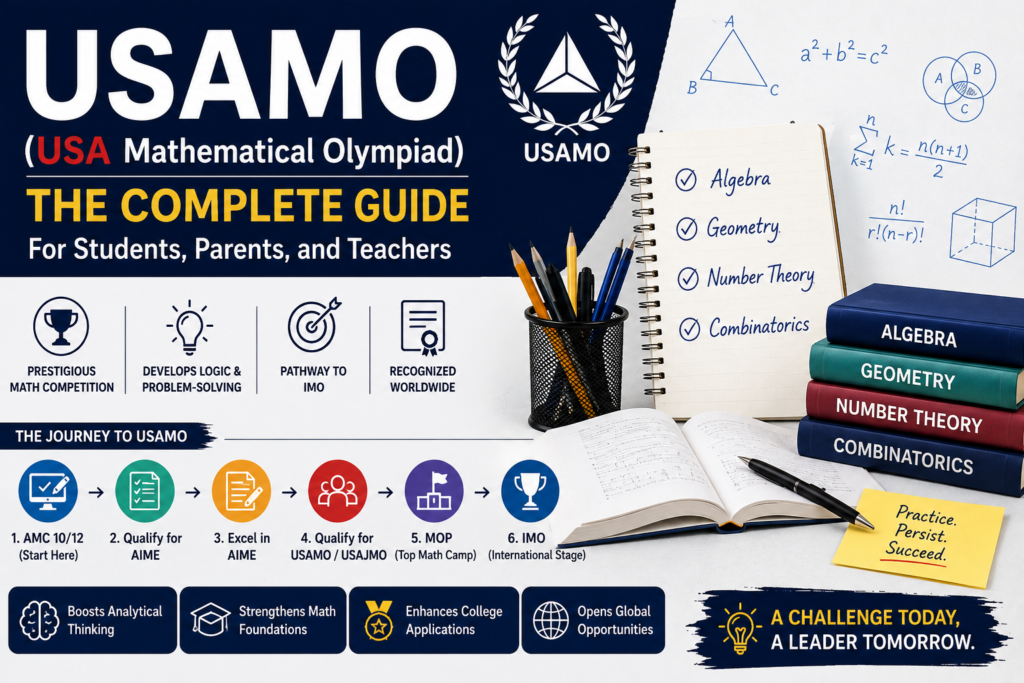
USAMO (USA Mathematical Olympiad): The Complete Guide for Students, Parents, and Teachers
If you dream of representing the United States at the International Mathematical Olympiad (IMO), then the USA Mathematical Olympiad (USAMO) is one of the most important milestones on that journey. Every year, thousands of talented students participate in the American Mathematics Competitions (AMC) and the American Invitational Mathematics Examination (AIME), but only a small group earns the opportunity to compete in the USAMO. It is widely regarded as one of the most challenging high school mathematics contests in the world, testing not only technical knowledge but also creativity, logical reasoning, and proof-writing skills.
Unlike school mathematics exams, the USAMO is not about applying memorized formulas. Success requires discovering elegant ideas, constructing rigorous proofs, and communicating mathematical arguments clearly. Many former USAMO participants have gone on to study at leading universities such as MIT, Harvard, Princeton, Stanford, and Caltech, while others have represented the United States at the International Mathematical Olympiad.
What is the USAMO?
The USA Mathematical Olympiad (USAMO) is the premier proof-based mathematics competition for high school students in the United States. It is organized through the Mathematical Association of America (MAA) as part of the American Mathematics Competitions program.
The competition serves as the primary selection stage for identifying students who may eventually represent the United States at the International Mathematical Olympiad (IMO). Reaching the USAMO is considered a remarkable achievement because only a very small percentage of AMC participants qualify each year.
Unlike multiple-choice contests, the USAMO requires students to write complete mathematical proofs. Every statement must be logically justified, and partial credit is awarded based on the quality and correctness of the proof.
A Brief History of USAMO
The USA Mathematical Olympiad was first held in 1972. It was created to identify students with exceptional mathematical talent who could compete successfully on the international stage.
Over the past five decades, the competition has become one of the most respected national mathematics olympiads. Many former participants have become university professors, research mathematicians, engineers, computer scientists, entrepreneurs, and leaders in technology companies.
The style of problems has also evolved over the years. Earlier contests often emphasized classical Euclidean geometry and algebraic manipulation, while modern USAMO problems place greater emphasis on originality, elegant proofs, and deep mathematical insight.
Today, past USAMO problems are studied by students across the world because they provide outstanding examples of creative mathematical thinking.
How Does a Student Qualify for the USAMO?
Qualification follows several stages.
Most students begin by taking either the AMC 10 or the AMC 12, depending on their grade level and age. Students with sufficiently high scores qualify for the American Invitational Mathematics Examination (AIME).
Performance on both the AMC and the AIME is combined to produce an index score. Students with the highest index scores are invited to participate in either the USAMO or the USA Junior Mathematical Olympiad (USAJMO), depending on their eligibility.
Because qualification depends on national performance each year, the exact cutoff score changes annually.
Although hundreds of thousands of students participate in the AMC contests, only a few hundred eventually qualify for the USAMO, making it one of the most selective mathematics competitions in North America.
USAMO Exam Format
The USAMO is very different from standard mathematics examinations.
The contest is conducted over two days, with three problems given each day. Students receive 4½ hours to solve the three problems on each day.
This means the entire examination consists of six proof-based problems.
Each problem is worth 7 points, giving a total possible score of 42 points.
Unlike objective examinations, there are no answer choices. Students must write complete mathematical arguments explaining every important step. Even if the final answer is correct, insufficient justification may result in significant loss of marks.
Similarly, a partially correct proof may receive valuable partial credit if the reasoning is mathematically sound.
What Topics Are Included in the USAMO Syllabus?
One of the most interesting features of the USAMO is that there is no official syllabus. Instead, problems are drawn from classical olympiad mathematics.
The four major areas are:
Algebra
Students should be comfortable with inequalities, functional equations, polynomials, sequences, recursions, identities, factorization, symmetric expressions, and algebraic transformations. Strong algebraic intuition is often more important than complicated calculations.
Geometry
Geometry problems frequently involve Euclidean constructions, cyclic quadrilaterals, angle chasing, similar triangles, homothety, power of a point, radical axis, Ceva’s Theorem, Menelaus’ Theorem, inversion, and advanced synthetic geometry.
Many geometry problems require a clever observation before any calculations begin.
Number Theory
Students should understand divisibility, modular arithmetic, prime numbers, greatest common divisors, Diophantine equations, Euler’s Totient Function, quadratic residues, congruences, and mathematical induction.
Number theory questions often appear simple at first glance but usually require deep reasoning.
Combinatorics
Topics include graph theory, counting techniques, invariants, extremal principles, coloring arguments, recursion, pigeonhole principle, probabilistic ideas, and combinatorial constructions.
Combinatorics rewards creativity more than memorization.
How Difficult Is the USAMO?
The USAMO is considered one of the most difficult mathematics competitions for high school students.
The challenge comes not from lengthy calculations but from discovering ideas that are not immediately obvious. A single elegant observation can solve an entire problem, while hours of routine computation may lead nowhere.
Many students who perform exceptionally well in school mathematics initially struggle with olympiad problems because proof writing demands a completely different way of thinking. Instead of asking “Which formula should I use?”, students must ask “Why must this statement always be true?”
Even experienced contestants often solve only a few problems completely during the examination. Scoring well therefore depends on writing rigorous proofs, presenting ideas clearly, and earning partial credit whenever possible.
The best preparation is to solve a large collection of past USAMO, IMO, and national olympiad problems while carefully studying official solutions. Over time, students begin to recognize common techniques, develop stronger intuition, and gain confidence in constructing elegant mathematical proofs.
USAMO (USA Mathematical Olympiad): The Complete Guide for Students, Parents, and Teachers
How to Prepare for the USAMO
Preparing for the USAMO is very different from preparing for school exams. Memorizing formulas or practicing routine exercises is not enough. Success comes from developing problem-solving skills, mathematical intuition, and the ability to write clear, rigorous proofs. Most successful contestants spend several years building these skills gradually.
A good preparation plan begins with strengthening your foundation in algebra, geometry, number theory, and combinatorics. These four subjects form the backbone of almost every USAMO problem. Before attempting advanced olympiad questions, make sure you are comfortable with the core concepts from each topic.
The next step is to solve problems regularly. Instead of trying dozens of questions in one sitting, focus on one or two challenging problems each day. Spend enough time exploring different ideas before looking at the official solution. Even if you cannot solve a problem completely, understanding why a particular solution works is an important part of the learning process.
Writing proofs should become a daily habit. After solving a problem, rewrite your argument neatly as if you were submitting it in the actual competition. A correct idea presented poorly may lose valuable marks. Clear mathematical writing is just as important as finding the solution itself.
A One-Year Study Plan
Students who are serious about qualifying for the USAMO should follow a structured study schedule.
During the first three months, concentrate on building strong fundamentals. Study classical olympiad techniques in algebra, geometry, number theory, and combinatorics while solving easier AMC and AIME problems.
Over the next three months, begin working on intermediate olympiad problems from national competitions such as the USAJMO, the British Mathematical Olympiad (BMO), the Canadian Mathematical Olympiad (CMO), and the Asian Pacific Mathematical Olympiad (APMO). These contests introduce many of the ideas that later appear in the USAMO.
The following three months should be devoted primarily to past USAMO and IMO problems. Try solving each problem under timed conditions before reading any solution. Once finished, compare your proof with the official one and identify areas where your reasoning or presentation can be improved.
In the final three months before the competition, simulate complete examinations. Set aside two consecutive days and solve three problems in four and a half hours each day, exactly as in the actual contest. This practice develops both mathematical stamina and effective time management.
Best Books for USAMO Preparation
Choosing the right resources can make preparation much more efficient. A few books have become classics among olympiad students.
- The Art and Craft of Problem Solving by Paul Zeitz introduces many important problem-solving techniques and is an excellent starting point.
- Problem-Solving Strategies by Arthur Engel contains hundreds of olympiad-level problems with detailed solutions and is considered one of the finest books for serious students.
- 104 Number Theory Problems by Titu Andreescu is highly recommended for strengthening number theory.
- Geometry Revisited by Coxeter and Greitzer remains one of the best introductions to classical Euclidean geometry.
- The IMO Compendium is an outstanding collection of International Mathematical Olympiad problems and official solutions from many years.
Along with these books, students should regularly solve past USAMO, USAJMO, AIME, and IMO papers. There is no substitute for working through original competition problems.
Common Mistakes Students Make
Many talented students fail to reach their potential because they prepare in the wrong way.
One common mistake is spending too much time reading solutions instead of solving problems independently. Struggling with a difficult problem is often where the most valuable learning takes place.
Another mistake is neglecting proof writing. Finding the correct idea is only part of the challenge. In the USAMO, every important step must be justified logically. A beautifully written proof is often the difference between a full score and only partial credit.
Some students also focus almost entirely on algebra while ignoring geometry or combinatorics. Since the USAMO draws problems from all major olympiad topics, balanced preparation is essential.
Finally, many students become discouraged after failing to solve difficult problems. Even experienced contestants regularly encounter questions that they cannot solve immediately. Persistence and patience are among the most important qualities of a successful olympiad student.
Benefits of Qualifying for the USAMO
Qualifying for the USAMO is an achievement that is respected by universities, educators, and mathematicians around the world.
Students who perform well often become candidates for the Mathematical Olympiad Program (MOP), where the United States selects its team for the International Mathematical Olympiad.
Beyond competitions, the skills developed through olympiad mathematics have lasting value. Students learn logical reasoning, creative thinking, careful analysis, and precise communication. These abilities are useful not only in mathematics but also in computer science, engineering, economics, physics, and many other fields.
Many former USAMO participants have gone on to study at prestigious universities such as MIT, Harvard, Princeton, Stanford, Carnegie Mellon, and Caltech. Others have built successful careers in research, technology, finance, artificial intelligence, and entrepreneurship.
USAMO vs IMO
The USAMO is a national olympiad, while the International Mathematical Olympiad (IMO) is the world’s most prestigious mathematics competition for high school students.
Students do not qualify directly for the IMO. Instead, they must first perform exceptionally well in the AMC and AIME, qualify for the USAMO, attend the Mathematical Olympiad Program, and then earn a place on the six-member United States IMO team.
Although both competitions emphasize proof-based mathematics, IMO problems are generally even more demanding and require greater originality and deeper mathematical insight.
Frequently Asked Questions
Who can participate in the USAMO?
Students who qualify through the AMC and AIME selection process and satisfy the eligibility requirements announced by the Mathematical Association of America.
How many problems are on the USAMO?
The examination contains six proof-based problems, with three problems solved each day over two days.
Is there any official syllabus?
No. The competition covers classical olympiad mathematics, mainly algebra, geometry, number theory, and combinatorics.
How long should students prepare?
Most successful participants spend several years building their problem-solving skills. However, even one year of focused preparation can lead to significant improvement.
Are calculators allowed?
No. The competition is entirely proof-based and does not permit calculators or computational software.
The USA Mathematical Olympiad is far more than a mathematics competition. It is a celebration of creativity, logical reasoning, and elegant problem solving. Reaching the USAMO requires dedication, patience, and years of consistent practice, but the journey itself helps students develop habits that remain valuable throughout their academic and professional lives.
Whether your goal is to qualify for the USAMO, represent the United States at the International Mathematical Olympiad, or simply become a stronger mathematical thinker, the key is to practice regularly, learn from every problem you solve, and never be discouraged by difficult challenges. Every great olympiad student began by solving one problem at a time, and with persistence, today’s practice can become tomorrow’s success.