

All-Russian Mathematical Olympiad: The Complete Guide for Students, Parents, and Teachers
When people discuss the world’s strongest mathematics Olympiad programs, one country is mentioned almost every time—Russia. For decades, Russian students have consistently produced outstanding results at the International Mathematical Olympiad (IMO), winning numerous gold medals and earning a reputation for exceptional mathematical creativity. Behind this success is a long tradition of mathematical education and one of the most challenging school competitions in the world: the All-Russian Mathematical Olympiad.
Known in Russian as the All-Russian Olympiad for School Students in Mathematics (Vserossiyskaya Olimpiada Shkolnikov – VSOSH), this competition is considered the highest national mathematics Olympiad for school students in Russia. Every year, hundreds of thousands of students begin the competition at the school level, but only a small number reach the final stage. Many of Russia’s future IMO team members, university professors, researchers, and scientists first demonstrated their talent through this prestigious Olympiad.
Unlike ordinary school examinations, the All-Russian Mathematical Olympiad emphasizes deep mathematical thinking rather than routine calculations. Students are expected to discover original ideas, construct rigorous proofs, and communicate their reasoning clearly. This philosophy has made the Russian Olympiad system one of the most respected mathematics training programs in the world.
What is the All-Russian Mathematical Olympiad?
The All-Russian Mathematical Olympiad is Russia’s official national mathematics competition for school students. It forms part of the All-Russian Olympiad for School Students, a nationwide academic competition organized across multiple subjects.
The mathematics Olympiad is designed to identify talented students with exceptional problem-solving ability and prepare them for higher-level mathematical study. Success in this competition is highly respected throughout Russia and often opens opportunities for admission to leading universities, advanced mathematical training programs, and participation in international competitions.
For many students, qualifying for the final stage is considered one of the greatest academic achievements during their school years.
A Brief History
Russia has one of the oldest and richest Olympiad traditions in the world. Mathematical competitions were organized in the Soviet Union long before the International Mathematical Olympiad was established.
During the twentieth century, Soviet mathematicians developed a unique educational philosophy that encouraged students to explore ideas independently instead of simply memorizing formulas. Mathematical circles, specialized schools, university outreach programs, and problem-solving seminars became an important part of mathematical education.
After the formation of the Russian Federation, this tradition continued through the All-Russian Olympiad for School Students. The competition has remained one of the country’s most prestigious academic events and continues to produce students who perform exceptionally well in international Olympiads.
Many famous mathematicians, university professors, and former IMO medalists began their academic journey through this competition.
Why Is the Russian Olympiad So Highly Respected?
One reason the All-Russian Mathematical Olympiad is admired worldwide is the style of its problems.
Rather than testing speed or memorization, the competition rewards creativity and elegant reasoning. Students are encouraged to search for original ideas instead of applying standard techniques. A successful solution often depends on discovering one key observation rather than performing lengthy calculations.
Russia also has a remarkable culture of mathematical education. Many students attend mathematical circles, participate in weekend seminars, and solve challenging problems from an early age. Experienced coaches, former Olympiad winners, and university mathematicians work closely with talented students, helping them develop proof-writing skills and mathematical intuition.
This long-term approach has allowed Russia to remain one of the strongest countries in international mathematics competitions for many decades.
Competition Structure
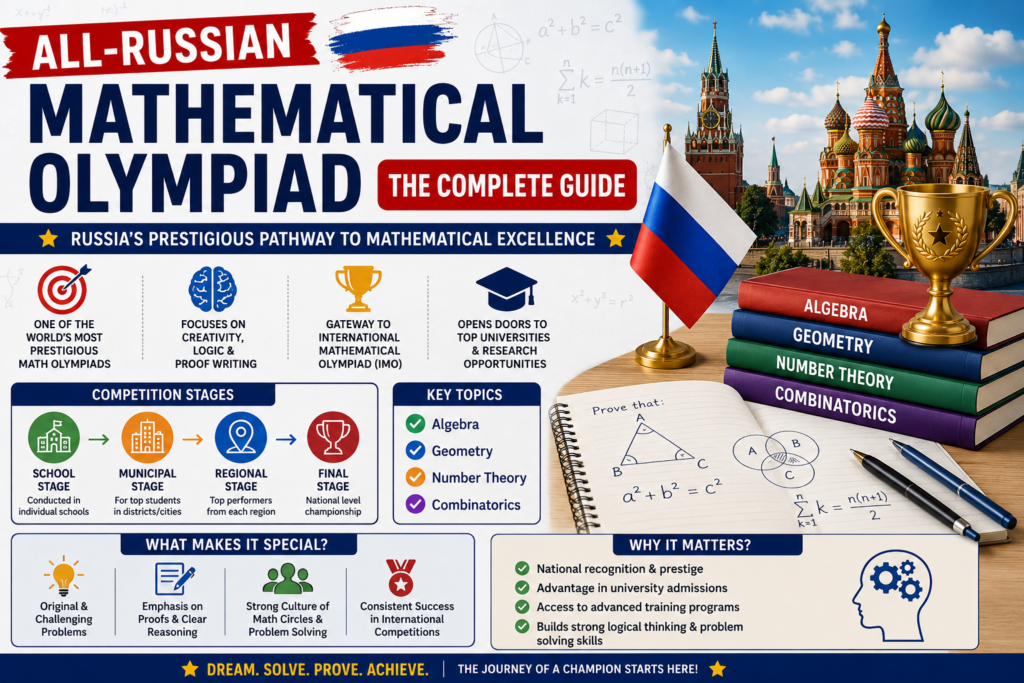
The All-Russian Mathematical Olympiad is conducted through several stages, allowing students from across the country to participate.
The journey usually begins at the school stage, where students compete within their own schools.
Successful participants advance to the municipal stage, where students compete against others from their district or city.
Top performers then qualify for the regional stage, which brings together some of the strongest students from each region of Russia.
The highest-performing students are invited to the final stage, the national championship of the All-Russian Mathematical Olympiad.
Each stage becomes significantly more difficult, and only the best students continue to the next round.
Who Can Participate?
The Olympiad is open to school students studying in Russia.
Students generally participate according to their grade level, although exceptionally talented younger students may sometimes compete at a higher level depending on the official competition rules.
Since eligibility requirements and participation procedures may change slightly from year to year, students should always check the latest official regulations published by the organizers.
Registration Process
One of the advantages of the All-Russian Mathematical Olympiad is that students do not usually need to complete a complicated national registration process.
Participation normally begins through schools. Educational institutions register interested students for the school stage according to the schedule announced by regional education authorities.
Students who qualify at each stage are automatically invited to participate in the next level of the competition.
Because the registration process is coordinated through schools and regional education departments, students should contact their mathematics teacher or school administration if they wish to participate.
Exam Format
The exact format varies slightly depending on the competition stage and grade level, but the general structure remains similar.
Students are presented with a small number of challenging proof-based problems and are given several hours to solve them.
Unlike multiple-choice examinations, every solution must include complete mathematical reasoning. Simply writing the final answer is not enough. Students are expected to justify each important step logically and present their ideas in a clear, organized manner.
Partial credit is awarded for correct mathematical arguments even if the complete solution is not finished.
This emphasis on proof writing makes the competition an excellent preparation for higher-level Olympiads such as the International Mathematical Olympiad.
Syllabus
Like many leading international Olympiads, the All-Russian Mathematical Olympiad does not publish a fixed chapter-by-chapter syllabus.
Instead, questions are drawn from the four classical areas of Olympiad mathematics.
Algebra
Problems often involve inequalities, polynomials, functional equations, sequences, recurrence relations, symmetric expressions, and algebraic identities. Students are expected to combine multiple ideas creatively rather than rely on routine techniques.
Geometry
Geometry plays an important role in the competition. Topics include Euclidean geometry, circles, cyclic quadrilaterals, similar triangles, power of a point, homothety, inversion, Ceva’s Theorem, Menelaus’ Theorem, and advanced synthetic geometry.
Number Theory
Students should understand divisibility, modular arithmetic, prime numbers, Diophantine equations, greatest common divisors, congruences, Euler’s Totient Function, quadratic residues, and mathematical induction.
Combinatorics
Combinatorics problems frequently involve graph theory, counting methods, invariants, extremal principles, recursion, coloring arguments, constructive algorithms, and the pigeonhole principle.
Most Olympiad problems combine concepts from several mathematical areas, making creativity far more important than memorization.
How Difficult Is the All-Russian Mathematical Olympiad?
The All-Russian Mathematical Olympiad is widely regarded as one of the most challenging national mathematics competitions in the world.
Even students who perform exceptionally well in school mathematics often find the Olympiad difficult because success depends on original thinking rather than standard methods. A single problem may require an hour or more of careful exploration before the key idea becomes clear.
Contestants are expected to write elegant proofs, justify every logical step, and communicate mathematical ideas with precision. These skills take years of consistent practice to develop, which is why Russia places such strong emphasis on mathematical circles, Olympiad training camps, and regular problem-solving sessions.
All-Russian Mathematical Olympiad: The Complete Guide for Students, Parents, and Teachers
How Russia Trains Future Olympiad Champions
One of the biggest reasons behind Russia’s remarkable success in international mathematics competitions is its unique approach to training talented students. Olympiad preparation in Russia is not limited to classroom lessons. Instead, students are encouraged to develop mathematical curiosity from an early age through mathematical circles, problem-solving seminars, specialized schools, and training camps.
Mathematical circles, known as “Math Circles,” have been an important part of Russian education for decades. These are weekly sessions where students discuss interesting mathematical ideas, solve challenging problems, and learn directly from experienced teachers, university professors, and former Olympiad medalists. Rather than focusing on examinations, these circles encourage creativity and independent thinking.
Many talented students also attend specialized mathematics schools where advanced topics are introduced much earlier than in the regular curriculum. This long-term approach helps students develop strong proof-writing skills and mathematical intuition before they begin participating in national competitions.
How to Prepare for the All-Russian Mathematical Olympiad
Preparing for the All-Russian Mathematical Olympiad requires patience, consistency, and a genuine interest in solving difficult problems. Unlike school examinations, success cannot be achieved by memorizing formulas or practicing routine exercises.
The first step is to build a solid foundation in algebra, geometry, number theory, and combinatorics. Students should understand the underlying concepts rather than simply learning standard methods.
The next step is to solve Olympiad problems regularly. Spending time on one challenging problem every day is usually far more effective than solving many easy exercises. Even unsuccessful attempts improve mathematical intuition and help students recognize useful techniques.
Writing complete proofs is equally important. After solving a problem, students should rewrite the solution carefully, making sure every logical step is clearly explained. Developing good mathematical writing habits can make a significant difference during the actual competition.
Finally, students should regularly review previous Olympiad papers. Studying official solutions helps them discover elegant methods and understand how experienced mathematicians present their arguments.
A One-Year Study Plan
Students aiming for the national finals should follow a structured preparation schedule.
During the first three months, concentrate on strengthening basic concepts in algebra, geometry, number theory, and combinatorics. Solve introductory Olympiad problems and become familiar with common proof techniques.
The next three months should focus on intermediate-level problems from Russian regional Olympiads, national Olympiads from other countries, and previous International Mathematical Olympiad questions.
During the following three months, students should begin solving past All-Russian Mathematical Olympiad papers under timed conditions. Every solution should be written neatly and compared with official solutions to identify better approaches.
The final three months should be devoted to mock examinations. Solving complete papers within the official time limit helps improve speed, concentration, and proof-writing skills.
Best Books for Preparation
Students preparing for the All-Russian Mathematical Olympiad often rely on a combination of classical Olympiad books and collections of previous competition problems.
Some of the most highly recommended books include:
- Problem-Solving Strategies by Arthur Engel
- The Art and Craft of Problem Solving by Paul Zeitz
- The IMO Compendium
- Geometry Revisited by Coxeter and Greitzer
- 104 Number Theory Problems by Titu Andreescu
- Collections of past Russian Mathematical Olympiad problems with official solutions
Students should also solve previous International Mathematical Olympiad (IMO), USAMO, Chinese Mathematical Olympiad (CMO), and Balkan Mathematical Olympiad problems to broaden their experience.
Benefits of Qualifying
Qualifying for the final stage of the All-Russian Mathematical Olympiad is considered one of the highest academic achievements for school students in Russia.
Successful participants receive national recognition and may gain significant advantages when applying to leading Russian universities. Many universities value Olympiad achievements because they demonstrate creativity, logical reasoning, and exceptional mathematical ability.
Outstanding students may also be invited to advanced mathematical training programs, research schools, and university seminars. These opportunities allow talented students to interact with professional mathematicians and prepare for international competitions.
The skills developed through Olympiad preparation extend far beyond mathematics. Participants learn how to think logically, solve unfamiliar problems, communicate complex ideas clearly, and approach challenges with patience and confidence. These abilities are highly valuable in engineering, computer science, artificial intelligence, economics, data science, finance, and scientific research.
Russia’s Success at the International Mathematical Olympiad
Russia has consistently ranked among the strongest countries in the history of the International Mathematical Olympiad.
Over the decades, Russian teams have won numerous gold, silver, and bronze medals, producing many world-famous mathematicians and scientists. Their success is widely attributed to a strong mathematical culture, experienced teachers, specialized schools, and continuous Olympiad training from an early age.
Many former Russian Olympiad participants have gone on to become university professors, Fields Medal winners, researchers, software engineers, and leaders in technology companies around the world.
All-Russian Mathematical Olympiad vs International Mathematical Olympiad
Although both competitions focus on proof-based mathematics, they serve different purposes.
The All-Russian Mathematical Olympiad is Russia’s national mathematics competition for school students. It identifies talented young mathematicians from across the country and serves as one of the important pathways for advanced Olympiad training.
The International Mathematical Olympiad (IMO) is the world’s most prestigious mathematics competition for high school students. National Olympiads such as the All-Russian Mathematical Olympiad help identify students who may later represent their countries at the IMO after additional training and selection.
Both competitions emphasize creativity, elegant proofs, and deep mathematical understanding rather than routine calculations.
Frequently Asked Questions
Can international students participate in the All-Russian Mathematical Olympiad?
The competition is primarily intended for students studying within the Russian education system. International participation depends on the official rules announced each year by the organizers.
Is there an official syllabus?
No. Like most major international Olympiads, the competition draws questions from algebra, geometry, number theory, and combinatorics without following a fixed textbook syllabus.
Are calculators allowed?
No. The competition is entirely proof-based, and calculators or electronic devices are generally not permitted.
How many stages are there?
Students normally progress through four stages: School Stage, Municipal Stage, Regional Stage, and Final Stage.
What is the best way to prepare?
The most effective preparation includes solving previous Olympiad problems, studying official solutions, strengthening proof-writing skills, and practicing consistently over several years.
The All-Russian Mathematical Olympiad represents far more than a national competition. It reflects a long-standing tradition of mathematical excellence that has inspired generations of students to explore mathematics with creativity and curiosity.
Whether you hope to participate in national Olympiads, qualify for the International Mathematical Olympiad, or simply become a stronger problem solver, studying the Russian Olympiad system offers valuable lessons. It demonstrates that true mathematical ability is developed through consistent practice, careful reasoning, and a willingness to explore difficult ideas.
Every Olympiad champion begins with simple questions, learns from mistakes, and gradually develops the confidence to tackle increasingly challenging problems. With dedication, patience, and regular practice, every student can improve their mathematical thinking and enjoy the rewarding journey of Olympiad mathematics.
Search Also
Indian National Mathematical Olympiad (INMO)
USA Mathematical Olympiad (USAMO)
Asian Pacific Mathematical Olympiad (APMO)