

International Mathematical Olympiad (IMO 2025)
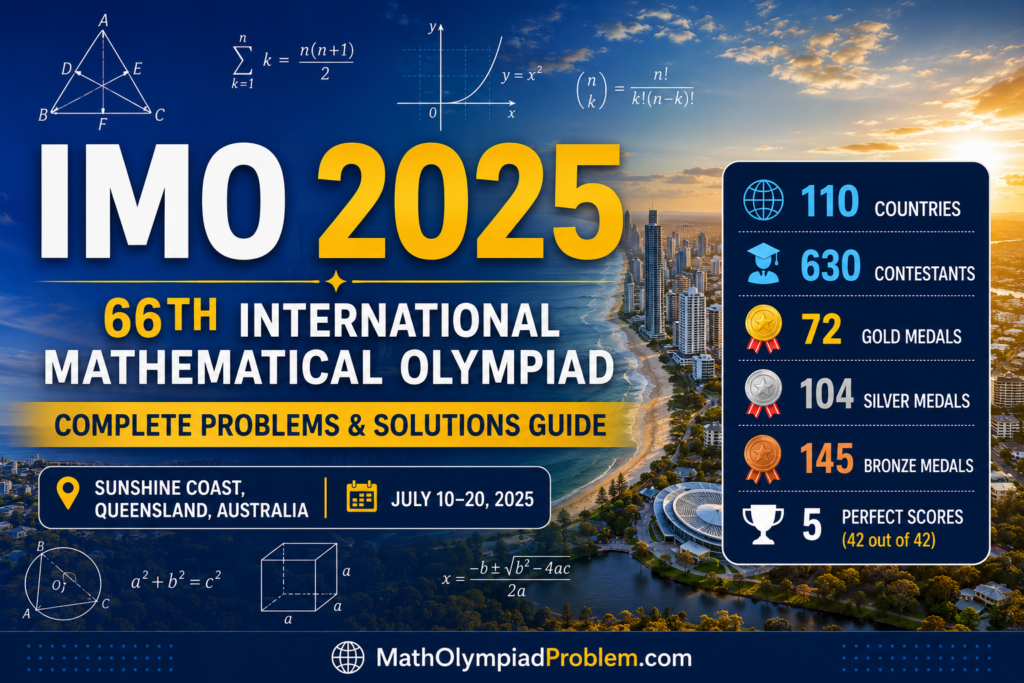
The 66th International Mathematical Olympiad (IMO 2025) was one of the most anticipated mathematics competitions in recent years. Hosted on the beautiful Sunshine Coast, Queensland, Australia, from 10 July to 20 July 2025, the event brought together hundreds of exceptionally talented young mathematicians from around the world. For ten unforgettable days, students competed in one of the toughest mathematical examinations ever designed while also celebrating the spirit of international friendship, cultural exchange, and a shared passion for problem solving. The International Mathematical Olympiad has always been much more than a competition, and the 2025 edition once again proved why it remains the most respected mathematics contest for high school students worldwide.
Every year, earning a place at the IMO represents the culmination of years of hard work. Contestants first qualify through demanding national mathematics Olympiads before being selected to represent their countries on the international stage. By the time they arrive at the IMO, every student has already demonstrated exceptional mathematical ability. Competing against the world’s best problem solvers requires not only technical knowledge but also creativity, perseverance, and the ability to construct elegant mathematical proofs under strict time limits.
Australia became only the second country in the Southern Hemisphere to host the International Mathematical Olympiad, and the organizers delivered an outstanding event. The Sunshine Coast, famous for its spectacular beaches, modern facilities, and welcoming atmosphere, provided an ideal setting for one of the world’s most prestigious academic competitions. Alongside the examinations, participants enjoyed cultural activities, sightseeing programs, and opportunities to meet students from more than one hundred different countries. These experiences continue to make the IMO unique because it encourages lifelong friendships while promoting mathematical excellence across international borders.
The official statistics reflect the impressive scale of the competition. A total of 110 countries participated in IMO 2025, with 630 contestants, including 69 female participants. Every contestant attempted six proof-based problems over two examination days, with each problem carrying a maximum of seven marks, giving a total possible score of 42 points. At the end of the competition, 72 Gold Medals, 104 Silver Medals, 145 Bronze Medals, and 132 Honourable Mentions were awarded. Remarkably, five contestants achieved the perfect score of 42 points, an extraordinary accomplishment considering the difficulty of the examination.
One reason the International Mathematical Olympiad continues to inspire students around the world is its philosophy. Unlike many examinations that reward memorization, the IMO encourages original thinking. Contestants are expected to solve unfamiliar problems using logical reasoning, creativity, and beautifully written mathematical proofs. Success depends on discovering new ideas rather than recalling standard formulas. This approach has made the IMO the ultimate benchmark for young mathematicians and a source of inspiration for mathematics teachers, researchers, and Olympiad trainers worldwide.
The IMO 2025 paper maintained this tradition perfectly. The six problems covered the four classical Olympiad disciplines—Algebra, Number Theory, Geometry, and Combinatorics—and presented contestants with a balanced mix of accessible and highly challenging questions. The first problem allowed many students to gain confidence early in the competition, while the later problems demanded deep insight and exceptional mathematical maturity. The careful progression of difficulty ensured that every contestant could demonstrate their abilities while still distinguishing the world’s strongest problem solvers.
Beyond medals and rankings, IMO 2025 highlighted the global importance of mathematics. Students who had spent years preparing in classrooms, mathematics circles, online communities, and national training camps finally had the opportunity to meet peers who shared the same enthusiasm for problem solving. Many participants formed friendships that will last throughout their academic and professional careers. This unique combination of competition and collaboration is one of the reasons why the International Mathematical Olympiad remains one of the world’s most respected educational events.
For teachers, parents, and students preparing for future Olympiads, IMO 2025 offers an invaluable learning opportunity. Studying the official problems and solutions helps students understand how world-class mathematicians approach unfamiliar challenges. Every problem demonstrates that success comes from patience, creativity, logical thinking, and precise mathematical communication rather than routine calculations. Whether you are preparing for national Olympiads, regional contests, or future International Mathematical Olympiads, the 2025 paper provides an outstanding collection of problems that will continue to inspire learners for many years.
The first examination day at IMO 2025 set the tone for the entire competition. As is traditional at the International Mathematical Olympiad, contestants were given 4 hours and 30 minutes to solve three proof-based problems. Although every participant had already excelled in their national Olympiads, the opening day reminded everyone that the IMO is a completely different challenge. Every statement had to be proved with complete mathematical rigor, and even small gaps in logic could cost valuable marks.
One of the most interesting features of the IMO is the careful arrangement of problems. The first question is usually designed to be the most approachable, allowing many contestants to build confidence early in the contest. The second problem generally demands deeper mathematical insight, while the third problem is often significantly more challenging and separates medal contenders from the rest of the field. IMO 2025 followed this tradition remarkably well.
Problem 1 – A Confident Start
Problem 1 was widely regarded as an excellent opening question. Although the statement appeared simple, it rewarded careful observation and logical reasoning rather than lengthy calculations. Students who remained patient and explored the structure of the problem usually found an elegant path toward the solution.
The problem demonstrated one of the defining characteristics of Olympiad mathematics: the simplest-looking questions are often the most beautiful. Instead of relying on advanced formulas, contestants needed to identify hidden relationships, organize their ideas carefully, and present a complete proof.
According to the official statistics, Problem 1 recorded the highest average score of the entire examination, with an average of approximately 5.22 out of 7 points. This indicates that a large number of contestants successfully solved the problem or earned substantial partial credit. Even so, obtaining full marks required precision, as incomplete arguments or missing justifications could still reduce the score.
For students preparing for future Olympiads, Problem 1 provides an important lesson. Never underestimate an apparently easy question. Reading the statement carefully, searching for patterns, and writing a clear proof are often more valuable than attempting complicated calculations.
Problem 2 – Creativity Becomes Essential
The second problem represented a noticeable increase in difficulty. While many contestants quickly understood the statement, discovering the correct mathematical idea proved much more demanding. Straightforward methods rarely worked, forcing competitors to experiment with different approaches before identifying the key observation.
This is exactly the type of problem that makes the International Mathematical Olympiad so respected. Instead of testing memorized techniques, it measures creativity, flexibility, and perseverance. Students must learn to abandon unsuccessful ideas, reconsider the problem from a different perspective, and gradually build a logical argument.
Official statistics show that Problem 2 had an average score of about 3.31 points, demonstrating that although many contestants earned partial credit, relatively fewer completed the proof successfully. This balance made it an excellent middle problem, rewarding deeper mathematical understanding while still remaining accessible to well-prepared competitors.
Students studying this problem should pay particular attention to how experienced solvers simplify complex situations. Rather than attacking the problem directly, successful contestants usually transformed it into a more manageable form before completing the proof. This strategy appears repeatedly in national and international Olympiads and is one of the most valuable habits an aspiring Olympian can develop.
Problem 3 – The Real Challenge of Day One
By the time contestants reached Problem 3, the examination entered its most demanding stage of the first day. This problem required exceptional mathematical maturity, careful planning, and the confidence to explore unfamiliar ideas without knowing immediately whether they would succeed.
Many participants reported that Problem 3 looked approachable at first glance but became increasingly difficult as they attempted to write a complete proof. Even contestants who identified promising ideas often struggled to convert those ideas into rigorous mathematical arguments.
The official statistics clearly illustrate the challenge. Problem 3 recorded an average score of approximately 1.60 points, making it significantly harder than the first two problems. Complete solutions were relatively rare, and even strong contestants were often satisfied with partial progress.
Difficult problems like this serve an important purpose in the International Mathematical Olympiad. They distinguish truly exceptional performances while encouraging students to think beyond familiar techniques. Even unsuccessful attempts often teach valuable lessons about mathematical reasoning, proof construction, and persistence.
What Can Students Learn from the First Examination Day?
The first three problems of IMO 2025 provide several important lessons for anyone preparing for future mathematics Olympiads.
First, success depends far more on logical thinking than on memorizing formulas. Contestants who approach problems patiently and systematically often outperform those who rely solely on technical knowledge.
Second, proof writing remains one of the most important skills in Olympiad mathematics. A correct mathematical idea is only the beginning. Every argument must be communicated clearly, every step must be justified, and every conclusion must follow logically from previous statements.
Finally, IMO 2025 once again demonstrated that persistence is one of the greatest strengths a young mathematician can possess. Many medal-winning contestants did not solve every problem immediately. Instead, they remained calm, explored different ideas, learned from unsuccessful attempts, and gradually constructed elegant solutions. This mindset is just as valuable as mathematical talent itself.
The first examination day therefore achieved exactly what an International Mathematical Olympiad paper is designed to accomplish. It challenged the world’s brightest students, rewarded creativity and rigorous reasoning, and produced a balanced distribution of scores that reflected genuine mathematical excellence.
Detailed Analysis of All Six IMO 2025 Problems
One of the biggest strengths of the International Mathematical Olympiad 2025 was its exceptionally balanced problem set. The six problems tested every major branch of Olympiad mathematics while rewarding creativity, logical reasoning, and elegant proof writing rather than memorized techniques. Like previous IMOs, the paper followed the traditional difficulty pattern: the opening problem on each day was relatively accessible, the middle problems required deeper insight, and the final problems were designed for the strongest contestants in the world.
Problem 1 – Combinatorics and Discrete Geometry
The opening problem introduced a configuration of lines in the plane together with the notion of “sunny” lines. Contestants had to determine all possible values of a parameter for which a collection of lines satisfied the given conditions. Although the statement was easy to understand, solving it required careful combinatorial reasoning and a systematic case analysis rather than trial and error.
This was an excellent opening problem because it rewarded logical organization and pattern recognition. Many contestants successfully discovered the correct configurations, but writing a complete proof remained essential for full marks.
Main topics
- Combinatorics
- Discrete Geometry
- Constructive Proofs
Difficulty: Easy to Moderate (Day 1 opener)
Average score: 5.216/7, the highest of the entire contest.
What students can learn
- Organize cases carefully.
- Look for invariants and structural patterns.
- Always justify why no other configurations are possible.
Problem 2 – Classical Euclidean Geometry
Problem 2 was a beautiful geometry problem involving two intersecting circles, circumcentres, orthocentres, parallel lines, and tangency. Like many classical IMO geometry questions, the statement introduced several geometric objects before asking contestants to prove a single elegant conclusion.
Success depended on identifying hidden angle relationships, exploiting properties of cyclic quadrilaterals, and connecting well-known theorems into one coherent proof. Strong diagram interpretation was just as important as technical knowledge.
Main topics
- Euclidean Geometry
- Circle Geometry
- Orthocentre
- Circumcentre
- Tangency
Difficulty: Moderate
Average score: 3.306/7.
What students can learn
- Draw accurate diagrams.
- Use auxiliary constructions when appropriate.
- Build proofs step by step instead of searching for one “magic trick.”
Problem 3 – Functional Equations and Number Theory
Problem 3 defined a special class of functions called bonza functions and asked contestants to determine the smallest constant satisfying a universal inequality. Although the definition was compact, the mathematical reasoning required was highly sophisticated. Contestants needed to understand the consequences of the defining condition before deriving global bounds.
Many competitors earned partial marks by proving intermediate properties, but only a small number completed the entire argument.
Main topics
- Functional Equations
- Number Theory
- Inequalities
Difficulty: Hard
Average score: 1.600/7.
What students can learn
- Investigate simple cases first.
- Derive structural properties before aiming for the final result.
- Functional equations often require creativity more than computation.
Problem 4 – Divisibility and Integer Sequences
The first problem of Day 2 studied an infinite sequence in which each term is defined using the three largest proper divisors of the previous term. Contestants had to determine every possible value of the sequence. The problem combined recursive thinking with classical divisibility arguments, requiring both experimentation and proof.
Although easier than the final two problems, it still demanded careful reasoning and a complete classification.
Main topics
- Number Theory
- Divisibility
- Integer Sequences
- Recurrence Relations
Difficulty: Moderate
Average score: 5.075/7.
What students can learn
- Explore small examples before generalizing.
- Search for recurring patterns.
- Learn how recursive definitions reveal long-term behaviour.
Problem 5 – Strategy Game and Inequalities
Problem 5 presented a two-player game between Alice and Bazza based on a real parameter. The objective was to determine exactly for which values of the parameter each player possesses a winning strategy. This required contestants to combine mathematical reasoning with strategic thinking rather than direct computation.
Such game-theoretic problems are among the most interesting in Olympiad mathematics because they require contestants to think several moves ahead while proving that their strategy always works.
Main topics
- Combinatorics
- Game Theory
- Inequalities
- Strategy
Difficulty: Hard
Average score: 3.002/7.
What students can learn
- Construct explicit winning strategies.
- Consider both players’ best possible moves.
- Prove why alternative strategies cannot succeed.
Problem 6 – Tiling and Combinatorial Optimization
The final problem asked contestants to tile a grid with rectangles while leaving exactly one uncovered unit square in everyrow and every column, then determine the minimum number of tiles required. It was a highly original optimization problem that demanded deep combinatorial insight and careful proof.
Problem 6 became the defining challenge of IMO 2025. Only six contestants earned full marks, while the average score was just 0.184/7, making it by far the hardest problem in the competition.
Main topics
- Combinatorics
- Tiling
- Optimization
- Constructive Proofs
Difficulty: Extremely Hard
Average score: 0.184/7.
What students can learn
- Difficult Olympiad problems often require entirely new ideas.
- Don’t give up after one unsuccessful approach.
- Even partial progress can earn valuable marks.
IMO 2025 PDF SOLUTIONS
Overall Evaluation of the IMO 2025 Paper
The IMO 2025 problem set was exceptionally well balanced. Problems 1 and 4 provided accessible starting points, Problems 2 and 5 required solid Olympiad experience, while Problems 3 and especially Problem 6 challenged even the world’s strongest young mathematicians. This progression created a fair examination that rewarded creativity, rigorous proof writing, and persistence. For aspiring Olympiad students, studying the IMO 2025 paper is an excellent way to strengthen skills in Algebra, Geometry, Number Theory, Combinatorics, functional equations, game theory, and mathematical proof writing, making it one of the finest recent problem sets for serious preparation.
Medal Winners, Final Results and Why IMO 2025 Will Be Remembered
The second examination day of the 66th International Mathematical Olympiad presented contestants with the remaining three problems, traditionally regarded as the most demanding part of the competition. By this stage, every participant understood that a single brilliant solution could make the difference between a medal and an Honourable Mention. The atmosphere inside the examination hall was one of complete concentration, with students spending hours testing ideas, refining arguments, and carefully writing mathematical proofs.
As expected, Problems 4, 5, and 6 required exceptional creativity and perseverance. These questions challenged contestants to combine multiple mathematical concepts into elegant and rigorous solutions. Many competitors managed to make partial progress, but only a small number successfully completed every proof. This balance of accessible and extremely challenging questions is one of the reasons why the International Mathematical Olympiad continues to be respected as the highest level of mathematics competition for secondary school students.
The final results reflected both the difficulty of the paper and the remarkable talent of the contestants. Out of 630 participants representing 110 countries, 72 students received Gold Medals, 104 received Silver Medals, and 145 received Bronze Medals. In addition, 132 contestants were awarded Honourable Mentions for outstanding solutions to individual problems. These achievements represent years of dedication, national training, and countless hours spent solving challenging mathematical problems.
One of the highlights of IMO 2025 was the outstanding performance of five contestants who achieved a perfect score of 42 out of 42. Achieving full marks at the International Mathematical Olympiad is an extraordinary accomplishment because every solution must be mathematically complete, logically rigorous, and clearly presented. Even a small gap in reasoning can result in lost marks, making a perfect score one of the rarest achievements in competitive mathematics.
As in previous years, the unofficial team rankings attracted considerable attention. Several countries once again demonstrated the strength of their mathematics education systems through consistently excellent performances. While team rankings generate excitement, the true spirit of the IMO extends beyond competition. Students from different nations spend nearly two weeks learning from one another, exchanging ideas, and building friendships that often continue throughout their academic careers. Many former IMO contestants later become leading mathematicians, scientists, engineers, economists, and researchers, showing the long-term impact of the competition.
Another remarkable feature of IMO 2025 was the diversity of participating countries. Teams represented every inhabited continent, illustrating the growing popularity of mathematics Olympiads around the world. For many smaller nations, qualifying students for the IMO is already a significant achievement, while larger countries continue to invest heavily in national training programs. This global participation demonstrates that mathematical talent exists everywhere when students receive encouragement and opportunities to develop their abilities.
For teachers and parents, IMO 2025 provides valuable insights into effective mathematical learning. The problems show that true mathematical excellence is built on curiosity, logical thinking, persistence, and clear communication rather than memorization. Students preparing for future Olympiads should study the official problems carefully, attempt their own solutions before reading the official proofs, and analyse why successful arguments work so elegantly. Every IMO paper offers lessons that extend far beyond the competition itself.
If you are preparing for future Olympiads, the IMO 2025 problem set deserves a place in your study plan. Begin by solving each problem independently, even if you cannot reach a complete solution. Afterwards, compare your approach with the official solutions and identify the key ideas you missed. This process develops creativity, strengthens proof-writing skills, and builds the confidence required for high-level mathematical competitions.
Frequently Asked Questions (FAQs)
Where was IMO 2025 held?
The 66th International Mathematical Olympiad was held on the Sunshine Coast, Queensland, Australia, from 10 July to 20 July 2025.
How many countries participated in IMO 2025?
A total of 110 countries participated in the competition.
How many contestants competed at IMO 2025?
There were 630 contestants, including 69 female participants.
What was the maximum possible score?
Each of the six problems carried 7 marks, giving a maximum possible score of 42 points.
How many perfect scores were achieved?
Five contestants earned the maximum score of 42 out of 42.
Where can I find the official IMO 2025 problems and solutions?
The official problems, solutions, statistics, and results are available through the official International Mathematical Olympiad website.
The International Mathematical Olympiad 2025 was another outstanding chapter in the history of the world’s most prestigious mathematics competition. From its inspiring venue on Australia’s Sunshine Coast to its beautifully designed problem set and exceptional student performances, the event demonstrated the power of mathematics to connect talented young people across cultures and continents. Whether you are a student preparing for your first Olympiad, a teacher guiding future competitors, or simply a mathematics enthusiast, the IMO 2025 problems offer an excellent opportunity to experience the creativity and elegance of mathematical problem solving at the highest level.
By studying the official problems and solutions, you are not only improving your mathematical skills but also joining a tradition that has inspired generations of young mathematicians since 1959. Every challenging proof, every creative idea, and every carefully written solution reminds us that mathematics is far more than numbers—it is a universal language of logic, discovery, and imagination.