

Introduction
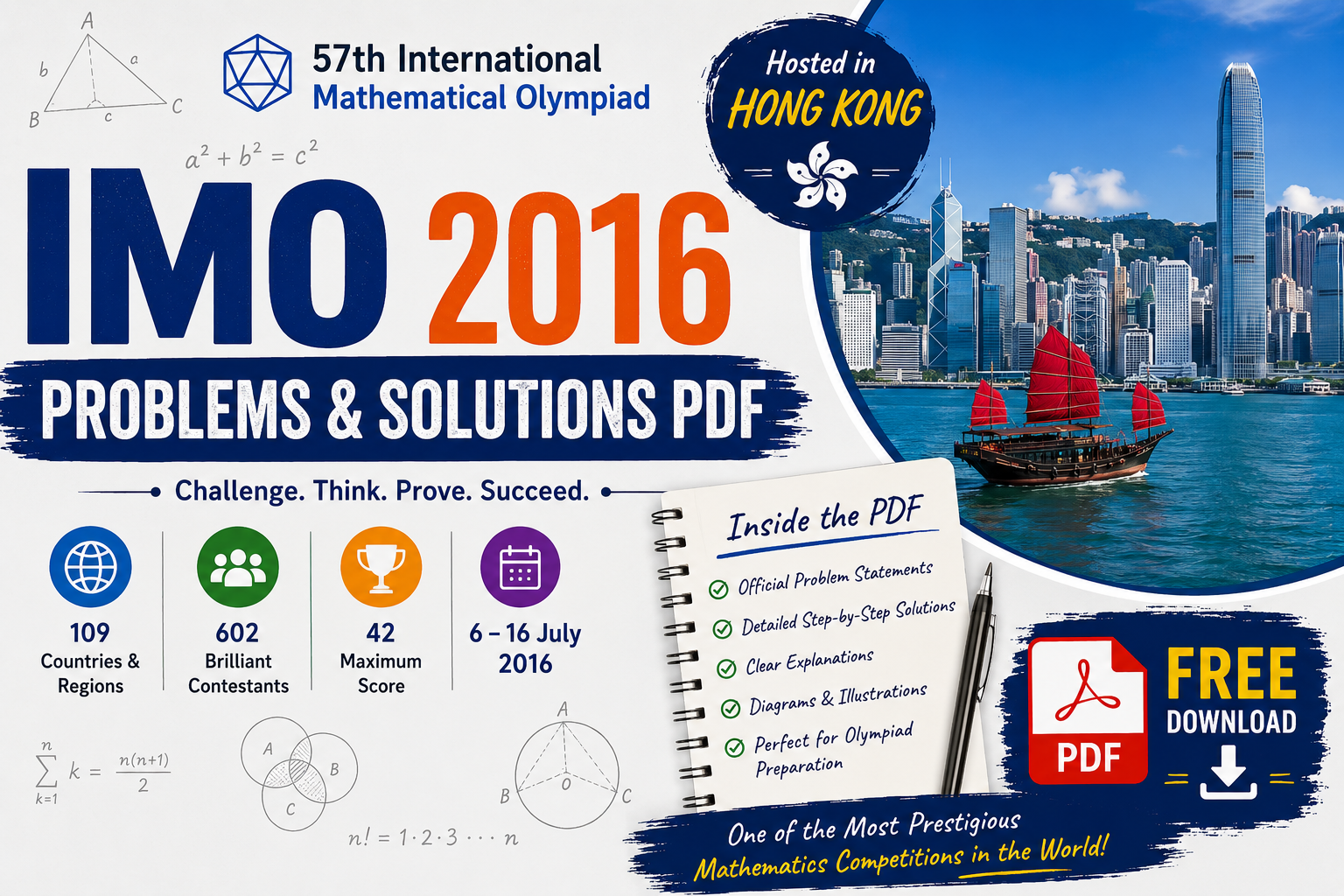
The 57th International Mathematical Olympiad (IMO 2016) stands as one of the most memorable editions of the world’s premier mathematics competition for high school students. Hosted in Hong Kong, this prestigious event brought together hundreds of the brightest young mathematicians from across the globe, each eager to test their creativity, logical reasoning, and problem-solving abilities against some of the finest minds in the world.
Unlike traditional examinations, the International Mathematical Olympiad is not about speed or memorizing formulas. Every problem is carefully designed to reward originality, mathematical insight, and rigorous proof-writing. Contestants are expected to explore unfamiliar ideas, recognize hidden patterns, and construct elegant arguments that clearly justify every conclusion. This unique philosophy is what has made the IMO the most respected mathematics competition in the world.
The IMO 2016 problem set is especially admired for its diversity. The six problems cover all major areas of Olympiad mathematics, including algebra, geometry, number theory, and combinatorics. Some questions begin with simple observations before leading to surprisingly deep mathematical ideas, while others require contestants to combine several advanced techniques into a single elegant proof.
Whether you are preparing for IOQM, RMO, INMO, national Olympiads, or future International Mathematical Olympiads, studying the IMO 2016 paper is an excellent way to strengthen your mathematical thinking. Teachers also frequently use these problems to introduce students to proof-based mathematics and demonstrate the beauty of creative problem solving.
On this page, you can learn about the competition, explore its highlights, and download the complete IMO 2016 Problems and Solutions PDF with detailed solutions for offline study.
IMO 2016 at a Glance
Here is a quick overview of the competition.
Host City: Hong Kong
Competition Dates: 6 July – 16 July 2016
Edition: 57th International Mathematical Olympiad
Participating Countries and Regions: 109
Total Contestants: 602
Maximum Score: 42 points (6 problems × 7 points)
The 2016 edition once again demonstrated how mathematics can unite students from different cultures, languages, and educational systems. While contestants competed for medals and national pride, the competition also encouraged collaboration, friendship, and a shared appreciation for mathematical beauty.
Throughout the event, students attended cultural activities, met fellow participants from around the world, and exchanged ideas that extended far beyond the examination hall. These experiences make the International Mathematical Olympiad much more than a competition—it is a celebration of young mathematical talent on a global stage.
Competition Format
The IMO has followed a consistent examination format for many decades, and the 2016 competition maintained this tradition.
Contestants sat for examinations over two consecutive days.
Each examination day consisted of:
- Three Olympiad problems
- Four hours and thirty minutes of working time
- A maximum of 21 points
Across both days, contestants attempted six problems, each worth 7 points, resulting in a maximum possible score of 42 points.
Unlike multiple-choice examinations, every solution required a complete mathematical proof. Judges carefully evaluated the logic behind every argument, awarding partial credit whenever significant progress toward a complete solution was demonstrated.
This emphasis on proof-writing distinguishes the International Mathematical Olympiad from most other mathematics competitions and encourages students to communicate mathematical ideas with precision and clarity.
Top Performing Teams
The IMO 2016 competition featured remarkable performances from many countries, reflecting years of dedicated Olympiad training and mathematical excellence.
Gold Medal Team Rankings
🥇 United States
🥈 South Korea
🥉 China
The 2016 competition was particularly historic because the United States finished first overall, marking only the second time in IMO history that the U.S. team won the championship. Their outstanding performance attracted considerable attention within the international mathematics community and inspired many young students around the world.
Several other countries also achieved impressive results, highlighting the increasingly competitive nature of the International Mathematical Olympiad.
Why is IMO 2016 Worth Studying?
Many experienced Olympiad coaches recommend the IMO 2016 paper because it provides an excellent balance between accessibility and difficulty.
The opening problems allow motivated students to gain confidence by discovering elegant observations, while the later questions gradually introduce deeper mathematical concepts that require creativity, persistence, and careful reasoning.
Unlike routine textbook exercises, Olympiad problems rarely have an obvious starting point. Students must experiment with different approaches, test ideas, identify patterns, and gradually build complete mathematical proofs.
Studying the IMO 2016 paper helps students develop valuable skills such as:
- Creative mathematical thinking
- Logical reasoning
- Proof-writing techniques
- Pattern recognition
- Strategic problem solving
- Mathematical communication
These skills remain useful not only in Olympiad competitions but also in university mathematics, computer science, engineering, and scientific research.
Mathematical Topics Covered
As with every International Mathematical Olympiad, the 2016 paper explored the four classical branches of Olympiad mathematics.
Algebra
Several problems required contestants to manipulate algebraic expressions, establish inequalities, and identify hidden relationships between variables. Success depended on insight rather than lengthy calculations.
Geometry
The geometry problems tested visualization, careful diagram analysis, and rigorous deductive reasoning. Students were expected to combine classical geometric results with original ideas to produce elegant proofs.
Number Theory
The number theory questions focused on divisibility, modular arithmetic, and properties of integers. Contestants needed a strong understanding of mathematical structure and logical argumentation.
Combinatorics
The combinatorial problems challenged students to analyze arrangements, counting arguments, invariants, and mathematical structures. These questions rewarded creativity and systematic thinking more than formula-based methods.
What Makes the IMO 2016 Paper Special?
One reason the IMO 2016 paper continues to be widely studied is its variety.
Each problem teaches a different mathematical lesson.
Some encourage contestants to search for symmetry.
Others demonstrate the power of contradiction.
Several problems highlight the importance of constructing examples before attempting a general proof.
Students quickly discover that success often comes not from advanced formulas but from patient observation and thoughtful exploration.
This is one of the defining characteristics of Olympiad mathematics. Beautiful ideas frequently emerge from seemingly simple questions.
Overview of the IMO 2016 Problems
One of the reasons the IMO 2016 paper remains highly regarded is the quality and diversity of its six problems. Every question explores a different mathematical idea and encourages contestants to think creatively rather than rely on standard techniques.
Although the difficulty increases as the competition progresses, every problem offers valuable lessons for students preparing for future Olympiads.
Problem 1
The opening problem provided a gentle introduction to the competition while still requiring genuine mathematical insight. At first glance, the statement appeared straightforward, but finding the correct approach required contestants to recognize an important pattern hidden within the given conditions.
Students who solved this problem successfully demonstrated careful observation, logical organization, and the ability to transform a simple idea into a complete mathematical proof.
For beginners studying Olympiad mathematics, Problem 1 is an excellent example of how elegant reasoning often proves more effective than lengthy calculations.
Problem 2
The second problem shifted the focus toward deeper mathematical reasoning. Contestants needed to examine the relationships between different mathematical objects and gradually uncover the underlying structure of the problem.
Rather than applying a familiar formula, successful participants explored several possible approaches before identifying the key observation.
This problem teaches an important lesson: persistence and flexibility are often just as valuable as technical knowledge.
Problem 3
The final problem of the first examination day represented a significant increase in difficulty.
Contestants were required to combine multiple mathematical ideas while maintaining complete logical precision throughout their proofs. Every step had to follow naturally from the previous one, leaving no gaps in the argument.
Problem 3 rewarded students who could remain patient under pressure and continue exploring different ideas even after several unsuccessful attempts.
It also demonstrated one of the defining characteristics of Olympiad mathematics: the most elegant solution is often surprisingly short once the correct idea has been discovered.
Problem 4
The first problem on the second examination day offered contestants another opportunity to demonstrate careful mathematical reasoning.
Although the statement appeared accessible, the solution required contestants to organize their thoughts clearly and avoid making unsupported assumptions.
Many successful participants discovered that drawing diagrams, testing small examples, and carefully analyzing special cases helped reveal the correct direction.
This problem highlights the importance of building intuition before attempting a formal proof.
Problem 5
Problem Five required considerably deeper mathematical thinking.
Contestants needed to connect several concepts into one coherent argument while ensuring that every logical step remained completely justified.
The challenge was not simply performing calculations but recognizing how different mathematical ideas interacted with one another.
Students studying this problem today often appreciate how beautifully different areas of mathematics come together to produce a surprisingly elegant conclusion.
Problem 6
As is traditional at the International Mathematical Olympiad, the final problem was the most demanding question of the competition.
Very few contestants were able to solve it completely.
Problem Six required originality, creativity, and exceptional proof-writing ability. Rather than following a familiar strategy, contestants needed to discover a new perspective that unlocked the hidden mathematical structure of the problem.
Although many students may initially find this problem intimidating, studying its official solution provides valuable insight into advanced Olympiad thinking and demonstrates how experienced mathematicians approach extremely difficult questions.
Mathematical Techniques Featured in IMO 2016
The IMO 2016 paper introduces students to many of the techniques that appear repeatedly in national and international mathematics competitions.
These include:
- Proof by contradiction
- Mathematical induction
- Extremal Principle
- Invariants and Monovariants
- Symmetry arguments
- Divisibility methods
- Functional reasoning
- Geometric transformations
- Careful case analysis
- Construction of examples
Learning these techniques is far more valuable than memorizing solutions because the same ideas continue to appear in future Olympiads in different forms.
Why Every Olympiad Student Should Solve Previous IMO Papers
Many students ask whether studying older International Mathematical Olympiad papers is still worthwhile.
The answer is undoubtedly yes.
Unlike many competitive examinations, mathematical ideas do not become outdated. A beautiful proof remains beautiful regardless of when the problem was created.
Previous IMO papers help students:
- Develop mathematical maturity.
- Learn how experienced contestants think.
- Improve proof-writing skills.
- Discover elegant solution techniques.
- Build confidence before competitions.
- Recognize recurring mathematical ideas.
Even if you cannot solve every problem independently, attempting them before reading the official solution is one of the most effective ways to improve your problem-solving ability.
Download IMO 2016 Problems and Solutions PDF
For students who prefer studying offline, this page includes the complete IMO 2016 Problems and Solutions PDF.
The PDF has been prepared as a convenient reference for students, teachers, and mathematics enthusiasts.
Inside the PDF, you will find:
- Official IMO 2016 problem statements
- Complete step-by-step solutions
- Clear mathematical notation
- Accurate diagrams where required
- High-quality formatting suitable for printing
A helpful study strategy is to attempt each problem on your own before reading the corresponding solution. Even if you are unable to finish every proof, the effort spent exploring different ideas will strengthen your mathematical intuition and improve your ability to tackle unfamiliar problems.
Tips for Studying the IMO 2016 Paper
To gain the maximum benefit from these problems, consider the following approach.
Begin by reading the entire problem carefully without rushing toward a solution. Many Olympiad questions contain subtle hints that become apparent only after careful examination.
Next, experiment with simple examples. Small cases often reveal patterns that suggest a general strategy.
If the problem involves geometry, draw a clear and accurate figure. A well-constructed diagram frequently exposes relationships that are difficult to notice otherwise.
When writing a solution, focus on logical clarity. Every mathematical claim should be supported by a convincing argument.
Finally, compare your proof with the official solution only after making a serious attempt yourself. Understanding why another method works is often just as valuable as finding the solution independently.
Who Should Use This PDF?
The IMO 2016 Problems and Solutions PDF is useful for a wide range of readers.
It is particularly valuable for:
- Students preparing for IOQM
- RMO and INMO aspirants
- National and regional Olympiad participants
- Teachers conducting Olympiad training sessions
- Mathematics clubs
- Undergraduate students interested in proof-based mathematics
- Anyone who enjoys challenging mathematical problems
Regardless of your current level, every problem offers an opportunity to learn something new.
The 57th International Mathematical Olympiad, held in Hong Kong in 2016, remains an outstanding example of mathematical creativity and excellence. Its carefully designed problems continue to inspire students around the world, demonstrating that mathematics is not merely a collection of formulas but a discipline built upon curiosity, logical reasoning, and elegant ideas.
Every question in the competition tells its own mathematical story. Some reward a single clever observation, while others require patience, experimentation, and deep analytical thinking. Together, they provide an exceptional learning experience for anyone interested in Olympiad mathematics.
Whether your goal is to qualify for future mathematics competitions, strengthen your proof-writing skills, or simply enjoy solving beautiful problems, the IMO 2016 Problems and Solutions PDF is an invaluable resource.
Take your time with each question, resist the temptation to look at the solution too quickly, and appreciate the elegance behind every proof. The habits you develop while studying Olympiad mathematics—careful reasoning, persistence, and creative thinking—will benefit you far beyond any competition.
By working through the IMO 2016 problems, you are not only preparing for future Olympiads but also developing the mindset of a mathematician: one that values curiosity, precision, and the joy of discovering new ideas.