

IMO 2023:64th International Mathematical Olympiad
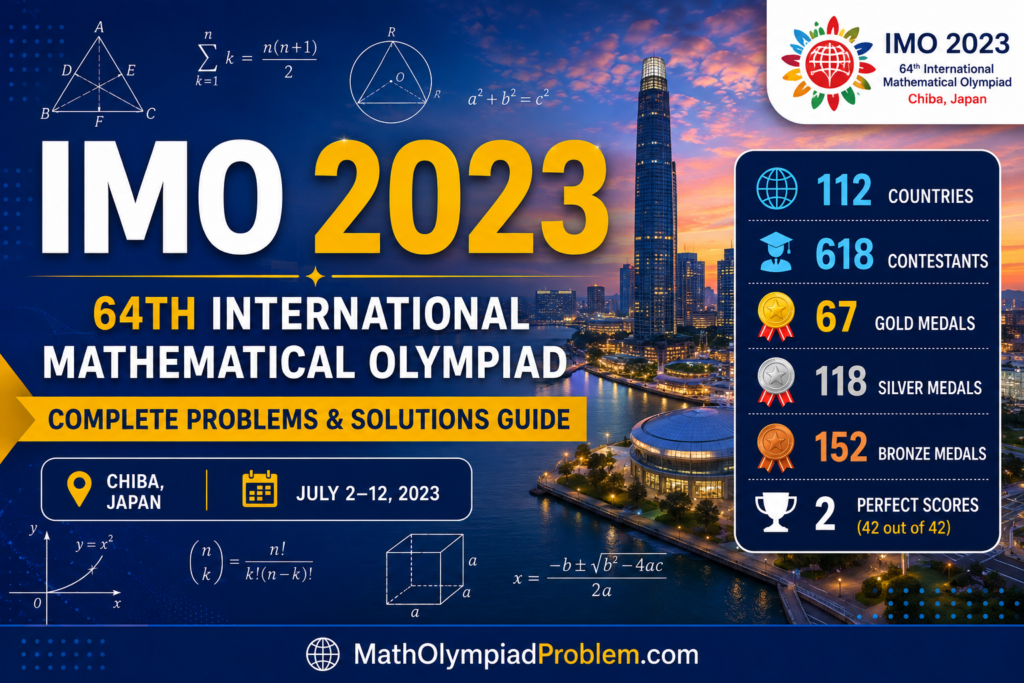
The 64th International Mathematical Olympiad (IMO 2023) marked another remarkable chapter in the history of the world’s most prestigious mathematics competition for high school students. Hosted in Chiba, Japan, from 2 July to 13 July 2023, the Olympiad brought together some of the brightest young mathematical minds from across the globe. For nearly two weeks, students representing their countries competed in one of the most challenging proof-based examinations ever created while also celebrating international friendship, cultural exchange, and a shared passion for mathematics. (IMO)
Since its inception in 1959, the International Mathematical Olympiad has inspired generations of students to think beyond textbooks and discover the beauty of logical reasoning. Unlike conventional school examinations, the IMO does not reward memorization or routine calculations. Instead, it challenges contestants to develop original ideas, recognize hidden mathematical patterns, and construct rigorous proofs. Every participant who reaches the IMO has already passed several highly competitive national selection rounds, making qualification itself an extraordinary achievement.
Japan, one of the world’s leading nations in science, technology, and mathematics education, organized the 64th International Mathematical Olympiad with exceptional professionalism. The host city of Chiba, located near Tokyo, welcomed hundreds of contestants, team leaders, observers, and volunteers from around the world. Besides the examinations, participants enjoyed cultural programs, educational visits, and opportunities to interact with students from different countries. These experiences have always been an important part of the IMO because they encourage international cooperation and lifelong friendships through mathematics. (IMO)
The scale of the competition once again demonstrated the growing popularity of mathematical Olympiads worldwide. A total of 112 countries participated in IMO 2023, sending 618 contestants, including 67 female contestants. Every participant attempted six proof-based problems over two examination days. Each problem carried 7 marks, making the maximum possible score 42 points. At the conclusion of the competition, 54 Gold Medals, 90 Silver Medals, and 170 Bronze Medals were awarded, while 192 contestants received Honourable Mentions for outstanding solutions. An impressive five contestants achieved the perfect score of 42 out of 42, highlighting the extraordinary level of mathematical talent present at the competition. (IMO)
One of the defining features of IMO 2023 was its beautifully balanced problem set. The six problems covered the four traditional branches of Olympiad mathematics—Algebra, Number Theory, Geometry, and Combinatorics—while requiring contestants to combine creativity with rigorous mathematical proof. Rather than relying on advanced university mathematics, the problems focused on elementary concepts presented in highly original ways. This philosophy has remained one of the greatest strengths of the International Mathematical Olympiad for more than six decades.
Another memorable aspect of IMO 2023 was the outstanding performance of several countries and individual contestants. Teams from around the world demonstrated remarkable preparation, and the competition remained intense until the final results were announced. While medals and rankings naturally attracted attention, the true success of the Olympiad lay in bringing together hundreds of talented students who shared the same curiosity, determination, and love for mathematics. Many of today’s leading mathematicians, scientists, engineers, and researchers began their journeys through competitions like the IMO, making this event an important platform for nurturing future innovators.
For teachers, students, and mathematics enthusiasts, the IMO 2023 problems and solutions provide an excellent opportunity to experience world-class mathematical thinking. Every problem encourages careful observation, logical deduction, and elegant proof writing. Even students who are unable to solve every question completely can significantly improve their mathematical maturity by studying the official solutions and understanding the key ideas behind each proof.
Problem 4 introduced contestants to an interesting challenge that required careful mathematical reasoning and a deep understanding of the underlying structure of the problem. Although it was the first problem of the second examination day, it was by no means straightforward. Many contestants initially believed that standard techniques would be sufficient, only to discover that success depended on identifying a key observation hidden within the problem.
The official statistics show that Problem 4 received one of the higher average scores of the second day, indicating that well-prepared contestants were able to make significant progress. Students who approached the question systematically, tested small cases, and carefully justified every argument generally performed well.
The most important lesson from Problem 4 is that Olympiad mathematics often rewards patience rather than speed. Instead of rushing toward a solution, successful contestants carefully explored the structure of the problem before writing a formal proof. This habit is essential for anyone preparing for future International Mathematical Olympiads.
Problem 5 represented a significant increase in difficulty. The problem demanded originality, logical precision, and the ability to combine several mathematical ideas into one complete argument. Many contestants discovered useful observations, but transforming those observations into a rigorous proof proved considerably more difficult.
Like many classic IMO middle problems, this question required contestants to think beyond familiar techniques. Success depended on recognizing hidden relationships, developing a suitable strategy, and avoiding unnecessary calculations. Students who remained flexible in their thinking often found elegant approaches that greatly simplified the problem.
According to the official marking statistics, Problem 5 produced a wide distribution of scores. Numerous contestants earned valuable partial marks, while relatively few completed the entire proof perfectly. This balance made the problem an excellent measure of mathematical maturity.
For future Olympiad students, Problem 5 demonstrates the importance of persistence. Even when a complete solution appears difficult, carefully proving intermediate results can earn valuable marks and often leads naturally toward the final argument.
Problem 6 became the defining challenge of IMO 2023. As is traditional for the final question of the International Mathematical Olympiad, it required exceptional creativity and mathematical insight. Many contestants spent several hours exploring different approaches before discovering whether their ideas could be developed into complete proofs.
The beauty of Problem 6 lay in its originality. Rather than testing complicated calculations, it encouraged contestants to discover an entirely new mathematical perspective. Students needed to analyse the problem from multiple viewpoints, identify hidden structures, and communicate their reasoning with complete precision.
Only a small number of contestants around the world obtained full marks on the final problem, making it one of the strongest distinguishing questions of the competition. Nevertheless, many students earned partial credit through clever observations and carefully justified intermediate arguments. This reflects one of the greatest strengths of the International Mathematical Olympiad—every good mathematical idea receives recognition, even if the final proof remains incomplete.
The final results of IMO 2023 reflected the exceptional standard of the competition. A total of 112 countries participated, sending 618 contestants to Chiba, Japan. At the conclusion of the Olympiad, 54 Gold Medals, 90 Silver Medals, and 170 Bronze Medals were awarded, while 192 contestants received Honourable Mentions. Five outstanding contestants achieved the maximum possible score of 42 out of 42, an achievement that highlights the extraordinary level of talent present at the competition. (imo-official.org)
Beyond the medal ceremony, IMO 2023 once again demonstrated that mathematics is a universal language capable of connecting people across cultures and continents. Students who met during the Olympiad exchanged ideas, learned about different educational systems, and built friendships that will continue throughout their academic and professional lives. For many contestants, these international experiences became just as valuable as the competition itself.
From an educational perspective, the IMO 2023 problem set remains an outstanding resource for students preparing for national and international mathematics Olympiads. Every problem illustrates a different style of mathematical thinking while emphasizing the importance of creativity, logical reasoning, and elegant proof writing. Teachers can use these problems to introduce advanced problem-solving strategies, while students can strengthen their analytical skills by attempting the questions before studying the official solutions.
One particularly valuable lesson from IMO 2023 is that successful Olympiad preparation cannot rely on memorizing formulas or standard methods. The competition consistently rewards students who can analyse unfamiliar situations, identify hidden patterns, and develop original arguments. These abilities are developed gradually through regular practice, careful study of previous IMO papers, and thoughtful discussion of different solution methods.
Dowload IMO 2023 PDF Solutios
Frequently Asked Questions
Where was IMO 2023 held?
The 64th International Mathematical Olympiad was held in Chiba, Japan, from 2 July to 13 July 2023.
How many countries participated in IMO 2023?
A total of 112 countries participated.
How many contestants competed?
There were 618 contestants, including 67 female participants.
What was the maximum possible score?
Each of the six problems carried 7 marks, giving a maximum score of 42 points.
How many perfect scores were achieved?
Five contestants achieved the maximum score of 42 out of 42.
Where can I find the official IMO 2023 problems and solutions?
The official problems, solutions, statistics, and results are available on the official International Mathematical Olympiad website.
The International Mathematical Olympiad 2023 was another outstanding celebration of mathematical excellence. Hosted successfully in Chiba, Japan, it brought together hundreds of brilliant young mathematicians who demonstrated remarkable creativity, determination, and problem-solving ability. The carefully designed problem set challenged contestants across every major branch of Olympiad mathematics while rewarding elegant proofs and original thinking.
Whether you are preparing for future Olympiads, teaching advanced mathematics, or simply enjoying beautiful mathematical ideas, the IMO 2023 problems remain an invaluable learning resource. By studying these problems and understanding the official solutions, students develop not only stronger mathematical skills but also the confidence, patience, and logical thinking required to succeed at the highest level of international mathematics competitions.