

Japanese Mathematical Olympiad (JMO): The Complete Guide for Students, Parents, and Teachers
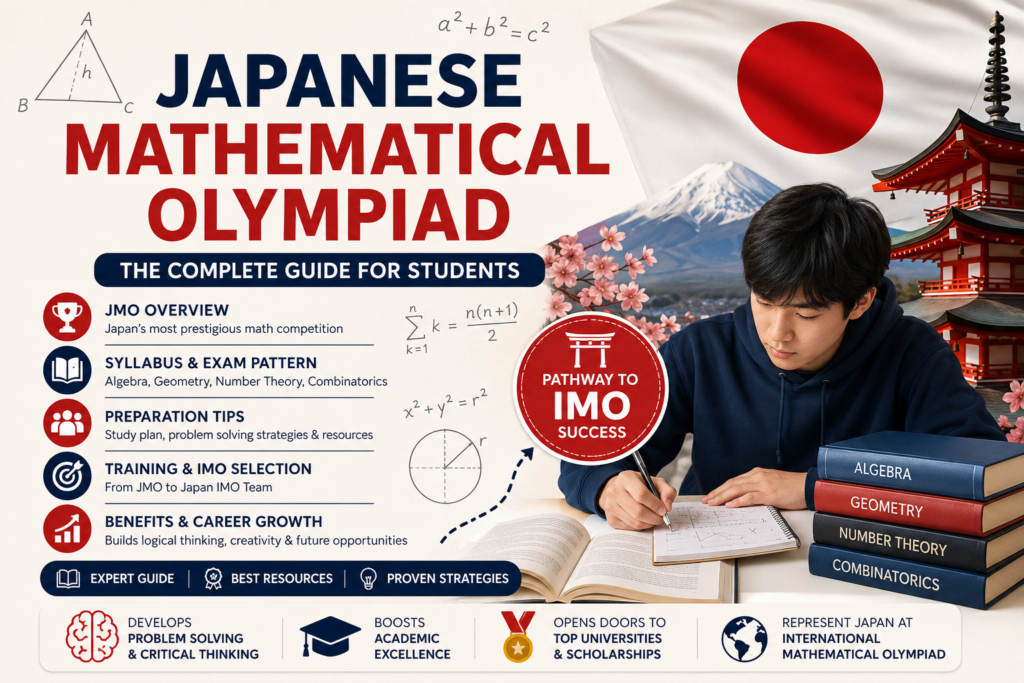
Japan has long been recognized as one of the world’s leading countries in mathematics education. From groundbreaking research to consistent success at the International Mathematical Olympiad (IMO), Japanese students have demonstrated exceptional mathematical talent for decades. One of the key reasons behind this success is the Japanese Mathematical Olympiad (JMO), the country’s premier mathematics competition for high school students.
The Japanese Mathematical Olympiad is far more than a competitive examination. It is a platform where talented students develop logical reasoning, creativity, and advanced problem-solving skills. Every year, thousands of students from across Japan participate in the Olympiad selection process, hoping to qualify for the national finals and eventually earn a place on Japan’s International Mathematical Olympiad team.
Unlike school examinations, the JMO emphasizes mathematical thinking instead of memorization. Contestants are expected to solve unfamiliar problems using logical arguments and elegant proofs. This unique approach encourages students to explore mathematics more deeply while developing skills that remain valuable throughout university studies and professional careers.
Whether you are a student preparing for Olympiad competitions, a parent looking for reliable information, or a teacher guiding future mathematicians, this complete guide explains everything you need to know about the Japanese Mathematical Olympiad.
What is the Japanese Mathematical Olympiad?
The Japanese Mathematical Olympiad (JMO) is Japan’s highest-level national mathematics competition for secondary school students. It identifies outstanding mathematical talent and serves as the official pathway for selecting Japan’s team for the International Mathematical Olympiad (IMO).
The competition is organized by the Mathematical Olympiad Foundation of Japan (MOFJ), a non-profit organization dedicated to promoting mathematics education and supporting talented young students.
The JMO challenges students with problems that require creativity, logical reasoning, and proof-writing skills. Instead of applying standard formulas, contestants must analyze unfamiliar situations, discover elegant mathematical ideas, and communicate their reasoning clearly.
For many students, qualifying for the Japanese Mathematical Olympiad is one of the highest academic achievements during high school.
A Brief History of the Japanese Mathematical Olympiad
Japan began participating in the International Mathematical Olympiad in the early years of the competition and quickly became one of the world’s strongest mathematical nations.
To identify and prepare talented students, the country established a structured national Olympiad system. Over time, this evolved into the modern Japanese Mathematical Olympiad, which is now recognized as one of the most respected national mathematics competitions in Asia.
The competition has helped discover many outstanding mathematicians who later represented Japan at the International Mathematical Olympiad and pursued successful careers in mathematics, engineering, computer science, physics, economics, and scientific research.
Today, the Japanese Mathematical Olympiad continues to inspire thousands of students every year and remains an important part of Japan’s mathematics education system.
Who Organizes the Japanese Mathematical Olympiad?
The Mathematical Olympiad Foundation of Japan (MOFJ) is responsible for organizing the Japanese Mathematical Olympiad.
The foundation works closely with university professors, experienced mathematicians, former Olympiad medalists, and mathematics educators to organize competitions, develop examination papers, conduct training camps, and select students for international contests.
Beyond organizing competitions, the foundation actively promotes mathematical education by encouraging students to explore challenging problems and develop creative thinking skills.
The MOFJ also coordinates Japan’s participation in international mathematics competitions, including the International Mathematical Olympiad.
Why is the Japanese Mathematical Olympiad So Prestigious?
The Japanese Mathematical Olympiad enjoys an excellent reputation because of its high academic standards and rigorous selection process.
Unlike ordinary examinations that focus on routine calculations, the JMO rewards originality and logical thinking. Students are expected to discover creative solutions, construct rigorous proofs, and explain their reasoning clearly.
The competition also serves as the gateway to Japan’s International Mathematical Olympiad team. Every year, only a small number of students progress through the selection process and earn the opportunity to represent Japan on the international stage.
Universities, teachers, and mathematics departments recognize strong JMO performance as evidence of exceptional analytical ability and mathematical potential.
Who Can Participate?
The Japanese Mathematical Olympiad is open to eligible secondary school students studying in Japan.
Students from different regions of the country may participate if they satisfy the eligibility requirements announced by the Mathematical Olympiad Foundation of Japan.
Many participants begin preparing several years before taking part in the competition because Olympiad mathematics requires advanced problem-solving skills beyond the standard school curriculum.
Students interested in participating should carefully follow the latest eligibility rules and registration announcements published by the organizing committee.
How Do Students Qualify?
Japan follows a carefully structured selection process to identify its strongest young mathematicians.
Students first participate in the Japanese Mathematical Olympiad preliminary examination, where they solve challenging problems covering different areas of mathematics.
Successful contestants qualify for the JMO Final Round, which is significantly more demanding and emphasizes proof writing and creative mathematical thinking.
Students who perform exceptionally well are invited to national training programs, where they receive advanced instruction from experienced mathematicians.
Following additional examinations and training, the six strongest students are selected to represent Japan at the International Mathematical Olympiad (IMO).
The qualification pathway can be summarized as follows:
Preliminary Examination → JMO Final Round → National Training Camp → Final Team Selection → International Mathematical Olympiad
Each stage becomes increasingly competitive and requires deeper mathematical understanding.
Registration Process
Students usually register for the Japanese Mathematical Olympiad through the official registration system managed by the Mathematical Olympiad Foundation of Japan.
Registration typically opens several months before the examination. Applicants must complete the online application, provide the required information, and submit their registration before the official deadline.
Because registration procedures and examination dates may change from year to year, students should always refer to the latest announcements published on the official MOFJ website.
Exam Pattern
The Japanese Mathematical Olympiad is a proof-based competition that evaluates students’ mathematical reasoning rather than computational speed.
The preliminary examination usually consists of challenging mathematical problems designed to identify students with strong analytical ability.
Students who qualify for the final round face even more difficult proof-based questions requiring elegant arguments and complete mathematical explanations.
Marks are awarded for the quality of the mathematical reasoning, and partial credit may be given when a solution contains important ideas even if it is incomplete.
This style of examination closely resembles the International Mathematical Olympiad and helps prepare students for higher-level competitions.
JMO Syllabus
The Japanese Mathematical Olympiad does not follow a fixed school textbook syllabus.
Instead, problems are drawn from the traditional areas of Olympiad mathematics.
Algebra
Students should understand inequalities, sequences, functional equations, algebraic identities, recurrence relations, polynomials, and symmetric expressions.
Geometry
Geometry problems frequently involve Euclidean geometry, circles, similar triangles, cyclic quadrilaterals, homothety, inversion, Ceva’s Theorem, Menelaus’ Theorem, and advanced geometric proofs.
Number Theory
Important topics include divisibility, modular arithmetic, prime numbers, Diophantine equations, congruences, greatest common divisors, Euler’s Theorem, and mathematical induction.
Combinatorics
Students should study counting techniques, graph theory, recursion, invariants, extremal principles, constructive methods, and the pigeonhole principle.
Many JMO problems combine concepts from multiple mathematical fields, requiring creativity rather than memorization.
How Difficult is the Japanese Mathematical Olympiad?
The Japanese Mathematical Olympiad is regarded as one of the most challenging mathematics competitions in Asia.
Even students who perform exceptionally well in school mathematics often find Olympiad problems difficult because there are no standard solution methods. Contestants must explore different ideas, recognize hidden patterns, and develop original proofs.
Success requires patience, creativity, logical thinking, and consistent practice over several years. Students who regularly solve Olympiad problems gradually build the mathematical intuition needed to perform well in the competition.
For this reason, qualifying for the Japanese Mathematical Olympiad is considered an outstanding academic achievement and an important step toward representing Japan at the International Mathematical Olympiad.
How to Prepare for the Japanese Mathematical Olympiad
Preparing for the Japanese Mathematical Olympiad requires patience, consistency, and a genuine love for mathematics. Unlike school examinations, where students often succeed by memorizing formulas and practicing similar questions, the JMO rewards creativity and original thinking. Every problem is designed to test how well students can analyze unfamiliar situations and build logical mathematical arguments.
The first step is to master the four main Olympiad subjects: algebra, geometry, number theory, and combinatorics. Students should understand the ideas behind each concept instead of simply learning formulas by heart. A strong conceptual foundation makes it much easier to solve difficult Olympiad problems.
Daily practice is essential. Solving one or two challenging problems every day develops mathematical intuition much faster than completing dozens of routine textbook exercises. Students should spend enough time exploring different approaches before reading the official solutions. Even unsuccessful attempts help improve problem-solving ability.
Proof writing is another skill that deserves special attention. Every solution should explain the reasoning clearly and logically. Learning to present ideas in an organized way not only improves examination scores but also develops mathematical communication skills that remain useful throughout higher education.
Finally, students should regularly solve previous Japanese Mathematical Olympiad papers. These problems provide valuable insight into the style, difficulty level, and expectations of the competition.
A One-Year Preparation Plan
A structured preparation plan helps students improve steadily throughout the year.
During the first three months, focus on building strong foundations in algebra, geometry, number theory, and combinatorics. Learn the standard Olympiad techniques while solving introductory proof-based problems.
The next three months should be devoted to solving previous JMO preliminary papers together with problems from other national Olympiads such as the Chinese Mathematical Olympiad (CMO), the Korean Mathematical Olympiad (KMO), the USA Mathematical Olympiad (USAMO), and the International Mathematical Olympiad (IMO). Exposure to different problem styles develops flexibility in mathematical thinking.
During the following three months, begin solving complete Japanese Mathematical Olympiad papers under timed conditions. Carefully compare your proofs with official solutions and identify areas where your reasoning or presentation can be improved.
The final three months should focus on mock examinations, advanced proof writing, and reviewing difficult problems. Consistent practice under examination conditions helps students build confidence and improve time management.
Best Books for Japanese Mathematical Olympiad Preparation
Choosing the right books is an important part of successful Olympiad preparation.
One of the most highly recommended books is The Art and Craft of Problem Solving by Paul Zeitz. It teaches creative problem-solving techniques and introduces many classical Olympiad ideas.
Another excellent resource is Problem-Solving Strategies by Arthur Engel. The book explains a wide variety of methods commonly used in national and international mathematics competitions.
The IMO Compendium is considered essential reading for advanced students. It contains decades of International Mathematical Olympiad problems together with detailed solutions that help students understand high-level mathematical reasoning.
For geometry, Geometry Revisited by Coxeter and Greitzer remains one of the finest books available.
Students wishing to improve their number theory should study 104 Number Theory Problems by Titu Andreescu.
In addition to books, solving previous JMO, IMO, APMO, USAMO, CMO, and INMO papers provides excellent preparation for advanced competitions.
National Training Camps and IMO Team Selection
Students who perform exceptionally well in the Japanese Mathematical Olympiad are invited to advanced national training camps organized by the Mathematical Olympiad Foundation of Japan.
During these camps, participants attend lectures by university professors and experienced Olympiad coaches. They solve advanced proof-based problems, participate in mock examinations, and receive detailed feedback on their mathematical reasoning.
Additional selection tests are conducted throughout the training program. Based on their overall performance, the six strongest students are chosen to represent Japan at the International Mathematical Olympiad (IMO).
This rigorous selection process ensures that Japan sends a highly competitive team each year.
Japan’s Success at the International Mathematical Olympiad
Japan has earned worldwide recognition for its outstanding performances at the International Mathematical Olympiad.
Over the years, Japanese students have won numerous gold, silver, and bronze medals, consistently placing the country among the world’s strongest mathematical nations. Many contestants have achieved excellent individual rankings and later become university professors, researchers, engineers, and leaders in science and technology.
Japan’s continued success reflects its strong mathematics education system, experienced Olympiad coaches, and well-organized national training program.
The Japanese Mathematical Olympiad remains the foundation of this achievement by identifying talented students and preparing them for international competition.
Benefits of Participating in the JMO
The Japanese Mathematical Olympiad offers many benefits beyond medals and certificates.
Students develop logical reasoning, creativity, analytical thinking, and perseverance. These abilities are valuable not only in mathematics but also in computer science, engineering, economics, artificial intelligence, physics, and many other disciplines.
Strong performance in the JMO is respected by universities and scholarship programs because it demonstrates exceptional academic potential and problem-solving ability.
Olympiad preparation also teaches students how to approach unfamiliar challenges with confidence, an important skill that continues to benefit them throughout university and professional life.
Most importantly, the competition encourages students to enjoy mathematics as a subject of discovery rather than memorization.
Frequently Asked Questions
Can international students participate in the Japanese Mathematical Olympiad?
The competition is primarily intended for students who meet the eligibility requirements established by the Mathematical Olympiad Foundation of Japan. Students should consult the official rules for the latest eligibility information.
Is there an official syllabus?
No. The JMO follows the traditional Olympiad curriculum, focusing on algebra, geometry, number theory, and combinatorics rather than a fixed textbook.
Are calculators allowed?
No. Calculators and electronic devices are not permitted during the examination.
How many stages are there?
The selection process generally includes a preliminary examination, a final round, national training camps, and final team selection for the International Mathematical Olympiad.
Is the Japanese Mathematical Olympiad difficult?
Yes. It is considered one of the most challenging mathematics competitions in Asia and requires creativity, proof-writing ability, and advanced mathematical thinking.
Official Registration and Information
Students interested in participating should visit the Mathematical Olympiad Foundation of Japan (MOFJ) for the latest information regarding registration, eligibility, competition dates, examination schedules, and official announcements.
Registration is generally completed through the official system announced by the organizing committee. Because dates and procedures may change each year, students should always rely on the latest information published by the foundation.
The Japanese Mathematical Olympiad is one of the world’s most respected national mathematics competitions. It challenges students to think creatively, solve unfamiliar problems, and communicate mathematical ideas with clarity and precision.
Although preparing for the JMO requires dedication and consistent effort, the experience offers rewards that extend far beyond the competition itself. Students develop advanced reasoning skills, confidence, perseverance, and a deeper appreciation for mathematics. These qualities remain valuable throughout university studies and future careers.
Whether your goal is to qualify for the national finals, attend Japan’s Olympiad training camps, or represent the country at the International Mathematical Olympiad, success begins with curiosity, disciplined practice, and a willingness to embrace challenging problems. Every great Olympian starts with a single problem—and every solved problem brings you one step closer to excellence.
Search Also
Chinese Mathematical Olympiad (CMO): Complete Guide
Asian Pacific Mathematical Olympiad (APMO): Complete Guide
International Mathematical Olympiad (IMO): Complete Guide
Indian National Mathematical Olympiad (INMO): Complete Guid
USA Mathematical Olympiad (USAMO): Complete Guide
British Mathematical Olympiad (BMO): Complete Guide
All-Russian Mathematical Olympiad: Complete Guide
IMO Previous Year Problems with Solutions