
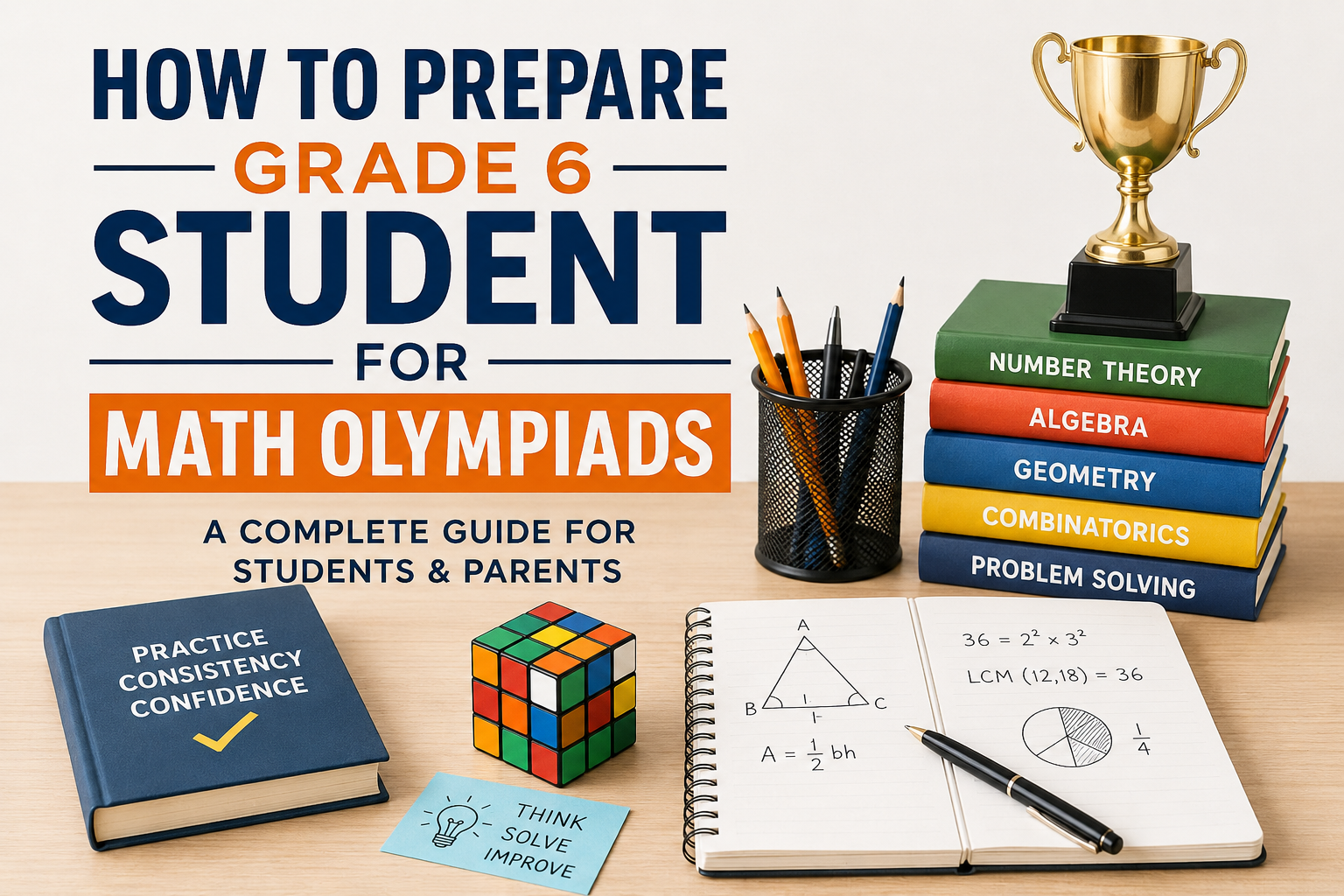
Every year, I meet parents who ask the same question:
“My child is in Grade 6. Is it too early to start Olympiad preparation?”
The answer is simple: Grade 6 is actually one of the best times to begin.
Many people assume Math Olympiads are only for gifted children who can solve impossible-looking problems. That is one of the biggest myths in mathematics education. In reality, most successful Olympiad students are not born solving difficult problems. They become strong problem solvers because they spend years developing mathematical thinking step by step.
If a student starts in Grade 6, there is enough time to build a strong foundation, develop confidence, and gradually move toward higher-level competitions. More importantly, the student learns how to think independently instead of relying on memorized formulas.
This article explains exactly how I would prepare a Grade 6 student starting from today.
First, Understand What Olympiad Mathematics Really Is
Many students enter their first Olympiad expecting questions similar to school exams.
Then they see a problem that looks unfamiliar and immediately panic.
The reason is simple.
School mathematics usually asks:
“Can you apply a method you already know?”
Olympiad mathematics asks:
“Can you discover a method that you have never seen before?”
That difference changes everything.
In a school examination, a student may solve twenty similar fraction questions using the same procedure.
In an Olympiad, a single fraction problem may require observation, experimentation, pattern recognition, and logical reasoning before any calculation begins.
That is why Olympiad preparation should focus on thinking skills rather than rushing through advanced topics.
The Biggest Mistake Parents Make
Many parents believe that Olympiad preparation means teaching algebra, calculus, or high-school mathematics as early as possible.
I have seen Grade 6 students learning topics years ahead of their school level but struggling with basic logical reasoning.
Being ahead in the syllabus is not the same as being good at Olympiad mathematics.
A student who understands divisibility, patterns, and logical reasoning deeply will usually outperform a student who has memorized advanced formulas without understanding them.
For Grade 6 students, depth matters far more than acceleration.
What Topics Should a Grade 6 Student Master?
Before attempting difficult Olympiad problems, students should become extremely comfortable with the following areas.
Number Theory
Number theory is one of the most important Olympiad topics.
Students should know:
- Prime numbers
- Composite numbers
- Factors
- Multiples
- Divisibility rules
- Greatest Common Factor (GCF)
- Least Common Multiple (LCM)
A surprising number of Olympiad problems can be solved using simple number theory ideas combined with logical thinking.
Fractions, Ratios, and Percentages
Many students can perform calculations with fractions but do not truly understand them.
Olympiad questions often test understanding rather than computation.
Students should be able to move comfortably between:
- Fractions
- Decimals
- Ratios
- Percentages
without relying on memorized tricks.
Geometry
At this stage, geometry should be visual and intuitive.
Students should understand:
- Angles
- Triangles
- Quadrilaterals
- Symmetry
- Area
- Perimeter
Rather than memorizing formulas, students should learn how shapes behave and how geometric relationships can reveal hidden information.
Counting and Combinatorics
This is often a completely new world for students.
Questions such as:
“How many different arrangements are possible?”
or
“How many paths can be formed?”
teach students systematic thinking.
Combinatorics is one of the most beautiful areas of Olympiad mathematics because it rewards creativity.
Logical Reasoning
This is the heart of every Olympiad.
Students should regularly solve:
- Logic puzzles
- Pattern problems
- Deductive reasoning questions
- Non-routine word problems
These activities develop the habit of thinking carefully before calculating.
The Resources I Recommend Most
If I had to choose only a few resources for a Grade 6 student, these would be my first choices.
Beast Academy
In my opinion, Beast Academy is one of the finest mathematics programs ever created for young problem solvers.
What makes it different is that it teaches students how to think rather than simply how to compute.
The explanations are engaging, visual, and designed to build genuine understanding.
Many successful Olympiad students have used Beast Academy as part of their preparation.
Singapore Math Challenging Word Problems
Singapore Mathematics has earned a strong reputation worldwide because it emphasizes deep understanding.
The challenging word problem books help students develop mathematical reasoning and model-building skills.
These are exactly the skills Olympiad students need.
MOEMS Problem Collections
Once students have a solid foundation, they should begin solving actual contest problems.
The Math Olympiad Contest Problems collections provide excellent practice and help students become familiar with competition-style thinking.
Challenge Math
This classic book introduces students to ideas rarely encountered in ordinary classrooms.
Many of the problems feel like miniature Olympiad challenges and encourage creative approaches.
A Study Schedule That Actually Works
One of the most common questions I receive is:
“How many hours should my child study each day?”
My answer surprises many parents.
For Grade 6 students, consistency is far more important than long study sessions.
A student who studies one hour every day will usually improve much faster than a student who studies six hours only on weekends.
A practical schedule looks like this:
Monday: Number Theory
Tuesday: Geometry
Wednesday: Logical Reasoning
Thursday: Word Problems
Friday: Counting and Combinatorics
Saturday: Olympiad Practice Set
Sunday: Review Mistakes
The review day is extremely important.
Many students solve a problem once and never look at it again.
Strong Olympiad students revisit mistakes repeatedly until they fully understand what went wrong.
The Secret Habit of Strong Olympiad Students
Over the years, I have noticed a common habit among top performers.
They keep a mistake notebook.
Whenever they solve a problem incorrectly, they record:
- The problem
- Their incorrect solution
- The correct solution
- The lesson learned
After several months, this notebook becomes one of the most valuable resources they own.
Most improvement in mathematics comes from analyzing mistakes, not from celebrating correct answers.
How Parents Can Help
Parents often feel unqualified to support Olympiad preparation because they are not mathematics experts.
Fortunately, expertise is not required.
The most valuable support usually comes from creating the right environment.
Encourage curiosity.
Allow students time to struggle with problems.
Avoid immediately providing answers.
Ask questions such as:
“What have you tried?”
“Can you draw a diagram?”
“Can you solve a simpler version first?”
These questions help students develop independence.
Remember that Olympiad mathematics is a marathon, not a sprint.
Progress often happens slowly and invisibly before suddenly becoming obvious.
What Success Really Looks Like
Many parents measure success only through medals and rankings.
While awards are wonderful, they should not be the primary goal.
A successful Grade 6 Olympiad student is someone who:
- Enjoys challenging problems
- Thinks logically
- Persists when stuck
- Learns from mistakes
- Develops mathematical confidence
These qualities last far longer than any certificate.
In fact, the students who eventually excel in advanced Olympiads such as AMC, AIME, and even the International Mathematical Olympiad are usually the ones who learned to enjoy problem solving long before they started winning awards.
If your child is currently in Grade 6, there is no need to rush into advanced mathematics or search for shortcuts. The strongest Olympiad foundations are built through careful, consistent work over time.
Focus on number theory, geometry, logical reasoning, and problem solving. Choose high-quality resources. Encourage curiosity. Review mistakes. Most importantly, help the student enjoy the process.
Olympiad mathematics is not about finding the fastest answer. It is about discovering new ways to think.
A student who develops that habit in Grade 6 gains something far more valuable than a medal: the ability to approach unfamiliar challenges with confidence, creativity, and persistence.
And that skill will continue to serve them long after every contest is over.