

Introduction
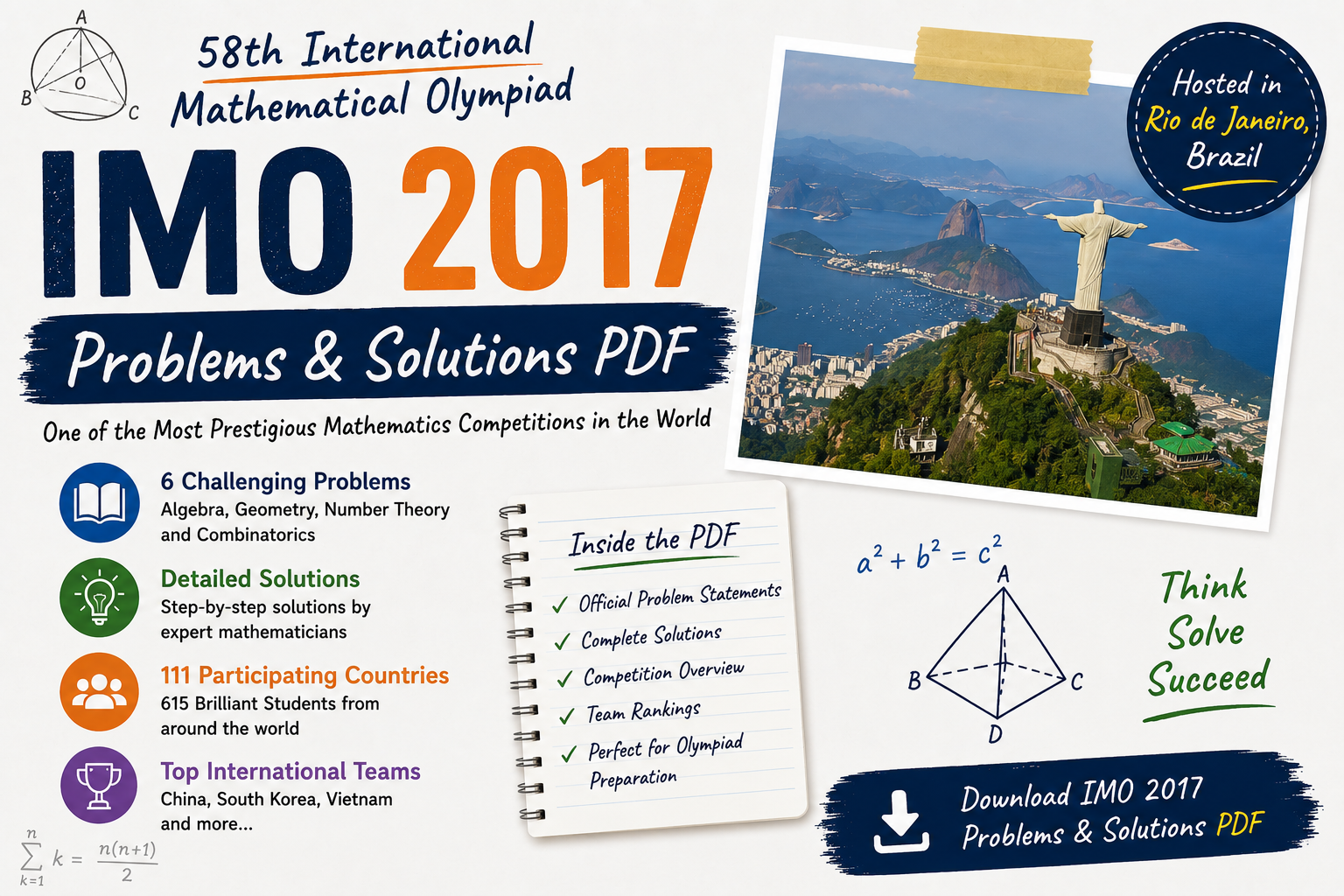
The 58th International Mathematical Olympiad (IMO 2017) remains one of the most memorable editions of the world’s most prestigious mathematics competition for high school students. Hosted in Rio de Janeiro, Brazil, the event brought together hundreds of exceptionally talented students from every corner of the world, all united by a shared passion for mathematics and problem solving.
Every year, the International Mathematical Olympiad showcases the beauty of mathematics through six carefully designed problems that demand creativity, logical thinking, perseverance, and elegant proof-writing. Unlike standard classroom examinations, the IMO is not about applying memorized formulas or routine techniques. Instead, contestants are encouraged to discover new ideas, recognize hidden mathematical structures, and present rigorous arguments that clearly justify every step of their solutions.
The IMO 2017 paper is widely appreciated by students and teachers alike because of its balanced collection of problems. It includes approachable opening questions that reward observation and insight, alongside challenging later problems that require advanced mathematical reasoning. Whether you are beginning your Olympiad journey or preparing for national and international competitions, studying the IMO 2017 problems is an excellent way to strengthen your mathematical thinking.
On this page, you can learn about the International Mathematical Olympiad 2017, explore important competition details, and download the complete IMO 2017 Problems and Solutions PDF for offline study and practice.
IMO 2017 at a Glance
The 58th International Mathematical Olympiad was held in Rio de Janeiro, Brazil, from 12 July to 23 July 2017. It was the first time Brazil hosted the International Mathematical Olympiad, and the event was organized with great success, welcoming participants from around the globe.
The competition attracted 111 countries and regions, making it one of the largest editions of the IMO up to that time. A total of 615 contestants participated in the event, each attempting six carefully selected problems over two examination days.
Each problem carried a maximum of 7 points, allowing contestants to score a maximum total of 42 points. The six problems covered the four classical areas of Olympiad mathematics:
- Algebra
- Geometry
- Number Theory
- Combinatorics
Beyond the examination itself, IMO 2017 celebrated international friendship, cultural exchange, and the universal language of mathematics.
Competition Forma
The format of IMO 2017 followed the traditional structure that has remained largely unchanged for decades.
Contestants sat for two examination sessions on consecutive days.
Each day consisted of:
- Three Olympiad problems
- Four hours and thirty minutes of working time
- A maximum possible score of 21 points per day
Over the entire competition, students solved six problems worth a combined total of 42 points.
Unlike many competitive examinations, contestants were required to provide complete mathematical proofs. Correct answers without proper justification received little or no credit. This emphasis on rigorous proof-writing is one of the defining characteristics of the International Mathematical Olympiad.
Top Performing Teams
The 2017 competition witnessed outstanding performances from several countries with long traditions of excellence in mathematics.
Top Three Teams
🥇 China
🥈 South Korea
🥉 Vietnam
Many other nations also delivered remarkable performances, demonstrating the growing global interest in mathematical Olympiads and advanced problem solving.
Why is IMO 2017 Important
Every IMO has its own unique personality, and the 2017 paper is no exception.
Many experienced Olympiad teachers consider IMO 2017 to be an excellent practice paper because it offers a healthy balance between accessibility and difficulty. The opening problems allow motivated students to build confidence, while the later questions introduce deeper mathematical ideas that reward persistence and originality.
Students preparing for competitions such as IOQM, RMO, INMO, USAMO, BMO, and future International Mathematical Olympiads can benefit greatly from studying this paper.
Problem Overview
Although each contestant faced the same six questions, every problem explored a different branch of mathematics and required a unique style of thinking.
Problem 1
The first problem served as an elegant introduction to the competition. Rather than relying on lengthy calculations, it encouraged contestants to identify an important observation and build a clear logical argument.
Many students found this problem approachable, making it an excellent example of how simple-looking questions can contain beautiful mathematical ideas.
Problem 2
This problem challenged contestants to think carefully about mathematical structure. Success depended on recognizing relationships hidden within the given conditions and developing a systematic proof.
Students studying this problem learn the importance of patience and careful analysis.
Problem 3
The final problem of Day One significantly increased the level of difficulty. Contestants were required to combine several advanced techniques while maintaining complete logical precision throughout their proofs.
This problem rewarded creativity just as much as technical skill.
Problem 4
The opening problem on the second day encouraged careful reasoning and thoughtful exploration of the problem statement. Students who organized their ideas clearly often discovered surprisingly elegant solutions.
Problem 5
Problem Five required contestants to connect multiple mathematical concepts into one coherent argument. It tested both persistence and flexibility in mathematical thinking.
Many experienced competitors consider this one of the most interesting problems of the competition.
Problem 6
Traditionally, the final problem of the IMO represents the greatest challenge, and IMO 2017 followed this tradition.
Problem Six demanded originality, deep understanding, and exceptional proof-writing ability. Even among the world’s strongest young mathematicians, relatively few contestants solved it completely.
Mathematical Ideas Explored
One reason previous IMO papers remain valuable is that they introduce students to mathematical techniques that appear repeatedly in Olympiad competitions.
The IMO 2017 paper explores ideas such as:
- Mathematical induction
- Invariants
- Extremal principle
- Functional reasoning
- Divisibility arguments
- Geometric constructions
- Combinatorial counting
- Symmetry
- Proof by contradiction
- Case analysis
Learning these techniques not only improves Olympiad performance but also develops analytical thinking that benefits students in higher mathematics, computer science, engineering, and scientific research.
Why Solve Previous IMO Papers?
Many successful Olympiad participants agree that solving previous IMO papers is one of the best ways to improve mathematical ability.
Working through older competitions helps students:
- Understand Olympiad-style questions
- Improve proof-writing techniques
- Discover elegant mathematical ideas
- Build confidence for future competitions
- Learn multiple approaches to solving the same problem
- Develop patience when working on difficult questions
Unlike routine exercises, Olympiad problems encourage students to experiment, make observations, and discover creative solutions independently.
Download IMO 2017 Problems and Solutions PDF
If you prefer studying offline, you can download the complete IMO 2017 Problems and Solutions PDF from this page.
The PDF includes:
- Official IMO 2017 problem statements
- Complete detailed solutions
- High-quality mathematical formatting
- Clear diagrams where required
- Printable layout for classroom or self-study
Before reading the solutions, try solving each problem on your own. Even if you cannot complete every question, spending time exploring different approaches will strengthen your mathematical intuition and improve your problem-solving skills.
Who Should Study IMO 2017?
The IMO 2017 paper is valuable for a wide range of learners, including:
- Students preparing for IOQM
- RMO and INMO aspirants
- National Olympiad participants
- Teachers conducting Olympiad training
- Undergraduate students interested in proof-based mathematics
- Anyone who enjoys challenging mathematical problems
Because the problems require logical thinking rather than advanced university mathematics, motivated school students can learn a tremendous amount from studying them carefully.
Tips for Solving Olympiad Problems
When working through the IMO 2017 problems, keep the following suggestions in mind:
- Read the problem several times before attempting a solution.
- Look for patterns, symmetry, and special cases.
- Draw accurate diagrams whenever geometry is involved.
- Write complete proofs instead of relying on intuition.
- If one method does not work, try a different perspective.
- Compare your solution with the official one only after making a serious attempt yourself.
Remember that struggling with a difficult problem is a normal and valuable part of learning mathematics.
The International Mathematical Olympiad 2017 stands as another outstanding chapter in the history of mathematical competitions. Hosted successfully in Brazil, it brought together hundreds of talented students whose creativity, determination, and love for mathematics inspired educators and learners around the world.
The six problems from IMO 2017 continue to be widely studied because they beautifully demonstrate how simple questions can lead to deep mathematical discoveries. Each solution offers valuable lessons in logical reasoning, proof-writing, and creative thinking.
Whether your goal is to qualify for future Olympiads, improve your mathematical skills, or simply experience the elegance of higher-level problem solving, the IMO 2017 Problems and Solutions PDF is an excellent resource.
Take your time with each problem, enjoy the challenge, and remember that every proof you write and every idea you discover brings you one step closer to becoming a stronger mathematician.