

The Complete Guide to the 25th International Mathematical Olympiad (IMO 1984)
The International Mathematical Olympiad (IMO) is the world’s oldest and most prestigious mathematics competition for high school students. Since its establishment in 1959, the IMO has inspired generations of talented young mathematicians by presenting challenging proof-based problems that require creativity, logical reasoning, and elegant mathematical thinking. Unlike ordinary school examinations, success at the IMO depends not on memorizing formulas but on discovering original ideas, recognizing hidden mathematical structures, and writing complete, rigorous proofs.
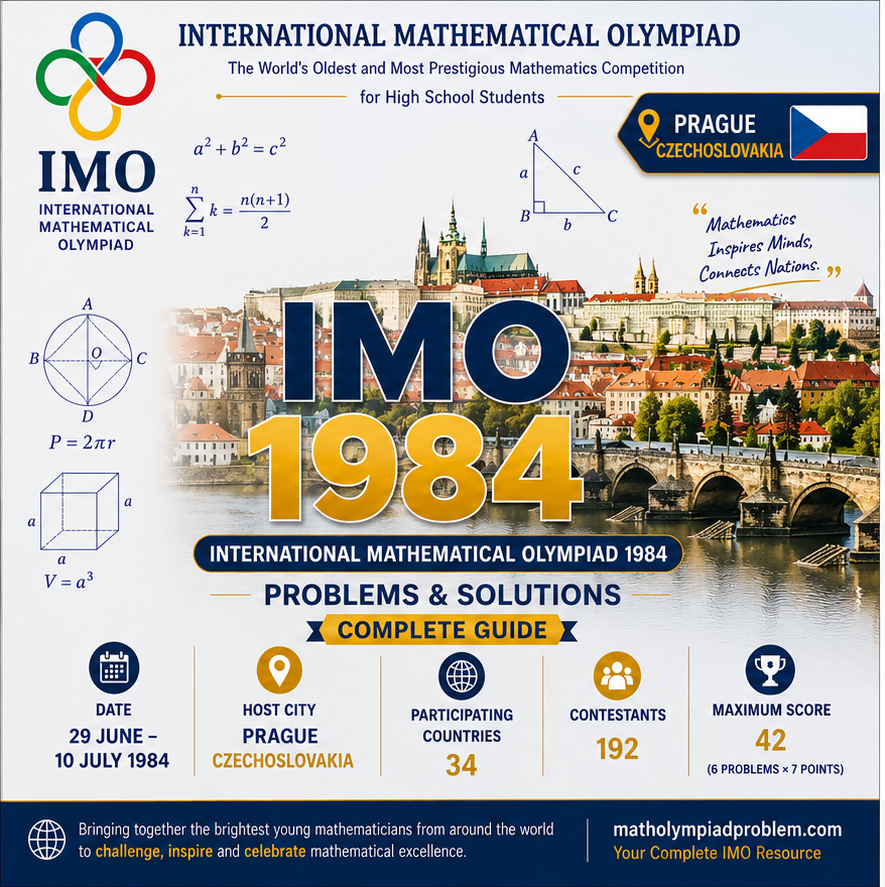
The 25th International Mathematical Olympiad (IMO 1984) was held in Prague, Czechoslovakia (now the Czech Republic) from 29 June to 10 July 1984. This special edition marked the 25th anniversary of the International Mathematical Olympiad, making it one of the most historically significant competitions in Olympiad history. The event brought together 192 contestants from 34 countries, celebrating twenty-five years of international mathematical cooperation and excellence.
The IMO 1984 problem set is regarded as one of the finest collections of Olympiad problems from the early years of the competition. The six carefully designed questions cover the four classical branches of Olympiad mathematics—geometry, algebra, number theory, and combinatorics. Each problem encourages contestants to think creatively, search for elegant mathematical ideas, and communicate their reasoning through clear and rigorous proofs.
More than four decades later, the IMO 1984 problems and solutions continue to be studied by Olympiad students, mathematics teachers, university professors, and national training camps throughout the world. Experienced Olympiad coaches frequently recommend this paper because it develops mathematical maturity, proof-writing ability, and creative problem-solving skills that remain essential in modern competitions.
One of the greatest strengths of IMO 1984 is its exceptional balance. The opening problems introduce important mathematical ideas without overwhelming contestants, while the later problems gradually increase in difficulty and require deeper mathematical insight. This natural progression makes the paper an outstanding resource for students preparing for IMO, IOQM, RMO, INMO, APMO, USAMO, EGMO, BMO, and many other national and international mathematics Olympiads.
Studying IMO 1984 is about much more than learning six official solutions. Every problem teaches students how mathematicians investigate unfamiliar situations, experiment with examples, recognize patterns, simplify complicated ideas, and build convincing mathematical arguments. These habits are valuable not only in Olympiad competitions but also in university mathematics, engineering, computer science, economics, physics, artificial intelligence, and scientific research.
Whether you are beginning your Olympiad journey or preparing for the International Mathematical Olympiad itself, IMO 1984 provides an excellent opportunity to strengthen your mathematical intuition and proof-writing skills.
In this complete guide, we will explore the structure of IMO 1984, discuss its mathematical themes, explain why it remains one of the greatest Olympiad papers ever written, and show how students can use these problems to become stronger mathematical thinkers.
Overview of IMO 1984
| Detail | Information |
|---|---|
| Olympiad | 25th International Mathematical Olympiad |
| Host City | Prague |
| Country | Czechoslovakia (now Czech Republic) |
| Competition Dates | 29 June – 10 July 1984 |
| Participating Countries | 34 |
| Contestants | 192 |
| Total Problems | 6 Proof-Based Problems |
| Examination Days | 2 |
| Time Per Day | 4 Hours 30 Minutes |
| Maximum Score | 42 Marks |
The competition followed the traditional IMO examination format.
Day One
- Problem 1
- Problem 2
- Problem 3
Day Two
- Problem 4
- Problem 5
- Problem 6
Contestants received 4 hours and 30 minutes on each examination day to solve three proof-based problems. Every problem carried 7 marks, making the maximum possible score 42 points. This examination structure has remained almost unchanged because it continues to evaluate mathematical creativity, logical reasoning, and proof-writing ability exceptionally well.
Why IMO 1984 Is Still Worth Studying
Every International Mathematical Olympiad develops its own mathematical identity.
Some competitions become famous for difficult geometry.
Others are remembered for elegant algebra or creative combinatorics.
IMO 1984 is admired because it combines beauty, balance, and educational value.
The opening problems encourage observation and logical reasoning.
The later problems require originality, persistence, and mathematical maturity.
This gradual progression makes IMO 1984 one of the finest training papers for students preparing for international mathematics competitions.
Another reason Olympiad coaches continue recommending IMO 1984 is that every solution demonstrates the importance of elegant mathematical thinking.
Students quickly discover that recognizing hidden structures is far more valuable than performing lengthy calculations.
This lesson remains one of the foundations of successful Olympiad preparation.
The Four Major Areas of Olympiad Mathematics
The IMO 1984 paper includes all four classical Olympiad disciplines.
Geometry
Geometry develops visualization and proof-writing skills.
Important topics include:
- Similar triangles
- Circle geometry
- Angle chasing
- Cyclic quadrilaterals
- Collinearity
- Auxiliary constructions
Many geometry problems become elegant after introducing one carefully chosen construction.
Algebra
Olympiad algebra emphasizes mathematical ideas instead of routine calculations.
Important concepts include:
- Algebraic identities
- Symmetric expressions
- Functional equations
- Strategic substitutions
- Inequalities
Several algebra problems from IMO 1984 demonstrate how one elegant observation can simplify an apparently difficult expression.
Number Theory
Number theory remains one of the most beautiful Olympiad subjects because simple questions often produce surprisingly elegant proofs.
Students preparing with IMO 1984 should review:
- Divisibility
- Congruences
- Modular arithmetic
- Prime numbers
- Greatest common divisors
- Integer equations
Experimenting with small numerical examples often reveals the pattern needed for a complete proof.
Combinatorics
Combinatorics develops logical organization and creative reasoning.
Important techniques include:
- Counting arguments
- Graph theory
- Recursive reasoning
- Invariants
- Extremal Principle
- Mathematical induction
These ideas continue appearing regularly in modern International Mathematical Olympiads.
Difficulty Analysis of IMO 1984
| Problem | Subject | Estimated Difficulty |
|---|---|---|
| Problem 1 | Geometry | ⭐⭐☆☆☆ |
| Problem 2 | Number Theory | ⭐⭐⭐☆☆ |
| Problem 3 | Algebra | ⭐⭐⭐⭐☆ |
| Problem 4 | Combinatorics | ⭐⭐⭐☆☆ |
| Problem 5 | Geometry | ⭐⭐⭐⭐☆ |
| Problem 6 | Advanced Problem Solving | ⭐⭐⭐⭐⭐ |
The paper follows the traditional IMO pattern, beginning with approachable problems before gradually introducing increasingly creative and demanding challenges.
What Makes IMO 1984 Special?
The 25th International Mathematical Olympiad is remembered as a milestone in Olympiad history because it celebrated the competition’s 25th anniversary. The carefully balanced problem set reflects the maturity of the IMO after a quarter century of development. Every problem rewards creativity, elegant reasoning, and rigorous proof-writing rather than complicated calculations. Even today, many experienced coaches recommend IMO 1984 as one of the best papers for students developing advanced proof-based problem-solving skills.
Skills You Will Develop by Studying IMO 1984
Working carefully through the complete IMO 1984 paper helps students develop:
- Creative mathematical thinking
- Proof-writing ability
- Logical reasoning
- Pattern recognition
- Mathematical communication
- Strategic problem solving
- Analytical thinking
- Confidence during competitions
- Persistence when solving unfamiliar problems
These abilities remain valuable in mathematics, engineering, computer science, economics, artificial intelligence, physics, and scientific research.
Before Reading the Solutions
One of the biggest mistakes Olympiad students make is reading the official solutions too early.
Instead, spend time exploring each problem independently.
Draw diagrams.
Test simple numerical examples.
Search for patterns.
Write down your own ideas.
Even unsuccessful attempts strengthen mathematical intuition.
Remember that Olympiad preparation is not about memorizing solutions.
It is about learning how mathematicians think.
More than forty years later, IMO 1984 remains one of the most recommended papers for serious Olympiad students. Its problems demonstrate that beautiful mathematics is built upon elegant ideas rather than complicated calculations. Every question encourages contestants to observe carefully, recognize hidden structures, and construct complete logical proofs instead of relying on memorized techniques.
As an Olympiad coach, I frequently recommend IMO 1984 to students preparing for advanced mathematics competitions because it provides an ideal transition from national Olympiads to international-level problem solving. The opening questions develop confidence, while the later problems gradually require greater creativity, deeper mathematical insight, and stronger proof-writing skills.
One of the most valuable lessons taught by IMO 1984 is patience. Many contestants initially struggle because the correct solution is not immediately obvious. However, by drawing diagrams, investigating small examples, and searching for patterns, students eventually discover the elegant mathematical observation that transforms the entire problem. This habit of thoughtful exploration is one of the defining characteristics of successful mathematicians.
The mathematical skills developed while studying IMO 1984 remain valuable far beyond Olympiad competitions. Logical reasoning, analytical thinking, creativity, and precise communication are essential abilities in mathematics, engineering, computer science, economics, artificial intelligence, physics, and scientific research.
A Coach’s Analysis of Every Problem
Although every IMO problem carries 7 marks, each one measures a different mathematical skill. Understanding these underlying ideas is far more valuable than memorizing the official solutions.
Problem 1 – Geometry
Subject
Geometry
Difficulty
⭐⭐☆☆☆
The opening problem introduces contestants to an elegant geometric configuration that rewards observation more than calculation. Many students immediately begin chasing angles, but experienced Olympiad contestants first spend time studying the diagram carefully. Hidden geometric relationships often become visible only after patient examination. Once the correct construction is introduced, the proof becomes surprisingly elegant.
Important Mathematical Ideas
- Similar triangles
- Circle geometry
- Angle chasing
- Collinearity
- Auxiliary constructions
Coaching Advice
Never begin calculations immediately. Spend several minutes understanding the diagram before writing your proof.
Problem 2 – Number Theory
Subject
Number Theory
Difficulty
⭐⭐⭐☆☆
The second problem illustrates the beauty of Olympiad number theory. Although the statement appears straightforward, solving it requires contestants to recognize important arithmetic relationships and explain why those relationships remain true for every possible case. Careful experimentation often provides the key insight.
Important Concepts
- Divisibility
- Congruences
- Modular arithmetic
- Prime numbers
- Greatest common divisors
Coaching Advice
Always investigate several simple examples before beginning the formal proof. Patterns discovered through experimentation often lead directly to the solution.
Problem 3 – Algebra
Subject
Algebra
Difficulty
⭐⭐⭐⭐☆
The third problem marks a noticeable increase in difficulty. Many contestants attempt lengthy algebraic calculations that soon become complicated. This usually indicates that a more elegant idea exists. The official solution demonstrates how symmetry and a carefully chosen substitution simplify the entire argument.
Important Techniques
- Algebraic identities
- Symmetric expressions
- Strategic substitutions
- Functional reasoning
- Simplification
Coaching Advice
Whenever calculations become longer instead of shorter, stop and search for a different perspective.
Problem 4 – Combinatorics
Subject
Combinatorics
Difficulty
⭐⭐⭐☆☆
The first problem on the second examination day focuses on logical organization rather than computation. Contestants must study smaller cases, recognize mathematical patterns, and gradually construct a rigorous proof. Success depends on careful reasoning and systematic thinking.
Important Mathematical Ideas
- Counting arguments
- Graph theory
- Recursive reasoning
- Invariants
- Extremal Principle
Coaching Advice
Simplify complicated situations by studying smaller examples first. Many combinatorial proofs become obvious after examining simple cases.
Problem 5 – Geometry
Subject
Geometry
Difficulty
⭐⭐⭐⭐☆
Problem 5 is one of the most elegant geometry problems in the competition. Several classical geometric ideas combine naturally to produce a beautiful proof. Contestants soon realize that identifying the correct observation is only half of the challenge. Presenting the reasoning clearly is equally important.
Important Concepts
- Circle geometry
- Similar triangles
- Collinearity
- Angle relationships
- Geometric transformations
Coaching Advice
Write every proof carefully and logically. Clear mathematical communication earns valuable marks.
Problem 6 – The Ultimate Challenge
Subject
Advanced Problem Solving
Difficulty
⭐⭐⭐⭐⭐
The final problem represents the highest level of creativity expected at the International Mathematical Olympiad. Only a small number of contestants solved it completely. Problem 6 rewards originality, persistence, and mathematical maturity rather than technical computation. Even partial progress demonstrates exceptional problem-solving ability.
Skills Required
- Creative reasoning
- Pattern recognition
- Structural thinking
- Generalization
- Advanced proof-writing
View PDF Solution
Coaching Advice
Do not become discouraged if you cannot completely solve Problem 6. Every serious attempt strengthens your mathematical intuition.
Five Common Mistakes Olympiad Students Make
Years of coaching experience reveal several mistakes that appear repeatedly.
1. Reading the Problem Too Quickly
Every word in an Olympiad problem is important. Read the statement carefully before beginning.
2. Beginning Calculations Immediately
Most Olympiad problems reward observation before computation. Search for mathematical patterns first.
3. Ignoring Small Examples
Simple examples frequently reveal the hidden mathematical structure behind difficult problems.
4. Writing Incomplete Proofs
A correct mathematical idea without proper justification cannot receive full marks. Every conclusion must be supported logically.
5. Giving Up Too Early
Many elegant mathematical ideas appear only after several unsuccessful attempts. Persistence is one of the most valuable Olympiad skills.
A Four-Week Study Plan Using IMO 1984
Instead of attempting all six problems in one sitting, study them systematically.
Week One
Solve Problems 1 and 2 under examination conditions. Afterwards, compare your work with the official solutions and understand every logical step.
Week Two
Study Problem 3 carefully. Explore different substitutions and algebraic approaches before reading the official proof.
Week Three
Work through Problems 4 and 5. Rewrite each official solution completely in your own words to strengthen your proof-writing ability.
Week Four
Spend several days investigating Problem 6. Treat it like a mathematical research project rather than an examination question. Discuss different approaches with teachers or fellow Olympiad students whenever possible.
Why Olympiad Coaches Still Recommend IMO 1984
Even after more than forty years, IMO 1984 remains one of the finest Olympiad papers ever created. It teaches students how to recognize mathematical structures, construct elegant proofs, communicate ideas clearly, and think creatively. These abilities continue to define success in modern mathematics Olympiads and advanced university mathematics.
Who Should Study IMO 1984?
The IMO 1984 paper is highly recommended for:
- Students preparing for the International Mathematical Olympiad (IMO)
- IOQM, RMO, and INMO aspirants
- APMO participants
- USAMO, EGMO, and BMO competitors
- Mathematics teachers
- Olympiad coaches
- University students studying proof-based mathematics
Whether your goal is earning an Olympiad medal or becoming a stronger mathematical thinker, IMO 1984 provides outstanding preparation
The 25th International Mathematical Olympiad (IMO 1984) remains one of the landmark competitions in Olympiad history. Hosted in Prague, Czechoslovakia (now the Czech Republic), it celebrated twenty-five years of the International Mathematical Olympiad while presenting six elegant problems that continue to inspire students around the world. Every problem demonstrates that successful mathematics depends on observation, creativity, logical reasoning, and rigorous proof-writing rather than memorized formulas or lengthy calculations. As you work through the IMO 1984 paper, remember that every unsuccessful attempt strengthens your mathematical intuition, every completed proof improves your reasoning, and every elegant idea expands your understanding of mathematics. These six problems remain an outstanding learning resource for every serious Olympiad student.
Frequently Asked Questions (FAQ)
1. Where was IMO 1984 held?
The 25th International Mathematical Olympiad was held in Prague, Czechoslovakia (now the Czech Republic).
2. How many countries participated in IMO 1984?
A total of 34 countries participated, with 192 contestants competing.
3. Why is IMO 1984 historically important?
It celebrated the 25th anniversary of the International Mathematical Olympiad, making it one of the most significant milestones in IMO history.
4. Which mathematical subjects appeared in IMO 1984?
The paper covered the four classical Olympiad disciplines: Geometry, Algebra, Number Theory, and Combinatorics.
5. Is IMO 1984 suitable for beginners?
Yes. Students beginning Olympiad preparation should first attempt Problems 1 and 2 before progressing to the more challenging later problems.
6. Is IMO 1984 still useful for modern Olympiad preparation?
Absolutely. The proof techniques and mathematical ideas introduced in IMO 1984 continue to appear in national Olympiads, international training camps, and advanced mathematics courses.
7. What is the biggest lesson students can learn from IMO 1984?
The greatest lesson is that Olympiad mathematics rewards elegant ideas, creative thinking, and rigorous proofs—not memorized formulas or complicated calculations.
Continue Your Olympiad Journey
After completing IMO 1984, continue your preparation with IMO 1985, IMO 1986, IMO 1987, and IMO 1988. Studying complete IMO papers in chronological order helps you recognize recurring mathematical ideas, strengthen proof-writing skills, and steadily develop the creativity and mathematical maturity required for success in national and international mathematics Olympiads. These classic papers remain among the finest learning resources available for every serious mathematics student.