

Introduction
The International Mathematical Olympiad (IMO) is the world’s most prestigious mathematics competition for secondary school students. Every year, the brightest young mathematicians from around the globe gather to solve six proof-based problems that demand creativity, logical reasoning, and rigorous mathematical proof. Unlike traditional examinations, the IMO rewards originality and deep understanding rather than memorization of formulas. For students preparing for advanced mathematics competitions, studying previous IMO papers is one of the most effective ways to develop problem-solving skills.
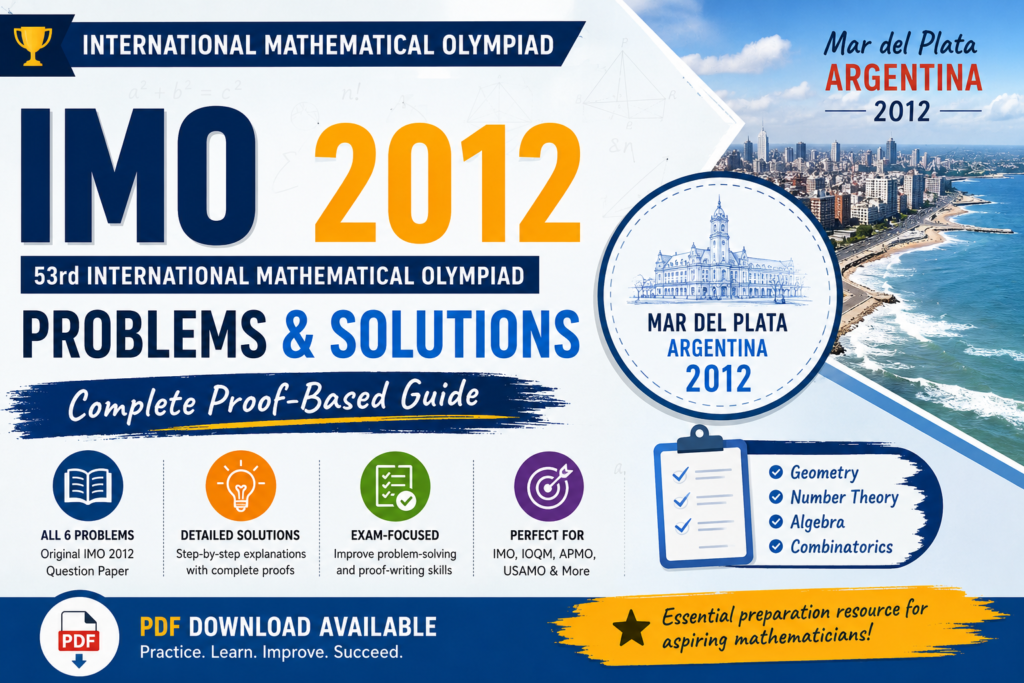
The 53rd International Mathematical Olympiad (IMO 2012) was held in Mar del Plata, Argentina, from 4 July to 16 July 2012. The event welcomed participants from more than 100 countries, making it one of the largest and most competitive mathematics contests in the world. Each participating nation selected its team through a series of challenging national examinations, ensuring that only the best young mathematicians reached the international stage.
The IMO 2012 paper is remembered for its elegant balance between accessibility and depth. Some questions rewarded careful observation and classical mathematical techniques, while others required contestants to discover completely new ideas. This combination makes the 2012 paper an outstanding learning resource for students who wish to strengthen their proof-writing abilities and prepare for future Olympiad competitions.
IMO 2012 at a Glance
| Detail | Information |
|---|---|
| Competition | International Mathematical Olympiad |
| Edition | 53rd IMO |
| Year | 2012 |
| Host City | Mar del Plata |
| Country | Argentina |
| Contest Format | Two Examination Days |
| Total Problems | 6 |
| Marks per Problem | 7 |
| Maximum Score | 42 |
Each contestant solved three problems on the first day and three problems on the second day. Students were given 4 hours and 30 minutes on each examination day to complete their solutions. Every answer had to be presented as a complete mathematical proof, with marks awarded for logical reasoning and mathematical accuracy rather than only the final result.
Why Is IMO 2012 Still Important?
More than a decade after the competition, IMO 2012 continues to be widely studied by students, teachers, and mathematics enthusiasts. The problems remain highly relevant because they introduce timeless mathematical ideas rather than techniques that become outdated. Many national Olympiads and advanced mathematics competitions continue to use similar styles of reasoning.
Working through the IMO 2012 paper helps students improve far more than their competition scores. It develops patience, precision, and the ability to approach unfamiliar problems with confidence. Every carefully written proof teaches valuable lessons about mathematical communication, which is an essential skill in higher education and scientific research.
Students preparing for competitions such as IOQM, APMO, USAMO, BMO, and other national Olympiads often include IMO 2012 in their study plan because of its balanced level of difficulty and its rich collection of mathematical ideas.
Mathematical Topics Covered
Like most International Mathematical Olympiads, the 2012 paper includes problems from the four major branches of Olympiad mathematics.
Geometry
Geometry problems require contestants to analyze carefully constructed figures and discover hidden relationships between points, lines, circles, and angles. Success often depends on drawing accurate diagrams and identifying elegant geometric properties that are not immediately visible.
Number Theory
Number theory explores fascinating properties of integers, divisibility, congruences, and arithmetic relationships. The problems encourage students to search for patterns and justify every conclusion through rigorous mathematical arguments.
Algebra
Algebraic problems extend far beyond equation solving. Students must recognize symmetry, manipulate expressions intelligently, and construct proofs that explain why a mathematical statement is always true.
Combinatorics
Combinatorics focuses on counting methods, arrangements, logical structures, and systematic reasoning. These problems reward organized thinking and the ability to transform complex situations into manageable mathematical arguments.
Together, these four branches provide a complete test of mathematical creativity and analytical ability, making IMO 2012 an excellent practice paper for ambitious students.
Overview of the Six Problems in IMO 2012
The IMO 2012 paper consists of six proof-based problems that test different areas of mathematics. Each problem requires logical reasoning, creativity, and a carefully written proof rather than numerical computation. Together, these problems provide an excellent opportunity to strengthen advanced mathematical thinking.
Problem 1 – Geometry
The first problem introduces a classical geometric configuration and challenges contestants to discover hidden relationships between points, lines, and angles. Although it appears approachable, a successful solution requires careful observation and a well-organized proof. Students practicing this problem improve their diagram interpretation skills and learn how classical geometry can produce elegant results.
Problem 2 – Combinatorics
Problem 2 focuses on combinatorial reasoning and logical organization. Contestants must analyze a mathematical structure, identify useful patterns, and prove that a particular property always holds. This question emphasizes systematic thinking rather than lengthy calculations and rewards students who can organize complex ideas clearly.
Problem 3 – Number Theory
The third problem explores fascinating properties of integers through divisibility and arithmetic relationships. Students are required to combine classical number theory techniques with creative observations to construct a complete proof. The problem demonstrates how simple-looking numerical conditions can lead to surprisingly deep mathematical arguments.
Problem 4 – Geometry
The fourth problem returns to Euclidean geometry with a more challenging configuration involving several constructed points. Contestants must combine multiple geometric ideas such as angle relationships, similar triangles, cyclic figures, or other classical techniques to establish the required result. Accurate diagrams and logical reasoning are essential for success.
Problem 5 – Algebra
Problem 5 examines algebraic structures and encourages students to recognize symmetry, manipulate expressions carefully, and discover hidden mathematical patterns. Rather than relying on routine algebraic manipulation, contestants must develop an elegant argument that explains why the required statement is always true.
Problem 6 – Advanced Geometry
As is traditional in many International Mathematical Olympiads, the sixth problem is among the most difficult questions in the competition. It requires exceptional creativity, deep geometric insight, and the ability to combine several advanced techniques into one complete proof. Although only a small number of contestants solve it completely, studying this problem provides valuable experience in high-level mathematical thinking.
Difficulty Level of IMO 2012
The IMO 2012 paper is generally considered balanced across all six problems. The opening questions provide opportunities for well-prepared contestants to build confidence, while the later problems demand exceptional creativity and persistence.
One of the strengths of this Olympiad is the variety of mathematical techniques required. Contestants cannot rely on a single favorite topic or standard method. Instead, they must adapt their thinking to each new challenge and develop original ideas under examination conditions.
Even experienced Olympiad participants often find themselves exploring several different approaches before discovering the correct proof. This makes the paper an outstanding resource for improving mathematical flexibility and independent thinking.
What Makes the IMO 2012 Problems Special?
One of the greatest strengths of the IMO 2012 paper is the balance between classical mathematical ideas and creative problem solving. Every problem encourages students to move beyond standard textbook methods and develop original approaches. Instead of applying memorized formulas, contestants must analyze unfamiliar situations, identify hidden structures, and construct rigorous proofs from first principles.
For this reason, the IMO 2012 paper remains an excellent training resource for students preparing for national and international mathematics competitions. Working through all six problems not only improves technical knowledge but also develops persistence, creativity, and logical reasoning—qualities that define successful Olympiad mathematicians.
Why Every Olympiad Student Should Study IMO 2012
Previous IMO papers are among the best learning resources available for serious mathematics students. Unlike routine textbook exercises, Olympiad problems encourage exploration and reward creative insight.
Studying IMO 2012 helps students:
- Develop rigorous proof-writing skills.
- Improve logical reasoning and mathematical communication.
- Learn elegant problem-solving strategies.
- Build confidence when facing unfamiliar questions.
- Understand how different areas of mathematics connect with one another.
- Prepare effectively for national and international Olympiad competitions.
Instead of memorizing solutions, students should focus on understanding the key mathematical ideas behind each proof. This approach develops lasting problem-solving ability that can be applied to many future competitions.
How to Use This Guide
This article is designed to help students make the most of the IMO 2012 paper. Rather than rushing directly to a solution, first spend time thinking about each problem independently. Draw diagrams, test examples, look for patterns, and write down every observation that seems useful.
Only after making a serious attempt should you compare your ideas with a detailed explanation. Learning from both successful and unsuccessful attempts is one of the fastest ways to improve in Olympiad mathematics.
In the next part of this guide, we will explore the overall learning value of IMO 2012, discuss effective preparation strategies, answer frequently asked questions, and provide additional resources to help you continue your Olympiad journey.
Continue Reading:
- IMO 2013 Problems and Solutions (Add your internal link:
/imo-2013-problems-and-solutions-pdf/) - IMO 2014 Problems and Solutions (Add your internal link:
/imo-2014-problems-and-solutions-pdf/)
How to Prepare for IMO Using the 2012 Paper
The International Mathematical Olympiad 2012 is more than just a collection of six challenging problems. It is an opportunity to experience the style of thinking expected at the highest level of school mathematics. Every problem encourages students to investigate ideas, test different approaches, and build complete mathematical proofs instead of relying on memorized formulas.
Many successful Olympiad participants recommend solving previous IMO papers because they expose students to a wide variety of mathematical techniques. Even if a problem cannot be solved immediately, studying its underlying ideas helps develop mathematical maturity and improves long-term problem-solving ability.
One of the biggest advantages of practicing with IMO 2012 is that the paper covers multiple branches of mathematics in a balanced way. Students learn how to switch between algebraic reasoning, geometric visualization, number theory arguments, and combinatorial thinking. This flexibility is one of the defining characteristics of successful Olympiad contestants.
Effective Study Strategy
Attempting an IMO paper requires a different mindset from solving ordinary classroom exercises. Instead of focusing on speed, students should concentrate on understanding the structure of each problem.
A useful study routine includes the following steps:
- Read the complete problem carefully before making calculations.
- Draw clear diagrams for geometry problems.
- Look for patterns and special cases.
- Record every useful observation.
- Spend at least one hour exploring different approaches.
- Compare your work with a detailed solution only after making a genuine attempt.
- Rewrite the proof in your own words to reinforce the main mathematical ideas.
Following this process consistently develops stronger reasoning skills than simply reading solutions.
Skills Developed Through IMO 2012
The IMO 2012 paper strengthens several important mathematical abilities that extend far beyond competitions.
Students improve their logical reasoning by learning how to organize complex arguments into clear and convincing proofs. They also develop patience, since many Olympiad problems require exploring several unsuccessful ideas before finding the correct path.
Another important benefit is improved mathematical communication. Writing a complete proof requires every statement to be justified logically, helping students express mathematical ideas with precision and clarity.
Perhaps the greatest lesson of IMO preparation is persistence. Difficult problems often appear impossible during the first reading, but careful analysis and systematic thinking frequently reveal elegant solutions.
Common Mistakes Students Make
Many students find Olympiad mathematics difficult because they approach the problems using school examination techniques. The following mistakes are common among beginners:
- Trying to memorize solution methods instead of understanding mathematical ideas.
- Giving up after only a few minutes.
- Ignoring diagrams or failing to redraw them accurately.
- Writing incomplete proofs that skip important logical steps.
- Concentrating only on calculations instead of searching for patterns.
- Studying solutions without first attempting the problems independently.
Avoiding these mistakes significantly improves both confidence and mathematical ability.
Why Teachers Recommend Previous IMO Papers
Teachers often use previous International Mathematical Olympiad papers because they introduce students to creative mathematics in its purest form.
Unlike routine textbook questions, Olympiad problems encourage investigation, experimentation, and logical reasoning. Students gradually learn that mathematics is not simply about obtaining an answer—it is about explaining why that answer must always be true.
For mathematics clubs, enrichment programs, and Olympiad training camps, IMO 2012 remains an excellent teaching resource because its problems demonstrate many classical proof techniques that continue to appear in national and international competitions.
IMO 2012 Question Paper PDF
Many students prefer practicing directly from the original question paper before reading any explanations. Solving the official paper under timed conditions helps develop mathematical creativity, proof-writing skills, and confidence for future Olympiad competitions.
If you are preparing for the International Mathematical Olympiad, IOQM, APMO, USAMO, or any national mathematics olympiad, we strongly recommend attempting the complete IMO 2012 paper independently before studying detailed solutions.
Who Should Practice IMO 2012?
The IMO 2012 paper is suitable for:
- Students preparing for the International Mathematical Olympiad.
- Participants in IOQM and other national Olympiad programs.
- APMO, BMO, USAMO, and regional Olympiad candidates.
- Mathematics club members.
- Teachers designing enrichment activities.
- Advanced secondary school students interested in proof-based mathematics.
Even students who are not preparing for competitions can benefit from studying these problems because they encourage logical thinking and analytical reasoning.
Frequently Asked Questions
What is the International Mathematical Olympiad?
The International Mathematical Olympiad (IMO) is the world’s most prestigious mathematics competition for secondary school students. Each participating country sends a team of talented young mathematicians selected through national competitions.
Where was IMO 2012 held?
The 53rd International Mathematical Olympiad was hosted in Mar del Plata, Argentina, during July 2012.
How many problems are included in IMO 2012?
The competition consists of six proof-based problems, each carrying 7 marks, giving a maximum possible score of 42 marks.
Which mathematical topics appear in IMO 2012?
The paper includes problems from Algebra, Geometry, Number Theory, and Combinatorics, providing a balanced assessment of mathematical creativity and proof-writing ability.
Is IMO 2012 suitable for beginners?
While the problems are challenging, motivated beginners can still learn a great deal by attempting the questions first and then studying detailed explanations. Regular practice gradually builds confidence and mathematical maturity.
Continue Your Olympiad Preparation
If you found the IMO 2012 paper interesting, continue your preparation by exploring additional International Mathematical Olympiad papers. Studying consecutive years helps you recognize recurring mathematical ideas while exposing you to new proof techniques and problem-solving strategies.
You may also enjoy:
The International Mathematical Olympiad 2012 stands as an excellent example of mathematical beauty, creativity, and logical reasoning. Its six carefully designed proof-based problems continue to inspire students around the world and remain valuable resources for Olympiad preparation. Whether your goal is to qualify for a national mathematics competition or simply become a stronger problem solver, studying the IMO 2012 paper will deepen your understanding of mathematics and improve your ability to think critically.
Remember that success in Olympiad mathematics is built through consistent practice rather than memorization. Every previous IMO paper you solve adds another layer to your mathematical intuition, making future challenges easier to understand. Continue exploring past Olympiads, analyze different proof techniques, and enjoy the process of discovering elegant mathematical ideas. With patience and regular practice, the lessons learned from IMO 2012 can become an important step in your journey toward mastering advanced mathematics.