

Introduction
The 55th International Mathematical Olympiad (IMO 2014) was a remarkable celebration of mathematical talent, bringing together some of the brightest high school students from around the world. Hosted in Cape Town, South Africa, the competition showcased not only outstanding mathematical ability but also the spirit of international friendship and academic excellence that has defined the IMO for more than six decades.
For every contestant, qualifying for the International Mathematical Olympiad is the result of years of dedication and hard work. Before reaching the world stage, students must first excel in regional and national Olympiads, competing against thousands of talented participants in their home countries. By the time they arrive at the IMO, they represent the very best young mathematicians in the world.
Unlike ordinary school examinations, the IMO is designed to reward creativity rather than memorization. Every problem requires careful observation, logical reasoning, and rigorous proof-writing. Contestants are encouraged to experiment with ideas, discover hidden mathematical structures, and communicate their reasoning with precision. This unique approach has made the International Mathematical Olympiad one of the most respected academic competitions worldwide.
The IMO 2014 problem set remains a favorite among teachers and Olympiad coaches because it presents a balanced mix of accessible questions and highly challenging problems. Each question introduces important mathematical ideas while encouraging students to develop independence, patience, and creative thinking.
Whether you are preparing for IOQM, RMO, INMO, USAMO, BMO, or future International Mathematical Olympiads, the IMO 2014 paper is an outstanding resource. Studying these problems not only improves problem-solving skills but also deepens your appreciation for the beauty and elegance of mathematics.
On this page, you can learn about the competition, discover its highlights, and download the complete IMO 2014 Problems and Solutions PDF with detailed solutions for self-study and Olympiad preparation.
IMO 2014 at a Glance
Here are the key facts about the competition.
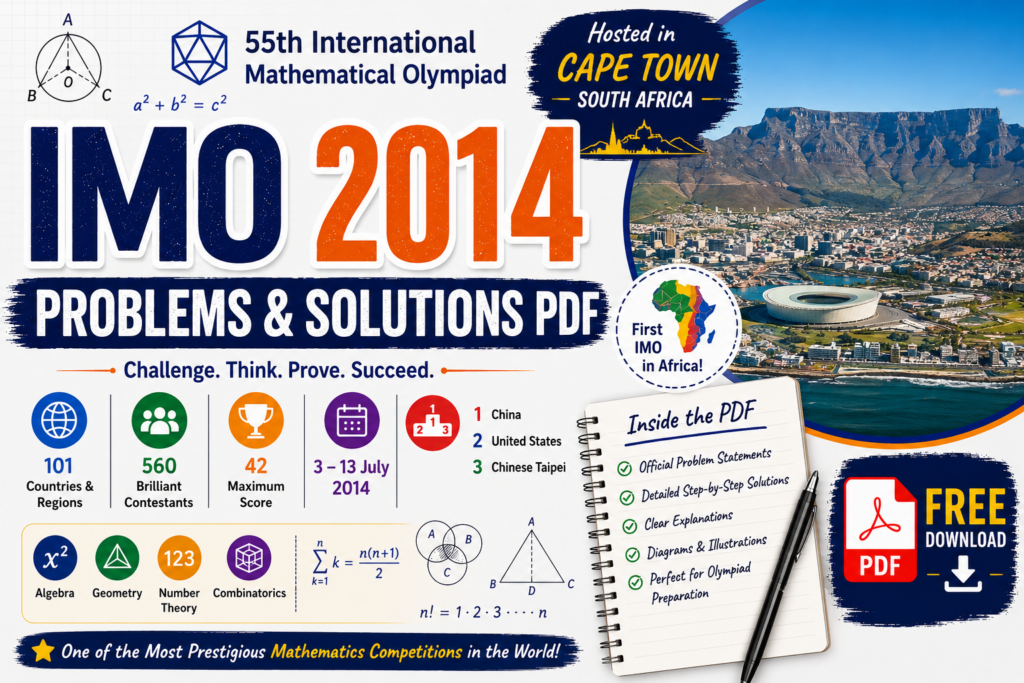
Host City: Cape Town, South Africa
Competition Dates: 3 July – 13 July 2014
Edition: 55th International Mathematical Olympiad
Participating Countries and Regions: 101
Total Contestants: 560
Maximum Score: 42 points (6 problems × 7 points)
The 2014 International Mathematical Olympiad was the first IMO ever hosted in Africa, making it a historic milestone in the competition’s long history. Cape Town provided an inspiring setting for the event, welcoming students, team leaders, coordinators, and observers from every continent.
Beyond the examinations, participants experienced cultural programs, educational activities, and opportunities to meet fellow students who shared the same enthusiasm for mathematics. Many contestants later described these international friendships as one of the most rewarding aspects of the Olympiad.
The event demonstrated that mathematics is truly a universal language capable of connecting people across cultures and national boundaries.
Competition Format
The International Mathematical Olympiad follows a format that has remained consistent for many years, ensuring fairness while giving contestants enough time to explore challenging problems in depth.
The competition is conducted over two examination days.
Each examination day consists of:
- Three proof-based problems
- Four hours and thirty minutes of working time
- A maximum of 21 points
Across both days, contestants attempt six problems, with each problem carrying 7 points, resulting in a maximum possible score of 42 points.
Unlike many competitive examinations, simply obtaining the correct answer is not sufficient. Contestants must provide complete mathematical proofs that clearly explain every step of their reasoning.
Judges evaluate solutions based on mathematical correctness, logical clarity, and completeness. Even partially correct ideas may receive partial credit if they contribute meaningfully toward the final proof.
This emphasis on rigorous reasoning is one of the defining features of the International Mathematical Olympiad and one of the reasons it is so highly respected throughout the mathematical community.
Top Performing Teams
The IMO 2014 competition witnessed exceptional performances from several countries with long traditions of Olympiad excellence.
Overall Team Rankings
🥇 China
🥈 United States
🥉 Chinese Taipei
These teams consistently demonstrated outstanding mathematical ability across all six problems and secured their positions through excellent individual performances.
Many other countries also achieved impressive results, highlighting the increasingly competitive nature of the International Mathematical Olympiad.
Each year, the overall standard of competition continues to rise as more nations invest in mathematical education and Olympiad training.
Why is IMO 2014 Worth Studying?
Every International Mathematical Olympiad introduces students to new mathematical ideas, but the IMO 2014 paper is particularly appreciated because of its thoughtful balance between elegance and difficulty.
Some problems reward careful observation and simple but powerful ideas.
Others require persistence, creativity, and the ability to combine several mathematical techniques into one coherent proof.
Rather than encouraging routine calculations, the paper teaches students how mathematicians actually think when faced with unfamiliar problems.
Working through the IMO 2014 paper helps students develop important skills such as:
- Creative mathematical thinking
- Logical reasoning
- Proof-writing
- Pattern recognition
- Strategic problem solving
- Analytical thinking
- Mathematical communication
These skills are valuable not only for Olympiad competitions but also for university mathematics, engineering, computer science, economics, and many other scientific disciplines.
Mathematical Topics Covered
Like every International Mathematical Olympiad, the 2014 competition explored the four major branches of Olympiad mathematics.
Algebra
The algebra problems challenged contestants to identify hidden relationships between variables and develop elegant arguments rather than relying on lengthy computations.
Many successful solutions involved recognizing symmetry, making clever substitutions, or transforming complicated expressions into simpler forms.
Geometry
Geometry has always been one of the highlights of the IMO, and the 2014 paper continued this tradition.
Contestants were expected to construct accurate diagrams, identify important geometric relationships, and combine classical theorems with original ideas.
The geometry problem rewarded careful visualization and precise logical reasoning.
Number Theory
The number theory problems explored divisibility, integer properties, modular arithmetic, and mathematical structure.
Students needed to think carefully about how numbers behave under different operations while maintaining complete mathematical rigor.
These questions demonstrated why number theory remains one of the most fascinating areas of Olympiad mathematics.
Combinatorics
The combinatorics problems focused on counting methods, arrangements, invariants, and structural reasoning.
Rather than applying memorized formulas, contestants had to discover creative strategies that simplified complicated situations.
Many students consider combinatorics one of the most enjoyable branches of Olympiad mathematics because elegant ideas often emerge from seemingly simple questions.
What Makes IMO 2014 Special?
The IMO 2014 paper continues to be recommended by experienced Olympiad coaches because every problem teaches an important mathematical lesson.
Some questions encourage students to search for hidden symmetry.
Others illustrate the power of contradiction or mathematical induction.
Several problems demonstrate how experimenting with small examples can reveal the general strategy needed for a complete proof.
Perhaps the greatest strength of the IMO 2014 paper is its emphasis on elegant reasoning.
Students quickly discover that successful Olympiad mathematics is not about memorizing advanced formulas but about asking insightful questions, exploring different approaches, and developing ideas patiently.
That is precisely why previous IMO papers remain valuable long after the competition has ended.
Overview of the IMO 2014 Problems
One of the reasons the IMO 2014 paper continues to be widely used in Olympiad training is the quality of its six problems. Each question explores a different branch of mathematics and encourages students to think independently, search for patterns, and construct elegant proofs rather than relying on standard formulas.
The problems gradually increase in difficulty, allowing contestants to build confidence before tackling more demanding challenges. Even today, teachers around the world recommend this paper because it introduces several important mathematical ideas that frequently appear in national and international Olympiads.
Problem 1
The first problem offered contestants a gentle introduction to the competition. Although the statement appeared simple, finding the correct solution required careful observation and a clear understanding of the relationships hidden within the problem.
Students who solved this problem successfully usually recognized an elegant idea early in their work and developed it into a complete mathematical proof.
For anyone beginning Olympiad preparation, Problem 1 is an excellent example of how logical reasoning often proves more valuable than complicated calculations.
Problem 2
The second problem required contestants to investigate a mathematical structure in greater depth.
Rather than applying a familiar method immediately, successful participants experimented with examples, searched for patterns, and gradually discovered the key observation that simplified the entire problem.
This question reminds students that mathematical discovery is often a gradual process. Careful exploration and patience are just as important as technical knowledge.
Problem 3
The final problem of the first examination day represented a significant increase in difficulty.
Contestants needed to combine several mathematical ideas while maintaining complete logical precision throughout their proofs.
Many participants spent a considerable amount of time exploring unsuccessful approaches before identifying the insight that unlocked the solution.
Problem 3 illustrates one of the most important lessons in Olympiad mathematics: perseverance often leads to elegant solutions that are impossible to see at first glance.
Problem 4
The first problem on the second day tested contestants’ ability to organize their mathematical reasoning carefully.
Although the question appeared approachable, writing a complete proof required careful attention to detail and a thorough understanding of the mathematical relationships involved.
Students studying this problem today often appreciate how a seemingly straightforward question can reveal surprisingly deep mathematical ideas.
Problem 5
Problem Five challenged contestants to connect several mathematical concepts into one coherent argument.
The solution required flexibility, creativity, and the ability to view the problem from different perspectives before identifying the most effective strategy.
Many Olympiad coaches continue to use this problem in training sessions because it demonstrates how elegant mathematical ideas can emerge from careful logical reasoning.
Problem 6
The final problem of the competition followed the long-standing IMO tradition of presenting contestants with the most difficult challenge of the examination.
Only a small number of participants produced complete solutions.
Problem Six demanded originality, persistence, and exceptional proof-writing skills. Instead of relying on familiar techniques, contestants had to discover a completely new approach that revealed the hidden mathematical structure of the problem.
Although difficult, studying the official solution provides valuable insight into advanced mathematical thinking and demonstrates how experienced problem solvers approach challenging questions.
Mathematical Ideas Explored in IMO 2014
The IMO 2014 paper introduces students to many techniques that continue to appear in mathematics competitions around the world.
Some of the important ideas include:
- Mathematical induction
- Proof by contradiction
- Extremal Principle
- Invariants and Monovariants
- Symmetry arguments
- Divisibility techniques
- Functional reasoning
- Geometric transformations
- Careful case analysis
- Constructive proofs
Learning these techniques helps students solve a wide variety of Olympiad problems rather than simply memorizing individual solutions.
As students become familiar with these ideas, they begin to recognize similar patterns in many other mathematics competitions.
Why Previous IMO Papers Are So Valuable
One of the most common questions asked by Olympiad students is how they should prepare for higher-level competitions.
Experienced coaches almost always give the same advice: solve previous International Mathematical Olympiad papers.
Unlike many examinations, mathematical ideas never become outdated. A beautiful proof written many years ago remains just as elegant and instructive today.
Working through older IMO papers helps students:
- Develop stronger mathematical intuition.
- Improve proof-writing skills.
- Learn multiple problem-solving strategies.
- Understand Olympiad-style questions.
- Discover elegant mathematical techniques.
- Build confidence before future competitions.
Even if you cannot solve every problem independently, attempting each question before reading the official solution is one of the most effective ways to improve your mathematical ability.
Download IMO 2014 Problems and Solutions PDF
If you prefer studying offline, you can download the complete IMO 2014 Problems and Solutions PDF from this page.
The PDF has been prepared for students, teachers, and mathematics enthusiasts who wish to study the competition in detail.
It includes:
- Official IMO 2014 problem statements
- Complete step-by-step solutions
- Clear mathematical notation
- Accurate diagrams where required
- High-quality formatting suitable for printing
For the best learning experience, try solving each problem yourself before reading the solution. Even unsuccessful attempts strengthen your mathematical intuition and improve your ability to tackle unfamiliar challenges.
The detailed solutions explain not only how each problem is solved but also the mathematical ideas behind every argument, making the PDF a valuable learning resource.
Tips for Studying IMO Problems Effectively
Success in Olympiad mathematics comes from developing good study habits rather than simply reading solutions.
Begin by reading each problem slowly and carefully. Many questions contain small details that become important later in the proof.
Whenever possible, experiment with simple examples. Small cases often reveal useful patterns that guide the general solution.
For geometry problems, draw accurate diagrams and label every important point clearly. A well-prepared figure frequently makes hidden relationships much easier to recognize.
If your first idea does not work, do not become discouraged. Many successful Olympiad solutions are discovered only after exploring several different approaches.
Finally, compare your proof with the official solution only after making a serious attempt yourself. This allows you to appreciate different methods and strengthens your mathematical understanding.
Who Should Study IMO 2014?
The IMO 2014 Problems and Solutions PDF is useful for anyone interested in developing stronger mathematical reasoning.
It is particularly recommended for:
- Students preparing for IOQM
- RMO and INMO aspirants
- National Olympiad participants
- Mathematics teachers
- Olympiad training camps
- Undergraduate students interested in proof-based mathematics
- Anyone who enjoys challenging mathematical problems
Regardless of your current level, every problem offers an opportunity to learn new techniques and develop deeper mathematical insight.
The 55th International Mathematical Olympiad, held in Cape Town, South Africa, occupies a special place in Olympiad history as the first IMO hosted on the African continent. Beyond its historic significance, the competition is remembered for its carefully crafted problems, outstanding organization, and the spirit of international cooperation that brought together talented students from more than one hundred countries.
The IMO 2014 problem set continues to inspire students because it demonstrates that mathematics is far more than calculation. Every problem encourages curiosity, logical reasoning, creativity, and the search for elegant solutions. Some questions reward a single clever observation, while others require patience, experimentation, and deep analytical thinking. Together, they provide an exceptional learning experience for anyone interested in higher mathematics.
Whether your goal is to qualify for future Olympiads, strengthen your proof-writing skills, or simply enjoy solving beautiful mathematical problems, the IMO 2014 Problems and Solutions PDF is an excellent resource. Working through these problems will not only improve your technical ability but also help you develop the habits of careful reasoning and creative thinking that define successful mathematicians.
Download the IMO 2014 Problems and Solutions PDF, challenge yourself with each problem, and enjoy the satisfaction that comes from discovering elegant mathematical ideas. Every solution you understand and every proof you write brings you one step closer to becoming a more confident and capable problem solver.