

Introduction
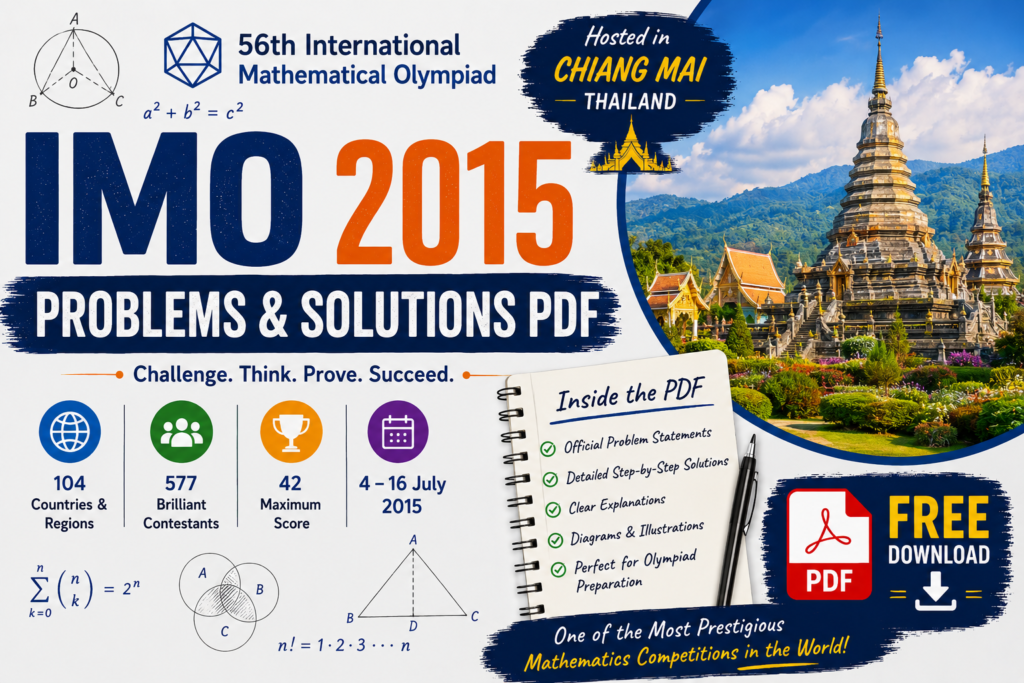
The 56th International Mathematical Olympiad (IMO 2015) holds a special place in the history of international mathematics competitions. Hosted in Chiang Mai, Thailand, the event brought together some of the world’s brightest high school students, each representing their country after successfully passing multiple stages of rigorous national selection. For nearly two weeks, young mathematicians from across the globe gathered not only to compete but also to celebrate their shared passion for mathematics.
The International Mathematical Olympiad is widely regarded as the most prestigious mathematics competition for school students. Since its inception in 1959, the IMO has inspired generations of students to explore mathematics beyond textbooks, encouraging them to think creatively, write rigorous proofs, and solve challenging problems through logical reasoning rather than routine calculations.
The IMO 2015 paper perfectly reflects these ideals. The six problems were carefully designed to test originality, mathematical maturity, and perseverance. Some questions rewarded elegant observations, while others required contestants to combine several advanced ideas before reaching a complete solution. Together, they offered a balanced and rewarding challenge that continues to be studied by Olympiad students around the world.
If you are preparing for competitions such as IOQM, RMO, INMO, USAMO, BMO, or future International Mathematical Olympiads, solving the IMO 2015 problems is an excellent way to improve your mathematical thinking. Even experienced teachers frequently use these problems in Olympiad training camps because they demonstrate beautiful mathematical ideas that remain relevant year after year.
On this page, you can learn about the competition, explore its highlights, and download the complete IMO 2015 Problems and Solutions PDF with detailed solutions for practice and self-study.
IMO 2015 at a Glance
Here are the key facts about the competition.
Host City: Chiang Mai, Thailand
Competition Dates: 4 July – 16 July 2015
Edition: 56th International Mathematical Olympiad
Participating Countries and Regions: 104
Total Contestants: 577
Maximum Score: 42 points (6 problems × 7 points)
The 2015 International Mathematical Olympiad was one of the largest mathematical gatherings ever organized for school students. Participants traveled from every continent, representing diverse cultures, languages, and educational systems. Despite these differences, they all shared a common goal: solving some of the most beautiful mathematical problems ever created.
The event also included cultural activities, excursions, and opportunities for students to meet fellow contestants from around the world. Many participants describe the friendships formed during the Olympiad as one of the most valuable parts of the experience.
Competition Format
The International Mathematical Olympiad follows a format that has remained almost unchanged for decades, allowing every contestant to demonstrate both creativity and endurance.
The competition consists of two examination days.
Each examination day includes:
- Three proof-based problems
- Four hours and thirty minutes of working time
- A maximum score of 21 points
Across both days, contestants attempt a total of six problems, each carrying 7 points, making the highest possible score 42 points.
Unlike many competitive examinations, no multiple-choice questions are used. Every answer must be supported by a complete mathematical proof. Contestants are evaluated not only on arriving at the correct conclusion but also on the clarity, precision, and logical structure of their arguments.
This emphasis on rigorous proof-writing is one of the reasons why the IMO is respected throughout the mathematical community.
Top Performing Teams
The IMO 2015 competition featured exceptional performances from many countries with long traditions of Olympiad excellence.
Overall Team Rankings
🥇 China
🥈 United States
🥉 South Korea
These teams demonstrated remarkable consistency across all six problems and once again highlighted the strength of their mathematics training programs.
Several other countries also achieved outstanding results, reflecting the steadily increasing standard of mathematical competitions worldwide.
Why is IMO 2015 Worth Studying?
Every International Mathematical Olympiad introduces students to new mathematical ideas, but the IMO 2015 paper is especially appreciated because of its balance.
The opening problems are accessible enough to encourage thoughtful exploration, while the later problems challenge even the strongest contestants with deep mathematical ideas.
Unlike routine textbook exercises, Olympiad problems rarely suggest an obvious method of solution. Students must experiment with different approaches, examine patterns, test examples, and gradually develop a complete proof.
Working through the IMO 2015 paper helps students develop important mathematical skills, including:
- Logical reasoning
- Creative thinking
- Proof-writing
- Mathematical communication
- Pattern recognition
- Strategic problem solving
- Analytical thinking
These abilities remain valuable not only for Olympiad competitions but also for university mathematics, computer science, engineering, and scientific research.
Mathematical Topics Covered
The IMO 2015 problems represent the four classical branches of Olympiad mathematics.
Algebra
The algebra problems explored relationships between variables, inequalities, and algebraic identities. Rather than relying on complicated calculations, contestants were expected to identify elegant observations that simplified the problem considerably.
Many students discover that successful algebra solutions often begin with recognizing symmetry or introducing an appropriate substitution.
Geometry
Geometry has always been one of the highlights of the International Mathematical Olympiad, and the 2015 paper continued this tradition.
The geometry problem required contestants to carefully analyze diagrams, identify hidden relationships, and construct rigorous proofs using classical geometric ideas together with original observations.
Drawing an accurate figure and exploring special cases often proved helpful before attempting the complete proof.
Number Theory
The number theory problems focused on properties of integers, divisibility, modular arithmetic, and mathematical structure.
Rather than applying standard formulas, contestants needed to think creatively and carefully justify every logical step.
These problems demonstrate why number theory remains one of the most fascinating areas of Olympiad mathematics.
Combinatorics
The combinatorial questions encouraged contestants to study arrangements, counting methods, invariants, and structural properties.
Success depended less on memorizing techniques and more on discovering elegant strategies that simplified seemingly complicated situations.
Combinatorics continues to be one of the most creative branches of Olympiad mathematics because even simple statements can lead to remarkably deep mathematical arguments.
What Makes IMO 2015 Special?
Many experienced Olympiad coaches recommend the IMO 2015 paper because it provides an excellent introduction to modern Olympiad problem solving.
Each problem teaches a different lesson.
Some encourage contestants to search for symmetry.
Others demonstrate the power of contradiction.
Several problems reward careful experimentation before attempting a formal proof.
Students soon realize that successful Olympiad mathematics is not about remembering advanced theorems. Instead, it is about asking the right questions, making careful observations, and developing ideas step by step.
Perhaps the greatest strength of the IMO 2015 paper is that every solution feels natural once the key idea has been discovered. This is one of the defining characteristics of beautiful mathematics: difficult problems often have surprisingly elegant solutions.
End of Part 1
IOverview of the IMO 2015 Problems
One of the reasons the IMO 2015 paper continues to be recommended by Olympiad trainers is the quality of its problems. Every question explores a different mathematical idea and encourages contestants to think independently rather than apply standard formulas. The paper gradually increases in difficulty, allowing students to build confidence before tackling more demanding challenges.
Although every contestant attempted the same six problems, each question required a unique way of thinking and highlighted a different aspect of mathematical creativity.
Problem 1
The opening problem provided a welcoming start to the competition while still demanding genuine mathematical insight. Rather than relying on complicated computations, contestants needed to recognize an important pattern hidden within the problem.
Students who approached the question patiently often discovered that a simple observation greatly simplified the proof.
Problem 1 demonstrates an important lesson for every Olympiad student: elegant reasoning is usually more valuable than lengthy calculations. It remains an excellent practice problem for anyone beginning serious Olympiad preparation.
Problem 2
The second problem required contestants to examine the relationships between different mathematical objects and gradually uncover the structure hidden beneath the statement.
Unlike routine textbook questions, there was no obvious starting point. Successful participants experimented with examples, looked for symmetry, and carefully refined their ideas before constructing a complete proof.
This problem teaches students the importance of persistence and systematic thinking when solving unfamiliar mathematical challenges.
Problem 3
The final problem of the first examination day represented a noticeable increase in difficulty.
Contestants needed to combine several mathematical techniques while maintaining complete logical precision throughout their arguments.
Many participants spent a significant amount of time exploring different approaches before discovering the key observation that unlocked the solution.
Problem 3 is an excellent reminder that difficult Olympiad questions rarely yield to the first idea that comes to mind. Progress often comes through careful experimentation and thoughtful analysis.
Problem 4
The first problem on the second day encouraged contestants to organize their reasoning carefully.
Although the statement appeared straightforward, writing a complete proof required attention to detail and a clear understanding of the underlying mathematical structure.
Students studying this problem today often appreciate how a seemingly simple question can contain surprisingly deep mathematical ideas.
Problem 5
Problem Five challenged contestants to connect multiple concepts into a single coherent argument.
Success depended on flexibility in thinking and the ability to recognize how different mathematical ideas complemented one another.
Many experienced Olympiad coaches regard this problem as an excellent teaching example because it illustrates how creativity and logical precision work together in advanced mathematics.
Problem 6
As tradition suggests, the final problem of the International Mathematical Olympiad was the most difficult question of the competition.
Only a small number of contestants managed to produce complete solutions.
Problem Six demanded originality, patience, and exceptional proof-writing ability. Rather than following familiar techniques, contestants needed to discover an entirely new perspective that revealed the hidden mathematical structure of the problem.
Although challenging, studying its official solution provides valuable insight into advanced Olympiad thinking and demonstrates how experienced mathematicians approach difficult problems.
Mathematical Ideas Explored in IMO 2015
One of the greatest strengths of previous IMO papers is that they introduce students to mathematical techniques that appear repeatedly in national and international competitions.
The IMO 2015 paper explores many important ideas, including:
- Proof by contradiction
- Mathematical induction
- Invariants and monovariants
- Extremal Principle
- Symmetry arguments
- Divisibility techniques
- Functional reasoning
- Geometric transformations
- Careful case analysis
- Constructive methods
Understanding these techniques is far more valuable than memorizing individual solutions. Once students recognize these ideas, they begin to see similar patterns in many other Olympiad problems.
Why Solving Previous IMO Papers Matters
Many students preparing for mathematics competitions ask where they should focus their efforts.
One of the best answers is simple: solve previous International Mathematical Olympiad papers.
Unlike many competitive examinations, mathematical ideas remain timeless. A beautiful proof written twenty years ago is just as elegant and instructive today.
Working through older IMO papers helps students:
- Understand the style of Olympiad questions.
- Improve proof-writing skills.
- Learn elegant mathematical techniques.
- Develop creative problem-solving strategies.
- Strengthen logical reasoning.
- Build confidence before competitions.
Even if you cannot solve every problem independently, spending time thinking about each question before reading the official solution is one of the most effective ways to improve your mathematical ability.
Download IMO 2015 Problems and Solutions PDF
To help students study the competition more effectively, you can download the complete IMO 2015 Problems and Solutions PDF from this page.
The PDF includes:
- Official IMO 2015 problem statements
- Complete step-by-step solutions
- Clear mathematical notation
- High-quality diagrams where required
- Print-friendly formatting for classroom use and self-study
For the best learning experience, attempt every problem before reading the solution. Even unsuccessful attempts strengthen mathematical intuition and develop the persistence required for higher-level competitions.
The detailed solutions included in the PDF explain not only how each problem is solved but also why the underlying ideas work. Understanding these ideas is the key to becoming a stronger problem solver.
Study Tips for Olympiad Students
Simply reading solutions is rarely enough to improve in mathematics. Real progress comes from actively engaging with each problem.
Before writing anything, read the statement carefully several times. Many Olympiad problems contain subtle details that become important later.
Experiment with small examples whenever possible. Simple cases often reveal patterns that guide the general solution.
For geometry problems, draw accurate diagrams and label every important point. A well-prepared figure frequently makes hidden relationships much easier to recognize.
Do not become discouraged if your first approach fails. Even experienced mathematicians explore several unsuccessful ideas before finding the correct one.
Finally, compare your proof with the official solution only after making a serious attempt yourself. Understanding why another approach succeeds is one of the most valuable parts of the learning process.
Who Will Benefit from This PDF?
The IMO 2015 Problems and Solutions PDF is an excellent resource for a wide range of readers.
It is particularly useful for:
- IOQM aspirants
- RMO and INMO students
- National Olympiad participants
- Mathematics teachers
- Olympiad training camps
- Undergraduate students interested in proof-based mathematics
- Anyone who enjoys solving challenging mathematical problems
Regardless of your current experience, every problem offers an opportunity to develop stronger reasoning skills and discover new mathematical ideas.
The 56th International Mathematical Olympiad, hosted in Chiang Mai, Thailand, remains one of the finest examples of mathematical creativity and intellectual excellence. Its carefully designed problems continue to inspire students, teachers, and mathematics enthusiasts around the world.
What makes IMO 2015 particularly memorable is the balance between accessibility and depth. Some problems begin with simple observations before leading to elegant proofs, while others require persistence, originality, and a willingness to explore unfamiliar ideas. Together, they demonstrate why Olympiad mathematics is admired not only as a competition but also as a beautiful branch of mathematics in its own right.
Whether you are preparing for future Olympiads, strengthening your proof-writing skills, or simply looking for interesting mathematical challenges, the IMO 2015 Problems and Solutions PDF is an invaluable resource. Every problem provides an opportunity to think more deeply, reason more carefully, and appreciate the elegance of mathematical problem solving.
As you work through the problems, remember that improvement comes through patience and consistent practice. Do not worry if a solution is not immediately apparent. Some of the greatest mathematical discoveries begin with curiosity, careful observation, and the determination to keep exploring.
Download the IMO 2015 Problems and Solutions PDF, challenge yourself with each question, and enjoy the rewarding journey of learning from one of the world’s most prestigious mathematics competitions.hematics Olympiads.