

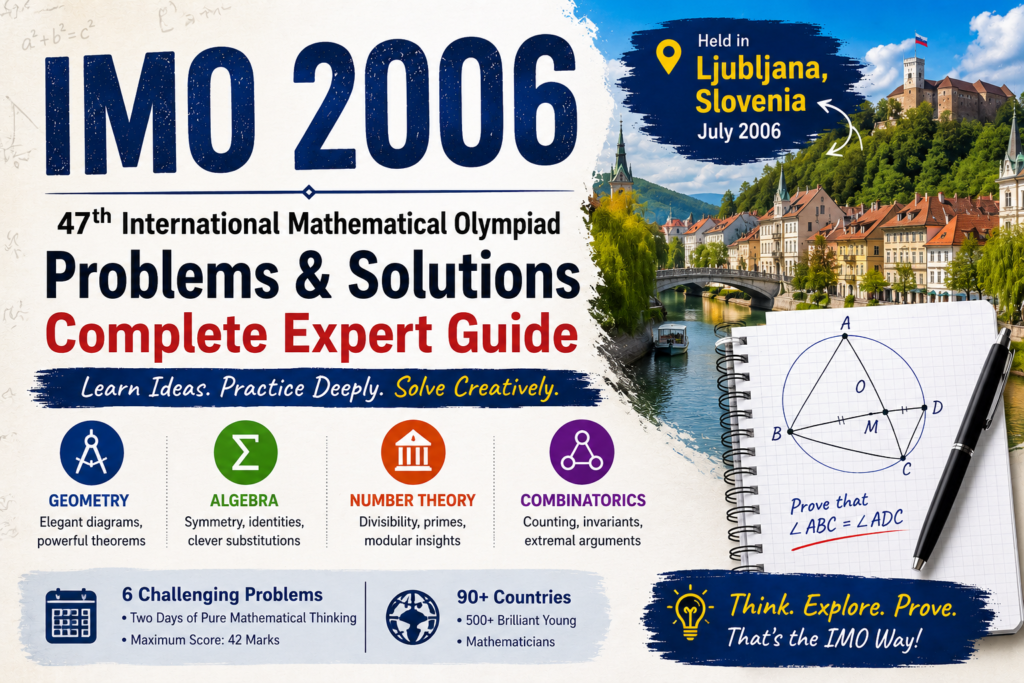
IMO 2006 Problems and Solutions
If you ask experienced Olympiad coaches to name a few International Mathematical Olympiad papers that every serious student should solve, IMO 2006 almost always appears on the list.
Held in Ljubljana, Slovenia, the 47th International Mathematical Olympiad (IMO 2006) brought together hundreds of the world’s most talented young mathematicians for two unforgettable days of mathematical discovery. But what makes this Olympiad special is not simply the medals or the rankings—it is the quality of the problems themselves.
Nearly twenty years later, teachers still recommend the IMO 2006 paper because it represents exactly what Olympiad mathematics should be: elegant, challenging, and deeply rewarding. Every question begins with a simple statement, yet each one invites students to explore ideas that go far beyond ordinary classroom mathematics.
One of the biggest surprises for newcomers is that there are no complicated formulas to memorize. In fact, many students discover that the hardest part is not performing calculations—it is finding the right idea.
That is why IMO 2006 remains such a valuable learning resource. It teaches students how mathematicians actually think.
Whether you are preparing for the International Mathematical Olympiad (IMO), IOQM, APMO, USAMO, BMO, or another national Olympiad, studying the 2006 paper will strengthen your mathematical reasoning in ways that ordinary textbooks simply cannot.
Quick Overview of IMO 2006
| Detail | Information |
|---|---|
| Olympiad | 47th International Mathematical Olympiad |
| Host City | Ljubljana |
| Country | Slovenia |
| Year | 2006 |
| Competition Dates | July 2006 |
| Problems | 6 Proof-Based Problems |
| Duration | Two Competition Days |
| Time Allowed | 4 hours 30 minutes each day |
| Maximum Score | 42 Marks |
Like every International Mathematical Olympiad, contestants solved three problems on each day.
Day One
- Problem 1
- Problem 2
- Problem 3
Day Two
- Problem 4
- Problem 5
- Problem 6
Every question carried 7 points, but anyone who has studied Olympiad mathematics knows that all seven marks are certainly not equally easy to earn.
Why IMO 2006 Is Still Studied Today
Thousands of Olympiad papers have been written over the years, so why do coaches continue recommending IMO 2006?
The answer is surprisingly simple.
This paper teaches thinking, not techniques.
Many school mathematics exams reward students who remember formulas or practice enough similar questions. Olympiad mathematics works differently.
Imagine standing in front of a locked door without knowing where the key is hidden.
That is what solving an IMO problem feels like.
You experiment.
You make mistakes.
You test ideas.
Sometimes you spend thirty minutes going in the wrong direction before suddenly noticing one beautiful observation that changes everything.
That experience is exactly what IMO 2006 offers.
Four Branches of Mathematics in One Competition
Every International Mathematical Olympiad aims to test different kinds of mathematical thinking.
The IMO 2006 paper includes problems from all four major Olympiad subjects.
Geometry
Geometry has always been one of the most loved areas of Olympiad mathematics.
The geometry questions in IMO 2006 remind students that a well-drawn figure can be just as powerful as a page full of calculations.
Contestants learn to look for:
- Hidden equal angles
- Similar triangles
- Cyclic quadrilaterals
- Circle properties
- Strategic constructions
One lesson becomes obvious very quickly:
The diagram is trying to tell you something.
Learning to “read” a diagram is one of the most valuable Olympiad skills.
Number Theory
At first glance, number theory often looks simple.
After all, the problems involve ordinary integers.
But simplicity can be deceptive.
The number theory question from IMO 2006 asks students to explore patterns hidden inside integers, divisibility, and modular arithmetic.
Instead of applying formulas, students must build logical arguments step by step.
This is one reason many mathematicians consider number theory one of the most beautiful branches of mathematics.
Algebra
Olympiad algebra rarely resembles the algebra taught in school.
Instead of solving routine equations, contestants search for symmetry, substitutions, and unexpected relationships.
The algebra problem from IMO 2006 rewards students who ask questions like:
“Can this expression be rewritten?”
“Is there a hidden pattern?”
“What happens if I substitute another variable?”
Often, the simplest observation unlocks the entire solution.
Combinatorics
Combinatorics is sometimes called the mathematics of clever thinking.
Many students initially expect complicated counting formulas.
Instead, Olympiad combinatorics asks something completely different:
“Can you explain why something must happen?”
The problems encourage students to think about structure rather than arithmetic.
Concepts such as invariants, graph theory, and extremal arguments appear naturally throughout Olympiad combinatorics, making it one of the most creative subjects in competitive mathematics.
Difficulty Analysis
Every IMO paper follows a familiar pattern.
The first problem is usually approachable for well-prepared students, while the final problem is designed to challenge even future mathematicians.
A reasonable difficulty breakdown for IMO 2006 is shown below.
| Problem | Subject | Relative Difficulty |
|---|---|---|
| Problem 1 | Geometry | ⭐⭐☆☆☆ |
| Problem 2 | Number Theory | ⭐⭐⭐☆☆ |
| Problem 3 | Algebra | ⭐⭐⭐⭐⭐ |
| Problem 4 | Combinatorics | ⭐⭐⭐☆☆ |
| Problem 5 | Geometry | ⭐⭐⭐⭐☆ |
| Problem 6 | Number Theory / Combinatorics | ⭐⭐⭐⭐⭐ |
This gradual increase in difficulty is intentional. It allows students of different abilities to demonstrate what they know while still providing the strongest contestants with problems that demand exceptional creativity.
What Makes IMO 2006 Different?
Having coached Olympiad students for many years, one thing becomes clear.
Students rarely remember the hardest calculations.
They remember the beautiful ideas.
IMO 2006 contains several moments where an apparently impossible problem suddenly becomes manageable because of one clever observation.
These are the moments that change the way students think about mathematics.
Instead of asking,
“Which formula should I use?”
students begin asking,
“What is this problem trying to tell me?”
That change in mindset is exactly what Olympiad training is meant to achieve.
Skills You’ll Build by Solving IMO 2006
Working through the complete IMO 2006 paper develops far more than technical knowledge.
Students gradually become better at:
- Writing complete mathematical proofs instead of incomplete arguments.
- Seeing patterns that others overlook.
- Breaking difficult problems into smaller pieces.
- Remaining calm when a solution is not immediately obvious.
- Communicating mathematical ideas clearly and logically.
- Thinking creatively under time pressure.
These are not just Olympiad skills—they are habits that benefit anyone studying mathematics, engineering, computer science, economics, or scientific research.
Before You Read the Solutions…
One mistake many students make is opening the official solution after only a few minutes.
Try not to do that.
If a problem feels difficult, that usually means you are learning.
Even spending an hour exploring unsuccessful ideas is valuable because it develops mathematical intuition.
The goal is not simply to know the answer.
The goal is to become the kind of mathematician who can discover the answer independently.
If there is one lesson that every Olympiad student eventually learns, it is this:
Great problems are remembered long after the competition ends.
That is exactly why the IMO 2006 paper is still discussed in Olympiad classrooms, university mathematics clubs, and national training camps nearly two decades later. The problems are challenging, but more importantly, they teach students how to think like mathematicians.
As an Olympiad coach, I often tell students not to measure their progress by the number of problems they solve, but by the number of new ideas they discover. IMO 2006 is full of those ideas.
Let’s look at each problem from that perspective.
Problem 1 – Geometry
Topic
Geometry
Difficulty
⭐⭐☆☆☆ (Accessible)
The opening problem is an excellent example of how the IMO welcomes contestants into the competition.
The diagram appears straightforward, but appearances can be deceptive. Students who immediately begin calculating angles often become stuck. Those who pause to study the figure usually notice a hidden relationship that makes the proof almost inevitable.
This is a classic Olympiad lesson: observation comes before calculation.
Ideas Behind the Problem
Instead of searching for formulas, students are encouraged to explore relationships such as:
- Similar triangles
- Equal angles
- Circle properties
- Cyclic quadrilaterals
- Auxiliary constructions
Coaching Tip
Whenever you face a geometry problem, ask yourself:
“What is missing from this diagram?”
Sometimes adding one carefully chosen line reveals the entire solution.
Problem 2 – Number Theory
Topic
Number Theory
Difficulty
⭐⭐⭐☆☆
The second problem shifts the focus from diagrams to logical reasoning.
At first, the problem seems to involve routine properties of integers. However, after a few minutes, most students realize that direct computation is unlikely to succeed.
The key is to recognize a hidden pattern and develop a proof based on that observation.
Important Mathematical Ideas
- Divisibility
- Modular arithmetic
- Prime factorization
- Integer properties
Coaching Advice
One habit separates experienced Olympiad students from beginners:
Before attempting a proof, they experiment.
Testing five or six small numerical examples often reveals patterns that are impossible to notice otherwise.
Never underestimate the power of experimentation.
Problem 3 – Algebra
Topic
Algebra
Difficulty
⭐⭐⭐⭐⭐
Problem 3 is where Day One becomes significantly more demanding.
Many contestants spend a long time manipulating expressions without making real progress.
The official solution reminds us of one of the most important principles in Olympiad mathematics:
Complicated calculations usually indicate that you haven’t discovered the main idea yet.
The strongest students search for symmetry instead of computation.
Mathematical Techniques
- Symmetry
- Algebraic identities
- Strategic substitutions
- Functional thinking
- Simplification
Coaching Tip
Whenever an algebraic expression looks complicated, stop calculating for a moment and ask:
“Can I rewrite this in a simpler way?”
That question often leads directly to the breakthrough.
Problem 4 – Combinatorics
Topic
Combinatorics
Difficulty
⭐⭐⭐☆☆
The first problem on the second day introduces a completely different style of thinking.
Unlike geometry or algebra, combinatorics rarely offers an obvious starting point.
Students must investigate the structure of the problem before attempting any formal proof.
Key Concepts
- Counting arguments
- Invariants
- Extremal Principle
- Logical deduction
What Makes This Problem Interesting?
There is rarely a standard method.
Instead, contestants gradually build intuition by exploring examples until a hidden structure becomes visible.
This process closely resembles mathematical research.
Problem 5 – Geometry
Topic
Geometry
Difficulty
⭐⭐⭐⭐☆
Many students consider this one of the most beautiful problems in the competition.
Unlike the first geometry question, this problem combines several different ideas into one elegant argument.
The challenge is not simply discovering the right theorem.
It is understanding how multiple geometric observations fit together.
Concepts Used
- Similar triangles
- Circle geometry
- Collinearity
- Angle chasing
- Geometric transformations
Coaching Insight
Students sometimes lose marks not because their mathematics is incorrect, but because their proofs are difficult to follow.
A beautiful proof tells a story.
Every sentence should naturally lead to the next.
Problem 6 – Advanced Number Theory and Combinatorics
Topic
Advanced Problem Solving
Difficulty
⭐⭐⭐⭐⭐
Like many final IMO problems, Problem 6 is designed to stretch even the strongest contestants.
Only a small percentage of participants earned full marks.
The problem requires persistence, creativity, and the willingness to abandon several unsuccessful approaches before finding the correct one.
Mathematical Ideas
- Advanced logical reasoning
- Structural arguments
- Generalization
- Deep pattern recognition
Coaching Advice
If you cannot solve Problem 6 completely, don’t be discouraged.
Even understanding the official solution carefully is valuable.
Many former IMO medalists admit that they also struggled with final problems during their preparation.
MO 2006 pdf
Five Lessons Every Student Can Learn from IMO 2006
After teaching Olympiad mathematics for many years, I’ve noticed that papers like IMO 2006 teach lessons that go far beyond individual problems.
1. Read Slowly
Many students lose marks because they misunderstand one sentence in the problem statement.
Read carefully.
Then read again.
Olympiad problems are written with remarkable precision.
2. Don’t Rush Into Calculations
Whenever students tell me,
“I’ve already filled two pages of calculations,”
my first question is usually,
“Have you actually found the idea?”
In Olympiad mathematics, ideas are worth more than calculations.
3. Draw Better Diagrams
A clean diagram often reveals relationships that remain hidden in the text.
Professional geometers redraw figures several times before beginning a proof.
Good diagrams save time.
4. Learn From Failed Attempts
Some of the best mathematical discoveries begin with unsuccessful ideas.
Do not erase your work immediately.
Sometimes yesterday’s failed approach becomes tomorrow’s breakthrough.
5. Finish Every Proof
Never assume that something is “obvious.”
Olympiad mathematics rewards complete logical arguments.
If one step is missing, the proof is incomplete.
A Four-Week Training Plan Using IMO 2006
If you’re serious about improving your Olympiad skills, don’t try to finish the paper in one day.
Instead, study it gradually.
Week 1
Attempt Problems 1 and 2 under timed conditions.
Afterward, compare your proofs with the official solutions.
Notice not only what you missed but also why the official arguments are more elegant.
Week 2
Focus entirely on Problem 3.
Even if you don’t solve it, spend several hours exploring different approaches.
That experience is valuable.
Week 3
Study Problems 4 and 5.
Rewrite the official proofs in your own words.
If you can explain a proof clearly without looking at the solution, you’ve truly understood it.
Week 4
Work on Problem 6.
Treat it like a research project.
Discuss ideas with friends or teachers.
Explore different methods.
There is no need to rush.
Why Teachers Still Recommend IMO 2006
One reason this paper has stood the test of time is its balance.
It doesn’t rely on obscure tricks or highly specialized knowledge.
Instead, it rewards qualities that every mathematician should develop:
- Curiosity
- Patience
- Precision
- Creativity
- Logical reasoning
That is exactly what makes it such an effective teaching tool.
Who Should Study This Paper?
IMO 2006 is ideal for:
- Students preparing for the International Mathematical Olympiad
- IOQM and RMO aspirants
- APMO participants
- USAMO and BMO students
- Mathematics teachers
- Olympiad coaches
- University students interested in proof-based mathematics
Even if you are not planning to compete internationally, solving these problems will improve the way you think about mathematics.
The 47th International Mathematical Olympiad (IMO 2006) is much more than a collection of six challenging questions. It captures the essence of mathematical problem solving—careful observation, creative thinking, and the satisfaction of discovering an elegant idea after persistent effort.
One of the biggest mistakes students make is believing that strong mathematicians solve every problem quickly. The reality is very different. Experienced problem solvers spend time exploring, making mistakes, revising their ideas, and gradually refining their arguments. That process is not a sign of weakness—it is the heart of mathematics.
If you decide to study the IMO 2006 paper, don’t judge your progress only by the number of problems you solve. Instead, pay attention to the habits you develop along the way. Learn to read problems patiently, draw accurate diagrams, test simple examples, and write proofs that are both correct and easy to follow. These habits will serve you well in every future Olympiad and throughout your mathematical journey.
Frequently Asked Questions (FAQ)
1. Where was the International Mathematical Olympiad 2006 held?
The 47th International Mathematical Olympiad took place in Ljubljana, Slovenia.
2. How many problems were included in IMO 2006?
The competition consisted of six proof-based problems, with three problems solved on each of the two competition days.
3. Which mathematical topics appeared in the IMO 2006 paper?
The paper covered the four core areas of Olympiad mathematics:
- Geometry
- Algebra
- Number Theory
- Combinatorics
4. Is IMO 2006 suitable for beginners?
Yes. Students who are new to Olympiad mathematics should begin with Problems 1 and 2, which introduce important techniques without the extreme difficulty of the later questions.
5. How should I study the IMO 2006 paper?
Attempt each problem independently before reading the official solution. After understanding the official proof, rewrite it in your own words. This process strengthens both mathematical understanding and proof-writing skills.
6. Is IMO 2006 still relevant for modern Olympiad preparation?
Absolutely. The ideas and proof techniques found in IMO 2006 remain fundamental to Olympiad training and continue to be used in mathematics camps, national training programs, and university enrichment courses around the world.
7. What is the biggest lesson students can learn from IMO 2006?
Perhaps the most important lesson is that great mathematics is driven by ideas, not by complicated calculations. The ability to recognize patterns, ask the right questions, and construct clear logical proofs is far more valuable than memorizing formulas.
Continue Your Olympiad Journey
If you found the IMO 2006 paper inspiring, continue your preparation by solving IMO 2005, IMO 2007, IMO 2008, and IMO 2009. Studying complete Olympiad papers year by year allows you to build mathematical maturity, discover a wide variety of proof techniques, and develop the confidence needed to tackle increasingly difficult problems. Over time, you’ll begin to notice recurring ideas across different years—a clear sign that you’re learning to think like an Olympiad mathematician rather than simply solving individual questions.