

IMO 2009 Problems and Solutions
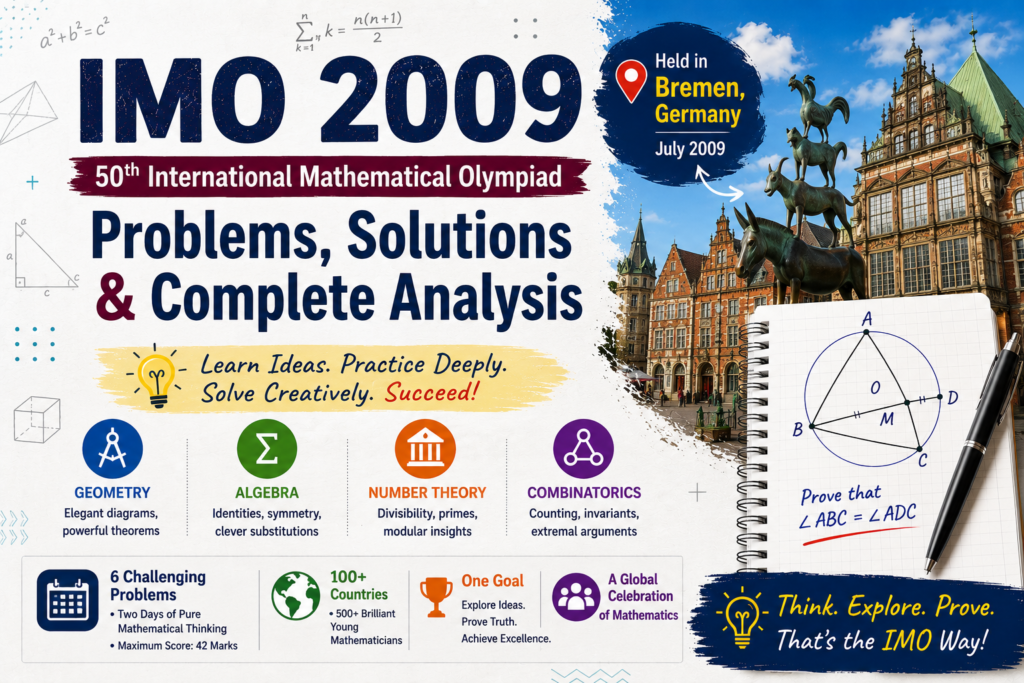
The 50th International Mathematical Olympiad (IMO 2009) was a landmark event in the history of mathematical competitions. Hosted in Bremen, Germany, from 10 July to 22 July 2009, the competition celebrated the golden jubilee of the International Mathematical Olympiad. Students, team leaders, and mathematicians from around the world gathered to commemorate fifty years of excellence in mathematical problem solving while competing in one of the world’s most prestigious academic contests.
The IMO is far more than a competition. It is a celebration of creativity, logical reasoning, and elegant mathematical thinking. Every problem is carefully selected to reward insight rather than memorization, making the IMO the ultimate challenge for talented young mathematicians.
The IMO 2009 paper is widely respected for its balanced mix of geometry, algebra, number theory, and combinatorics. It offers students an excellent opportunity to develop proof-writing skills and experience the style of questions that appear in top international Olympiads.
Whether you are preparing for the IMO, IOQM, APMO, USAMO, BMO, or another national Olympiad, studying the IMO 2009 problems is one of the best ways to strengthen your mathematical foundation.
Overview of IMO 2009
| Detail | Information |
|---|---|
| Olympiad | 50th International Mathematical Olympiad |
| Year | 2009 |
| Host City | Bremen |
| Country | Germany |
| Competition Dates | 10–22 July 2009 |
| Problems | 6 |
| Competition Days | 2 |
| Time Allowed | 4 hours 30 minutes each day |
| Maximum Score | 42 Marks |
| Participating Countries | More than 100 |
| Participants | Over 550 students |
As in every IMO, contestants solved three problems on each competition day.
- Day 1: Problems 1, 2 and 3
- Day 2: Problems 4, 5 and 6
Each problem was worth 7 points, giving a maximum possible score of 42 points.
Why IMO 2009 Is an Important Olympiad Paper
The fiftieth IMO marked an important milestone, and the problem selection reflected the spirit of the event. The paper combines approachable opening problems with exceptionally challenging final questions, encouraging students to think creatively and communicate their ideas through rigorous proofs.
Unlike many school mathematics examinations, the IMO does not reward the memorization of formulas. Instead, contestants must analyze unfamiliar situations, identify patterns, and construct logical arguments from first principles.
For aspiring Olympiad students, the IMO 2009 paper serves as an excellent introduction to advanced mathematical reasoning.
Subjects Covered in IMO 2009
The six problems represent the four major branches of Olympiad mathematics.
Geometry
Geometry problems in IMO 2009 require careful observation and elegant reasoning. Students encounter ideas involving circles, triangles, angle relationships, and geometric transformations. Rather than relying on coordinate geometry or lengthy calculations, these problems reward clear visual thinking and well-organized proofs.
Algebra
The algebra problem challenges students to recognize hidden structures within equations and expressions. Success often comes from identifying symmetry, making clever substitutions, or transforming the problem into a more familiar form.
Number Theory
The number theory question explores the fascinating properties of integers. Contestants must apply logical reasoning to divisibility, modular arithmetic, and arithmetic structures while avoiding unnecessary calculations.
Combinatorics
Combinatorics focuses on arrangements, counting techniques, and logical structures. These problems encourage creative thinking and frequently involve invariants, extremal principles, or graph-theoretic ideas.
Difficulty Analysis
Like every International Mathematical Olympiad, the six problems increase gradually in difficulty.
| Problem | Subject | Difficulty |
|---|---|---|
| Problem 1 | Geometry | ★★☆☆☆ |
| Problem 2 | Algebra | ★★★☆☆ |
| Problem 3 | Number Theory | ★★★★★ |
| Problem 4 | Combinatorics | ★★★☆☆ |
| Problem 5 | Geometry | ★★★★☆ |
| Problem 6 | Algebra / Combinatorics | ★★★★★ |
Problems 1 and 2 were accessible to well-prepared contestants, while Problems 3 and 6 demanded exceptional creativity and persistence.
What Makes IMO 2009 Unique?
The IMO 2009 paper is admired for several reasons.
Elegant Problem Design
Every question has a clean statement that can be understood with elementary mathematics, yet solving it requires deep insight.
Balanced Difficulty
The paper progresses naturally from approachable problems to highly challenging ones, allowing contestants of different skill levels to demonstrate their abilities.
Timeless Mathematical Ideas
Although the competition took place in 2009, the techniques introduced remain highly relevant for modern Olympiad preparation.
Skills You Develop by Studying IMO 2009
Working through the complete paper helps students improve:
- Proof-writing ability
- Logical reasoning
- Mathematical creativity
- Pattern recognition
- Strategic problem-solving
- Precision in mathematical communication
- Confidence in tackling unfamiliar problems
These skills are valuable not only for mathematics competitions but also for university studies in mathematics, computer science, engineering, and related fields.
Competition Format
Each contestant received three proof-based problems per day and had 4 hours and 30 minutes to solve them.
Unlike standard examinations, answers alone receive little credit. Every claim must be supported by a complete mathematical argument. Judges evaluate both the correctness of the solution and the clarity of the proof.
This emphasis on communication is one of the defining features of the International Mathematical Olympiad.
Why Every Olympiad Student Should Solve IMO 2009
Many successful IMO medalists recommend solving complete past papers instead of studying isolated techniques. The IMO 2009 paper provides an excellent opportunity to experience the rhythm of an actual international competition.
Attempting the problems under timed conditions helps students:
- Improve time management.
- Learn how to choose which problem to attempt first.
- Practice writing clear and organized proofs.
- Build confidence in handling unfamiliar questions.
Even if you cannot solve every problem, carefully studying the official solutions afterward will deepen your understanding of advanced mathematical techniques.
we explored the history of the 50th International Mathematical Olympiad (IMO 2009), its competition format, major mathematical topics, and why this paper remains one of the best resources for Olympiad preparation.
In this second part, we’ll examine each problem from an Olympiad coach’s perspective, discuss the mathematical ideas involved, identify common mistakes, and explain how students can use the IMO 2009 paper to improve their proof-writing and problem-solving abilities.
Problem-by-Problem Overview
Every International Mathematical Olympiad paper follows a carefully planned progression in difficulty. Although each problem is worth 7 marks, the required level of creativity increases significantly from Problem 1 to Problem 6.
Rather than focusing on memorizing solutions, students should understand the underlying mathematical ideas behind each problem.
Problem 1 – Geometry
Subject
Geometry
Difficulty
⭐⭐☆☆☆ (Easy to Moderate)
The opening problem of IMO 2009 introduces a classical geometric configuration. While the statement appears simple, the challenge lies in identifying hidden relationships between angles, lines, and circles.
Students who carefully analyze the diagram before beginning calculations usually discover an elegant path to the solution.
Important Concepts
- Angle chasing
- Similar triangles
- Circle geometry
- Cyclic quadrilaterals
- Auxiliary constructions
Olympiad Insight
One of the biggest lessons from this problem is that drawing an extra line or identifying a hidden cyclic quadrilateral can dramatically simplify the proof.
Experienced Olympiad students rarely rush into calculations—they first search for geometric patterns.
Problem 2 – Algebra
Subject
Algebra
Difficulty
⭐⭐⭐☆☆
Problem 2 challenges contestants to manipulate algebraic expressions while recognizing symmetry and hidden structures.
Although the calculations themselves are not excessively difficult, choosing the correct transformation requires creativity.
Mathematical Techniques
- Symmetry
- Algebraic identities
- Clever substitutions
- Rearranging expressions
What You Learn
Olympiad algebra emphasizes elegant reasoning rather than lengthy computations.
Students should always ask:
“Can this expression be rewritten in a simpler form?”
That single question often leads to the key idea.
Problem 3 – Number Theory
Subject
Number Theory
Difficulty
⭐⭐⭐⭐⭐
Problem 3 is widely regarded as one of the most demanding questions on the first day.
The statement involves integers and divisibility, but the solution requires far more than applying standard formulas.
Students typically begin by experimenting with small examples before discovering the deeper mathematical pattern.
Key Concepts
- Divisibility
- Modular arithmetic
- Prime numbers
- Integer properties
Olympiad Lesson
Successful number theory solutions often begin with careful experimentation.
Testing several small cases helps reveal the structure hidden inside the problem.
Problem 4 – Combinatorics
Subject
Combinatorics
Difficulty
⭐⭐⭐☆☆
Problem 4 opens the second day with an interesting combinatorial challenge.
Rather than counting objects directly, contestants must recognize a logical structure that remains unchanged throughout the problem.
Important Ideas
- Counting arguments
- Invariants
- Extremal Principle
- Logical deduction
Learning Outcome
This problem teaches students to think about why a process behaves in a certain way rather than simply performing calculations.
Problem 5 – Geometry
Subject
Geometry
Difficulty
⭐⭐⭐⭐☆
The second geometry problem of IMO 2009 is considerably more sophisticated than the first.
Contestants must combine multiple geometric observations into one complete proof.
This problem rewards organization and patience.
Concepts Used
- Circle theorems
- Similarity
- Collinearity
- Angle relationships
- Geometric transformations
Olympiad Insight
Many students discover the correct idea but lose marks because their proof is not logically organized.
Writing mathematics clearly is just as important as finding the solution.
Problem 6 – Advanced Algebra and Combinatorics
Subject
Algebra / Combinatorics
Difficulty
⭐⭐⭐⭐⭐
The final problem represents the highest level of difficulty in the competition.
Only a small percentage of contestants worldwide obtained full marks.
Problem 6 requires exceptional creativity, persistence, and the ability to combine multiple mathematical ideas.
Important Techniques
- Structural reasoning
- Advanced inequalities
- Combinatorial arguments
- Generalization
- Elegant proof construction
What Students Learn
Even making partial progress on this problem demonstrates strong Olympiad ability.
Do not become diuraged if you cannot solve it completely.
Common Mistakes Students Make
After teaching Olympiad mathematics for many years, coaches notice the same mistakes repeatedly.
Avoiding these errors can dramatically improve performance.
1. Reading Too Quickly
Many contestants misunderstand the problem statement because they rush through it.
Read every condition carefully before starting.
2. Starting Calculations Immediately
Olympiad problems reward observation.
Spend several minutes looking for patterns before writing equations.
3. Ignoring Small Examples
Testing simple cases often reveals hidden mathematical structure.
Professional problem solvers almost always begin with experimentation.
4. Writing Incomplete Proofs
A correct answer without logical justification receives very little credit.
Every mathematical claim must be explained.
5. Giving Up Too Early
Many successful IMO contestants spend more than an hour exploring unsuccessful approaches before finding the key idea.
Persistence is an essential Olympiad skill.
How to Prepare Using IMO 2009
The IMO 2009 paper is an excellent self-study resource.
A structured approach might look like this:
Week 1
Solve Problems 1 and 2.
Focus on writing neat, complete proofs.
Week 2
Study Problem 3 carefully.
Even if you cannot solve it independently, understanding the official solution will strengthen your number theory skills.
Week 3
Attempt Problems 4 and 5.
Pay close attention to proof organization.
Week 4
Work on Problem 6.
Treat it as a research problem rather than an examination question.
Explore different ideas without worrying about finishing immediately.
Why Official Solutions Are So Valuable
After attempting each problem independently, compare your work with the official solution.
Doing so helps you learn:
- Elegant proof techniques
- Alternative approaches
- Better mathematical notation
- Efficient reasoning
- Professional presentation style
Sometimes the official proof is surprisingly short, showing that the best Olympiad solutions rely on insight rather than lengthy calculations.
Who Should Study IMO 2009?
The IMO 2009 paper is ideal for:
- IMO aspirants
- IOQM students
- APMO participants
- USAMO and BMO candidates
- National Olympiad qualifiers
- Mathematics teachers
- Undergraduate students interested in proof-based mathematics
It is also an excellent resource for anyone who enjoys solving challenging mathematical puzzles.
The 50th International Mathematical Olympiad (IMO 2009) is much more than a collection of six difficult problems—it represents fifty years of mathematical excellence, creativity, and international collaboration. Each question encourages students to think independently, explore multiple approaches, and communicate their ideas through precise and elegant proofs.
One of the greatest strengths of the IMO 2009 paper is its balance. The problems are challenging enough to stretch advanced students while remaining accessible to anyone willing to think deeply and persist through difficult moments. As you work through the problems, remember that struggling is a natural part of the learning process. Every unsuccessful attempt helps develop the intuition needed for future success.
Instead of memorizing techniques, focus on understanding why each proof works. Over time, you’ll begin to recognize common Olympiad strategies, spot hidden patterns more quickly, and develop the confidence to tackle unfamiliar problems. These are the habits that distinguish accomplished Olympiad mathematicians and continue to benefit students throughout their academic and professional careers.
Frequently Asked Questions (FAQ)
1. Where was IMO 2009 held?
The 50th International Mathematical Olympiad took place in Bremen, Germany.
2. Why is IMO 2009 historically significant?
It marked the 50th anniversary of the International Mathematical Olympiad, making it a milestone event in the history of mathematical competitions.
3. How many problems were included?
The competition consisted of six proof-based problems, with three problems solved on each of the two competition days.
4. Which mathematical subjects appeared?
The paper covered Geometry, Algebra, Number Theory, and Combinatorics, reflecting the traditional structure of the IMO.
5. Is IMO 2009 suitable for beginners?
Students new to Olympiad mathematics should begin with Problems 1 and 2. The later problems are significantly more challenging and are best attempted after gaining experience with proof-based problem solving.
6. How should I study this paper?
Attempt each problem independently under timed conditions before reading the official solution. Afterwards, rewrite the proof in your own words to strengthen your understanding and proof-writing skills.
7. Is the IMO 2009 paper still useful today?
Yes. The mathematical ideas, proof techniques, and problem-solving strategies remain timeless and continue to be used in Olympiad training camps around the world.
Continue Your Olympiad Preparation
If you’ve completed the IMO 2009 paper, continue your training with other classic Olympiad collections such as:
- IMO 2008 Problems and Solutions
- IMO 2010 Problems and Solutions
- IMO 2011 Problems and Solutions
- APMO Previous Year Papers
- IOQM Previous Year Questions
- USAMO and BMO Archives
Studying complete Olympiad papers year by year is one of the most effective ways to build mathematical maturity, improve proof-writing, and prepare for national and international mathematics competitions.
This detailed analysis will help you understand not only how the problems are solved, but also how experienced Olympiad mathematicians think when approaching challenging proof-based questions.