

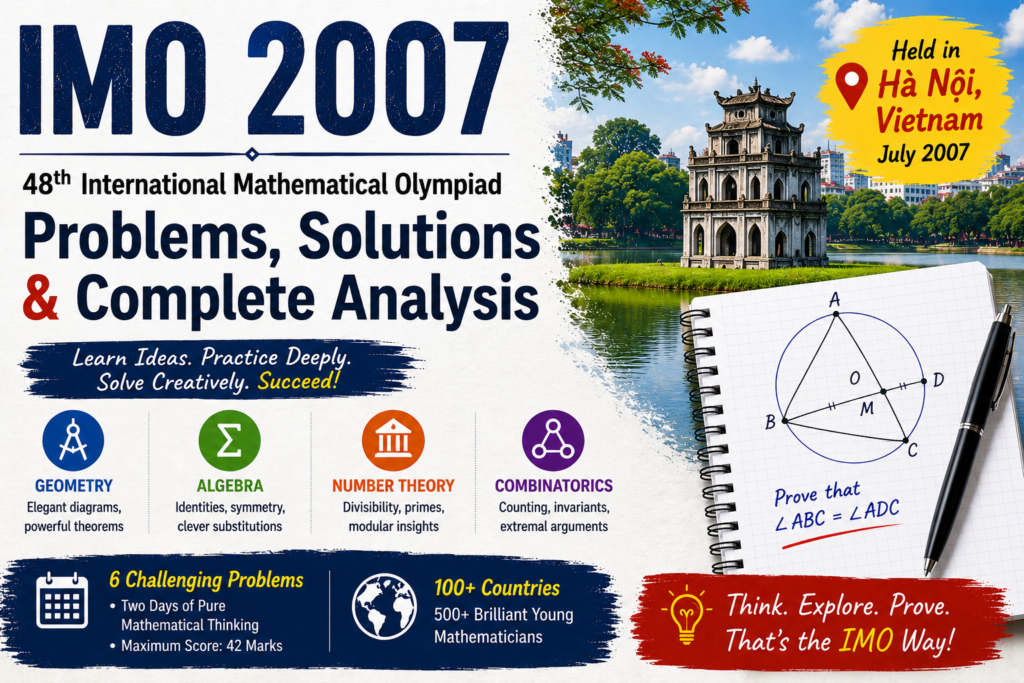
IMO 2007 Problems and Solutions
The 48th International Mathematical Olympiad (IMO 2007) was held in Hà Nội, Vietnam, from 19 July to 31 July 2007. As one of the world’s most prestigious mathematics competitions for secondary school students, the event brought together exceptionally talented young mathematicians from across the globe. More than 90 countries participated, making the competition a remarkable celebration of mathematical excellence, cultural exchange, and academic achievement.
The International Mathematical Olympiad is unlike any ordinary examination. Contestants are not asked to recall formulas or solve routine textbook exercises. Instead, they face six carefully designed proof-based problems that require creativity, logical reasoning, and deep mathematical insight. Every solution must be justified with a complete proof, making the IMO one of the most challenging academic competitions in the world.
The IMO 2007 paper is widely appreciated for its elegant problem design and balanced selection of topics. It contains beautiful examples of Geometry, Algebra, Number Theory, and Combinatorics, making it an outstanding resource for students preparing for the IMO, IOQM, APMO, USAMO, BMO, and other national mathematics Olympiads.
Whether you are an aspiring Olympiad contestant, a mathematics teacher, or simply someone who enjoys challenging mathematical problems, studying IMO 2007 will help you develop stronger reasoning skills and a deeper appreciation for proof-based mathematics.
Overview of IMO 2007
| Detail | Information |
|---|---|
| Olympiad | 48th International Mathematical Olympiad |
| Year | 2007 |
| Host City | Hà Nội |
| Country | Vietnam |
| Competition Dates | 19–31 July 2007 |
| Competition Format | Two Days |
| Total Problems | 6 |
| Time Allowed | 4 hours 30 minutes each day |
| Maximum Score | 42 Marks |
| Participating Countries | More than 90 |
| Participants | Over 500 students |
Like every International Mathematical Olympiad, the examination was divided into two competition days.
Day 1
- Problem 1
- Problem 2
- Problem 3
Day 2
- Problem 4
- Problem 5
- Problem 6
Each problem was worth 7 points, giving contestants a maximum possible score of 42 points.
Why Every Olympiad Student Should Study IMO 2007
One of the reasons the IMO 2007 paper continues to be recommended by Olympiad coaches is its excellent balance between accessibility and challenge. The opening problems allow well-prepared students to build confidence, while the later problems require deeper mathematical insight and originality.
Unlike many competitive examinations that reward speed, the IMO rewards thoughtful problem solving. Contestants are expected to explore ideas, recognize patterns, test conjectures, and construct rigorous mathematical proofs.
Studying the IMO 2007 paper helps students understand how professional mathematicians approach unfamiliar problems and gradually transform observations into complete logical arguments.
Mathematical Topics Covered
The six problems in IMO 2007 represent the four major branches of Olympiad mathematics.
Geometry
Geometry plays an important role in the IMO 2007 paper. The problems require students to investigate relationships between points, lines, angles, and circles while constructing elegant proofs.
Important techniques include:
- Angle chasing
- Similar triangles
- Circle theorems
- Cyclic quadrilaterals
- Geometric constructions
Rather than relying on coordinate geometry, contestants are encouraged to use classical Euclidean methods.
Algebra
The algebra problem demonstrates how symmetry and careful manipulation can simplify seemingly difficult expressions.
Students preparing for Olympiad algebra should be comfortable with:
- Polynomial identities
- Symmetric expressions
- Functional reasoning
- Clever substitutions
- Inequalities
One of the defining features of Olympiad algebra is that elegant ideas almost always outperform lengthy calculations.
Number Theory
Number theory remains one of the most fascinating areas of Olympiad mathematics because simple statements often conceal surprisingly deep ideas.
The number theory problem in IMO 2007 explores integer properties through logical deduction.
Students strengthen their understanding of:
- Divisibility
- Prime numbers
- Modular arithmetic
- Greatest common divisors
- Integer equations
Success depends on recognizing mathematical structure rather than memorizing formulas.
Combinatorics
Combinatorics challenges students to think creatively about arrangements, counting, and logical structures.
Unlike standard counting problems, Olympiad combinatorics often requires identifying invariants or extremal configurations.
Key concepts include:
- Counting arguments
- Graph theory
- Invariants
- Extremal Principle
- Recursive reasoning
Developing strong combinatorial intuition is one of the most valuable skills for future Olympiad success.
Difficulty Analysis of IMO 2007
The IMO follows a carefully designed progression in difficulty.
| Problem | Subject | Difficulty |
|---|---|---|
| Problem 1 | Geometry | ★★☆☆☆ |
| Problem 2 | Number Theory | ★★★☆☆ |
| Problem 3 | Algebra | ★★★★★ |
| Problem 4 | Combinatorics | ★★★☆☆ |
| Problem 5 | Geometry | ★★★★☆ |
| Problem 6 | Combinatorics | ★★★★★ |
Problems 1 and 2 are generally considered accessible to well-prepared contestants, while Problems 3 and 6 require exceptional creativity and advanced proof-writing skills.
What Makes IMO 2007 Special?
Although every International Mathematical Olympiad is unique, the 2007 paper has earned a reputation for its elegant balance and memorable problem design.
Elegant Mathematical Ideas
Each problem has a short, clear statement, yet the underlying mathematics is rich and thought-provoking.
Strong Balance Across Topics
Students gain valuable experience in all four major Olympiad subjects, making the paper ideal for comprehensive preparation.
Creative Proof Techniques
Several official solutions rely on a single clever observation rather than lengthy calculations, demonstrating one of the fundamental principles of Olympiad mathematics: elegance is often more powerful than complexity.
Lasting Educational Value
Even today, IMO 2007 remains a popular training paper in mathematics camps, enrichment programs, and Olympiad coaching sessions around the world.
Skills You Will Develop
Carefully working through the IMO 2007 problems helps students improve much more than technical knowledge.
The paper develops:
- Logical reasoning
- Mathematical creativity
- Proof-writing ability
- Pattern recognition
- Analytical thinking
- Precision in mathematical communication
- Confidence when approaching unfamiliar problems
These skills continue to be valuable in university mathematics, computer science, engineering, economics, and scientific research.
Competition Strategy for IMO 2007
Many experienced Olympiad coaches recommend the following approach when attempting the paper:
- Read all three problems before deciding where to begin.
- Start with the problem that appears most approachable.
- Draw accurate diagrams for geometry questions.
- Test small examples in algebra and number theory problems.
- Write complete proofs instead of jumping directly to conclusions.
- Leave sufficient time to review your arguments and correct any logical gaps.
Remember that Olympiad mathematics rewards careful reasoning more than speed.
.
Problem-by-Problem Overview
Like every International Mathematical Olympiad, the IMO 2007 examination consists of six carefully selected proof-based problems. Although each problem is worth 7 marks, they test different mathematical abilities and gradually increase in difficulty.
The goal is not simply to solve the problems but to develop the habits of thinking that define successful Olympiad mathematicians.
Problem 1 – Geometry
Subject
Geometry
Difficulty
⭐⭐☆☆☆ (Easy to Moderate)
The opening problem presents a classical geometric configuration that rewards observation more than computation.
Students must carefully examine relationships between angles, lines, and circles before deciding which theorem to apply. The official solution is remarkably elegant because it relies on identifying one key geometric relationship rather than performing lengthy calculations.
Important Concepts
- Similar triangles
- Angle chasing
- Circle theorems
- Cyclic quadrilaterals
- Auxiliary constructions
Expert Insight
Many contestants immediately search for formulas, but experienced Olympiad students first ask:
“What hidden geometric relationship is the diagram trying to reveal?”
This habit often leads directly to the correct proof.
Problem 2 – Number Theory
Subject
Number Theory
Difficulty
⭐⭐⭐☆☆
Problem 2 investigates interesting properties of integers and divisibility.
Although the statement appears simple, the challenge lies in recognizing patterns and constructing a rigorous proof using logical arguments.
Mathematical Techniques
- Divisibility
- Modular arithmetic
- Prime factorization
- Greatest common divisors
- Integer reasoning
Olympiad Lesson
Before writing equations, experiment with several small examples.
Many beautiful number theory proofs begin by discovering a pattern through experimentation.
Problem 3 – Algebra
Subject
Algebra
Difficulty
⭐⭐⭐⭐⭐
The third problem is one of the most demanding questions on the first competition day.
Contestants must identify hidden symmetry within algebraic expressions and transform the problem into a simpler form.
Rather than relying on difficult calculations, success depends on recognizing the correct mathematical structure.
Key Concepts
- Symmetry
- Polynomial identities
- Functional reasoning
- Algebraic transformations
- Inequalities
Expert Insight
Olympiad algebra teaches an important lesson:
The best solution is usually the simplest one—not the longest one.
A clever substitution often replaces several pages of calculations.
Problem 4 – Combinatorics
Subject
Combinatorics
Difficulty
⭐⭐⭐☆☆
The first problem on Day 2 focuses on logical reasoning and mathematical structure.
Students must analyze arrangements carefully and identify an invariant or extremal configuration that simplifies the problem.
Important Ideas
- Counting techniques
- Invariants
- Extremal Principle
- Logical deduction
Learning Outcome
Problem 4 demonstrates that combinatorics is not merely about counting objects—it is about understanding why certain mathematical structures behave the way they do.
Problem 5 – Geometry
Subject
Geometry
Difficulty
⭐⭐⭐⭐☆
The second geometry problem is considerably more sophisticated than Problem 1.
Contestants must combine several classical geometric results into one elegant proof.
The challenge is not only discovering the correct idea but also presenting it clearly and logically.
Mathematical Tools
- Circle geometry
- Similar triangles
- Collinearity
- Angle relationships
- Geometric transformations
Olympiad Lesson
A beautifully organized proof often receives full credit more easily than a correct but confusing argument.
Clear mathematical communication is one of the defining features of successful Olympiad contestants.
Problem 6 – Advanced Combinatorics
Subject
Combinatorics
Difficulty
⭐⭐⭐⭐⭐
The final problem represents the highest level of creativity expected in the competition.
Only a relatively small number of contestants around the world earned full marks on this question.
Its solution requires patience, careful experimentation, and the ability to connect several advanced mathematical ideas.
Important Techniques
- Graph theory
- Advanced counting
- Structural reasoning
- Extremal arguments
- Generalization
Learning Outcome
Even making significant progress on Problem 6 is an excellent achievement.
Students should view this problem as an opportunity to develop mathematical maturity rather than simply trying to finish it quickly.
IMO 2007 PDF solution
Common Mistakes Students Make
While studying IMO 2007, students often encounter the same challenges.
Recognizing these mistakes can help you improve more quickly.
1. Reading Too Quickly
Olympiad problems are carefully worded.
Missing a single condition can completely change the nature of the problem.
Take time to understand every sentence before beginning.
2. Beginning Calculations Too Early
Many contestants assume that difficult problems require complicated calculations.
In reality, the strongest Olympiad solutions usually begin with careful observation and planning.
Spend a few minutes searching for patterns before writing equations.
3. Ignoring Small Examples
Testing small cases is one of the most effective problem-solving techniques.
Simple examples frequently reveal hidden structures that later become the foundation of the proof.
4. Writing Incomplete Proofs
A correct answer without logical justification earns very little credit.
Every statement must follow logically from previous arguments.
Remember that the IMO evaluates mathematical reasoning, not just final answers.
5. Losing Confidence
Some IMO problems are intentionally designed to challenge even the world’s strongest students.
Do not become discouraged if you cannot solve every question.
Persistence is one of the most important qualities of an Olympiad mathematician.
How to Study IMO 2007 Effectively
To gain the maximum benefit from this paper, avoid reading the official solutions immediately.
Instead, follow a structured study plan.
Week 1
Attempt Problems 1 and 2 under examination conditions.
Review your proofs carefully before comparing them with the official solutions.
Week 2
Study Problem 3.
Even if you cannot solve it independently, understanding the official ideas will strengthen your algebraic thinking.
Week 3
Work on Problems 4 and 5.
Pay particular attention to proof presentation and logical organization.
Week 4
Spend several days exploring Problem 6.
Treat it as a research problem.
Experiment with different ideas without worrying about obtaining a complete solution immediately.
Why Official Solutions Are Important
After attempting each problem independently, compare your work with the official solutions.
Doing so helps you learn:
- Elegant proof-writing
- Efficient mathematical arguments
- Alternative solution methods
- Better mathematical notation
- Professional presentation style
One of the most surprising aspects of Olympiad mathematics is that the official solutions are often much shorter than students expect.
This demonstrates the value of insight over computation.
Who Should Study IMO 2007?
The IMO 2007 paper is highly recommended for:
- Students preparing for the International Mathematical Olympiad (IMO)
- IOQM aspirants
- APMO participants
- National Mathematics Olympiad qualifiers
- USAMO and BMO students
- Mathematics teachers and Olympiad coaches
- Undergraduate students interested in proof-based mathematics
Because of its balanced problem selection, it is suitable for both independent study and classroom discussion.
The 48th International Mathematical Olympiad (IMO 2007) remains a timeless collection of mathematical ideas that continue to inspire students around the world. More than just a competition paper, it is a lesson in creativity, logical reasoning, and the art of constructing elegant proofs. Each problem encourages students to think independently, test ideas carefully, and appreciate the beauty of mathematics beyond routine calculations.
As you work through the IMO 2007 problems, remember that progress comes through persistence. Few students solve every problem on their first attempt, and even experienced Olympiad participants often spend hours exploring different approaches before finding the key insight. Every unsuccessful attempt teaches valuable lessons that improve your mathematical intuition.
The best way to benefit from this paper is to solve each problem honestly, compare your work with the official solutions, and then rewrite the proofs in your own words. Over time, this process develops the confidence, precision, and creativity needed for success in national and international mathematics competitions.
Frequently Asked Questions (FAQ)
1. Where was IMO 2007 held?
The 48th International Mathematical Olympiad was hosted in Hà Nội, Vietnam.
2. How many problems were included?
Contestants solved six proof-based problems, divided equally over two competition days.
3. What topics appeared in IMO 2007?
The paper covered all four major Olympiad subjects:
- Geometry
- Algebra
- Number Theory
- Combinatorics
4. How difficult is the IMO 2007 paper?
The paper is considered well-balanced. Problems 1 and 2 are accessible to well-prepared students, while Problems 3 and 6 are significantly more challenging and require advanced problem-solving skills.
5. Is IMO 2007 suitable for beginners?
Yes. Beginners should start with the first two problems and gradually work toward the more difficult questions as their proof-writing skills improve.
6. What is the best way to prepare using this paper?
Attempt each problem under timed conditions, avoid reading the solution immediately, and compare your proof with the official one only after making a genuine effort. Rewriting the solution in your own words is an excellent way to reinforce understanding.
7. Is IMO 2007 still relevant today?
Absolutely. The mathematical ideas, proof techniques, and strategies featured in IMO 2007 remain fundamental to Olympiad training and are still studied in mathematics camps and enrichment programs around the world.
Continue Your Olympiad Journey
Once you have completed the IMO 2007 paper, continue building your skills by studying IMO 2006, IMO 2008, IMO 2009, and IMO 2010. Solving complete papers year by year exposes you to a wide variety of proof techniques, strengthens your mathematical intuition, and prepares you for increasingly challenging competitions. Consistent practice, careful reflection, and a willingness to learn from every problem are the keys to becoming a successful Olympiad mathematician.