

Introduction
The International Mathematical Olympiad (IMO) is the world’s oldest and most prestigious mathematics competition for secondary school students. Every year, talented young mathematicians from across the globe compete by solving six challenging proof-based problems that test creativity, logical reasoning, and mathematical rigor. Unlike standard school examinations, the IMO encourages students to discover original ideas, build elegant arguments, and present complete mathematical proofs.
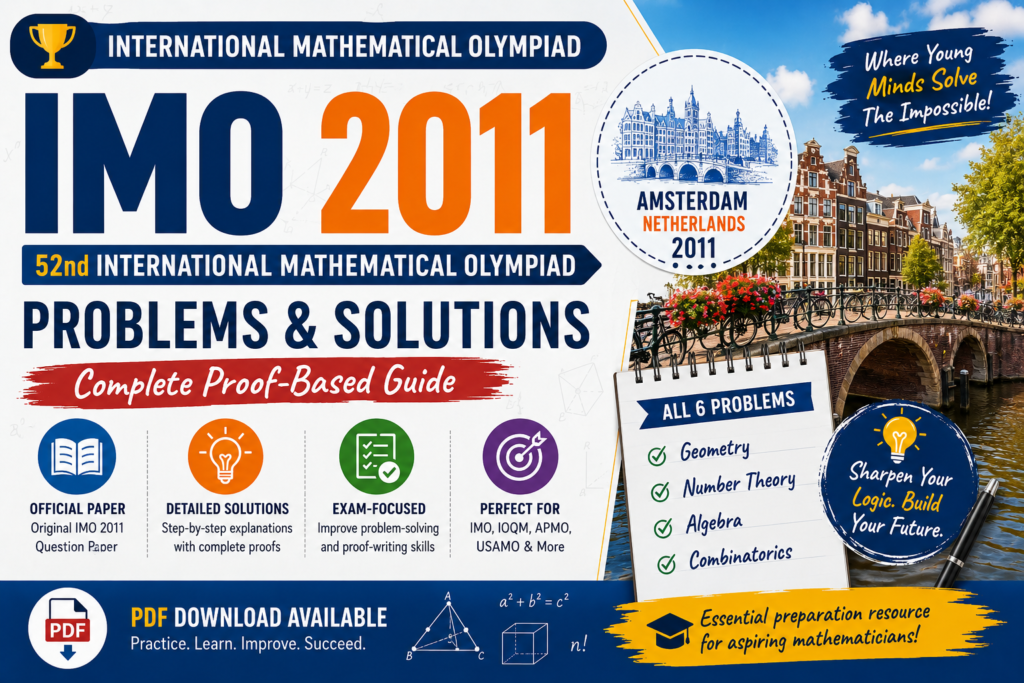
The 52nd International Mathematical Olympiad (IMO 2011) was held in Amsterdam, Netherlands, from 12 July to 24 July 2011. The competition welcomed participants from more than one hundred countries, making it one of the largest international academic events for school students. Each nation selected its six-member team through highly competitive national Olympiads, ensuring that only the country’s strongest young mathematicians reached the international stage.
The IMO 2011 paper is widely appreciated for its balanced combination of classical mathematics and creative problem solving. Some questions reward careful observation and systematic reasoning, while others demand deep insight and advanced proof techniques. Because of this balance, the 2011 paper remains an excellent learning resource for students preparing for national and international mathematics competitions.
IMO 2011 at a Glance
| Detail | Information |
|---|---|
| Competition | International Mathematical Olympiad |
| Edition | 52nd IMO |
| Year | 2011 |
| Host City | Amsterdam |
| Country | Netherlands |
| Contest Format | Two Examination Days |
| Total Problems | 6 |
| Marks per Problem | 7 |
| Maximum Score | 42 |
The examination was conducted over two days. Contestants solved three problems on each day and were given four hours and thirty minutes to complete their proofs. Every solution was evaluated for mathematical correctness, logical reasoning, and clarity of presentation.
Why Study IMO 2011?
More than a decade after the competition, IMO 2011 continues to be one of the most recommended previous-year papers for Olympiad preparation. The problems introduce mathematical ideas that remain relevant today and demonstrate the level of reasoning expected in international competitions.
Working through the IMO 2011 paper helps students strengthen proof-writing skills, improve logical thinking, and develop confidence when tackling unfamiliar mathematical challenges. Instead of focusing on routine calculations, contestants learn to recognize hidden structures, connect different mathematical concepts, and construct elegant arguments.
Many successful participants in competitions such as IOQM, APMO, USAMO, BMO, and other national Olympiads include IMO 2011 in their regular practice because it offers a rich variety of mathematical techniques and problem-solving strategies.
Mathematical Topics Covered
Like other International Mathematical Olympiads, the 2011 paper includes questions from four major branches of Olympiad mathematics.
Geometry
Geometry problems require careful diagram analysis, creative constructions, and rigorous proofs. Students often combine classical Euclidean techniques with elegant observations to establish surprising geometric relationships.
Number Theory
The number theory questions explore divisibility, modular arithmetic, integer properties, and logical reasoning. These problems reward students who can identify patterns and justify every conclusion carefully.
Algebra
Algebraic problems challenge students to manipulate expressions intelligently, recognize symmetry, and develop general mathematical arguments instead of relying on routine calculations.
Combinatorics
Combinatorics examines arrangements, counting methods, logical structures, and systematic reasoning. These questions encourage students to organize information efficiently while constructing complete mathematical proofs.
Together, these topics provide a comprehensive assessment of mathematical creativity and analytical thinking.
Difficulty Level of IMO 2011
The IMO 2011 paper is generally regarded as moderately challenging with an excellent balance between accessible opening problems and demanding later questions. Well-prepared contestants could gain confidence from the earlier problems before facing more sophisticated mathematical ideas in the second half of the examination.
One of the defining features of IMO 2011 is its emphasis on elegant reasoning rather than lengthy calculations. Many solutions are surprisingly concise once the key observation is discovered. This makes the paper particularly valuable for students learning how experienced Olympiad mathematicians approach unfamiliar problems.
Why Every Olympiad Student Should Practice IMO 2011
Previous IMO papers provide some of the highest-quality mathematical training available for secondary school students. Every carefully designed problem encourages independent thinking and helps students understand how different mathematical concepts work together.
Studying IMO 2011 allows students to:
- Develop rigorous proof-writing techniques.
- Improve mathematical communication.
- Strengthen logical reasoning.
- Build confidence when solving unfamiliar problems.
- Learn elegant Olympiad strategies.
- Prepare effectively for advanced mathematics competitions.
Rather than memorizing solutions, students should focus on understanding the mathematical ideas that make each proof successful. This approach leads to deeper learning and long-term improvement.
How to Use This Guide
To gain the greatest benefit from the IMO 2011 paper, first attempt every problem independently before reading any explanation. Draw diagrams whenever necessary, test small examples, search for useful patterns, and record every promising observation.
After making a serious effort, compare your reasoning with a detailed solution and identify the key ideas you may have overlooked. Repeating this process consistently is one of the most effective ways to improve in Olympiad mathematics.
Continue Reading:
Overview of the Six Problems in IMO 2011
The International Mathematical Olympiad 2011 consists of six proof-based problems that examine different branches of mathematics. Each problem is worth 7 marks, giving a maximum possible score of 42 marks. Rather than testing memorization, these questions encourage students to think creatively, develop logical arguments, and present complete mathematical proofs.
The six problems cover Geometry, Number Theory, Algebra, and Combinatorics, making the paper an excellent resource for anyone preparing for advanced mathematics competitions.
Problem 1 – Geometry
The opening problem introduces a carefully designed geometric configuration that requires contestants to investigate relationships between points, lines, and angles. Although the statement appears straightforward, solving the problem successfully depends on identifying hidden geometric properties and constructing a logical proof. Students practicing this problem strengthen their diagram analysis skills and learn how classical Euclidean geometry can produce elegant mathematical results.
Problem 2 – Number Theory
The second problem explores interesting properties of integers through divisibility and arithmetic reasoning. Contestants must carefully analyze the given conditions, recognize useful numerical patterns, and develop a rigorous mathematical argument. Instead of relying on direct computation, the problem rewards logical thinking and a deep understanding of elementary number theory.
Problem 3 – Combinatorics
Problem three focuses on combinatorial reasoning and systematic thinking. Students investigate a mathematical structure, organize information efficiently, and prove that a particular statement always holds. The challenge lies in constructing a proof that is both complete and logically convincing. This problem demonstrates how careful organization and creative reasoning often lead to surprisingly elegant solutions.
Problem 4 – Algebra
The fourth problem shifts attention to algebraic reasoning. Contestants must analyze mathematical expressions, recognize symmetry, and discover relationships that are not immediately obvious. Rather than applying routine algebraic techniques, students are encouraged to explore different approaches before identifying the key mathematical idea that unlocks the proof.
Problem 5 – Geometry
Returning to geometry, Problem 5 presents a more sophisticated configuration involving several geometric objects and carefully constructed relationships. Accurate diagrams, logical deductions, and familiarity with classical geometric techniques all play important roles in developing a successful proof. Many students regard this as one of the most enjoyable geometry problems of the competition.
Problem 6 – Advanced Mathematics
The sixth and final problem is traditionally the most difficult question in the Olympiad, and IMO 2011 follows this tradition. The problem requires exceptional creativity, patience, and advanced proof-writing ability. Contestants often combine ideas from multiple areas of mathematics while developing a complete solution. Although only a small percentage of participants achieve full marks, studying this problem provides valuable insight into high-level mathematical thinking.
What Makes IMO 2011 Special?
One of the greatest strengths of the IMO 2011 paper is the balance between classical mathematical techniques and innovative problem solving. Every question encourages students to move beyond standard textbook methods and explore unfamiliar ideas. Instead of applying memorized formulas, contestants learn how to investigate mathematical structures, discover hidden patterns, and justify every conclusion through rigorous proofs.
Because of this balanced design, the IMO 2011 paper remains an excellent training resource for students preparing for competitions such as IOQM, APMO, USAMO, BMO, and many national mathematics olympiads.
Effective Preparation Strategy
Practicing previous IMO papers is one of the best ways to improve mathematical reasoning. However, students should avoid reading solutions immediately after seeing a problem.
A productive study routine includes:
- Read the complete problem carefully.
- Draw diagrams whenever geometry is involved.
- Look for small examples and useful patterns.
- Spend at least one hour exploring different approaches.
- Compare your work with a detailed explanation only after making a genuine attempt.
- Rewrite the proof in your own words to strengthen understanding.
Following this method consistently develops confidence and improves long-term problem-solving ability.
Skills Developed Through IMO 2011
Working through the IMO 2011 paper helps students develop many valuable mathematical skills, including:
- Logical reasoning.
- Proof-writing techniques.
- Creative problem solving.
- Mathematical communication.
- Pattern recognition.
- Analytical thinking.
- Persistence when facing difficult problems.
These skills are valuable not only for mathematics competitions but also for university studies, engineering, computer science, and scientific research.
Download IMO 2011 Question Paper PDF
Practicing from the official question paper provides the most authentic Olympiad experience. We recommend attempting all six problems independently before reading detailed explanations.
Study Tip: Solve the paper under actual examination conditions by giving yourself 4 hours and 30 minutes for each day’s three problems. This helps improve time management and builds confidence for future mathematics competitions.
Frequently Asked Questions
Where was IMO 2011 held?
The 52nd International Mathematical Olympiad was held in Amsterdam, Netherlands, during July 2011.
How many problems are included in IMO 2011?
The examination consists of six proof-based problems, each worth 7 marks, for a total of 42 marks.
Which mathematical topics appear in IMO 2011?
The paper includes problems from Geometry, Number Theory, Algebra, and Combinatorics, covering all major areas of Olympiad mathematics.
Is IMO 2011 suitable for beginners?
Although challenging, motivated students can learn a great deal from IMO 2011 by attempting the problems independently and then studying detailed explanations. Regular practice gradually builds mathematical maturity and confidence.
Why should I solve previous IMO papers?
Previous IMO papers introduce students to creative mathematical thinking, elegant proof techniques, and advanced problem-solving strategies. They remain one of the best resources for preparing for national and international mathematics competitions.
Continue Your Olympiad Preparation
If you enjoyed studying the IMO 2011 Problems and Solutions, continue exploring previous International Mathematical Olympiad papers to strengthen your mathematical skills.
You may also like:
The International Mathematical Olympiad 2011 remains one of the finest collections of proof-based mathematics available to students around the world. Its six carefully designed problems challenge contestants to think creatively, communicate mathematical ideas clearly, and construct rigorous proofs using elegant reasoning. More than a decade after the competition, the paper continues to serve as an outstanding learning resource for Olympiad preparation.
Whether your goal is to compete in the International Mathematical Olympiad, qualify for IOQM, participate in APMO, or simply improve your mathematical thinking, studying the IMO 2011 Problems and Solutions is an excellent investment in your learning journey. Approach each problem with patience, curiosity, and persistence, and remember that every proof you complete brings you one step closer to becoming a stronger and more confident problem solver.